Mountaineering & Climbing Hardware
Rope Pulleys & Zip-Line Trolleys
25 products
This range covers rope pulleys for rescue, rope access, arborist and rigging systems, together with trolleys and handlebars for zip lines and adventure parks. It includes single and double pulleys, tandem pulleys, ball-bearing and plain-bushing models, a progress-capture pulley with integral rope grab, and complete zip-line trolleys. Side plates are mainly aluminium alloy, hot forged on several models and often anodised, with versions in stainless steel and zinc-plated steel; sheaves are aluminium or stainless steel. Listed ratings run from 15 to 45 kN for ropes and cables up to 12, 13 or 16 mm. Mountaineering pulleys in Europe are covered by EN 12278, while zip lines and ropes courses are designed under EN 15567 in Europe and commonly ASTM F2959 in North America. All models are available for OEM and private-label supply or modification to a drawing.
Products
25 products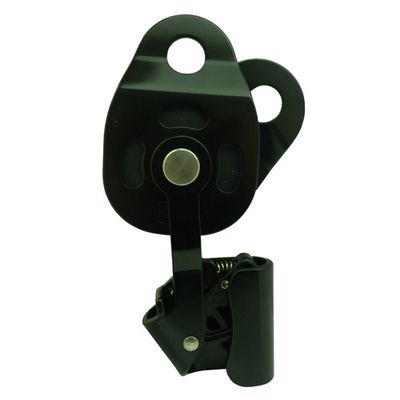 AADP-021
 Ball-Bearing Pulley with Integral Rope Grab
The AADP-021 is a mobile pulley with a ball bearing and an integral rope grab, made in anodised aluminium alloy for 8 to 13 mm rope. It works as a progress-capture pulley in haul systems for rescue, rope access and rigging, and it is listed with CE certification to EN 567 and EN 12278.
View product AP-010
 Aluminium Alloy Pulley, 20 kN
The AP-010 is an aluminium alloy pulley rated at 20 kN breaking strength for 13 mm rope. It suits redirects, light haul systems and rope work in climbing, rescue training, arborist and general rigging applications.
View product AP-020
 Aluminium Alloy Pulley, 78 g
AP-020 is a 78 g aluminium alloy pulley with a 30 kN breaking strength, designed for ropes up to 12 mm. Its low weight makes it a practical redirect and haul-system pulley for rescue kits, rope access, climbing and arborist use.
View product AP-030-B
 Aluminium Alloy Pulley with Ball Bearing
AP-030-B is an aluminium alloy pulley fitted with a ball bearing, rated at 30 kN breaking strength for 13 mm rope. The ball bearing reduces friction, making it suitable for hauling and mechanical-advantage systems in rescue, rope access and rigging.
View product AP-041
 Aluminium Alloy Pulley, 20 kN
AP-041 is an aluminium alloy pulley with a 20 kN breaking strength for 13 mm rope. It is a straightforward redirect and haul pulley for climbing, rope access training, arborist work and general rigging.
View product AP-043
 Anodised Aluminium Pulley without Ball Bearing, 91 g
The AP-043 is a lightweight anodised aluminium alloy pulley without a ball bearing, rated at 24 kN breaking strength for ropes up to 13 mm and weighing 91 g. It is a compact redirect and haul pulley for rescue kits, rope access, climbing and arborist use.
View product AP-080
 Aluminium Alloy Pulley, 25 kN
The AP-080 is an aluminium alloy pulley rated at 25 kN breaking strength for ropes up to 13 mm. It is used to redirect rope and build haul systems in rescue, rope access, industrial rigging and arborist work.
View product AP-081
 Aluminium Alloy Pulley for 16 mm Rope
The AP-081 is an aluminium alloy pulley rated at 28 kN breaking strength for ropes up to 16 mm. Its larger rope capacity suits arborist rigging lines and thick static ropes in rescue and industrial hauling systems.
View product AP-082
 Aluminium Alloy Double Pulley for 16 mm Rope
AP-082 is an aluminium alloy double pulley rated at 24 kN breaking strength for ropes up to 16 mm. With two sheaves in one body it is used to build compact mechanical-advantage systems for rescue, arborist rigging and industrial lifting.
View product AP-083
 Hot-Forged Aluminium Alloy Pulley
The AP-083 is a hot-forged aluminium alloy pulley rated at 25 kN for ropes up to 13 mm. It is the larger of the AP-083/AP-084 pair and is used in haul systems, redirects and rigging for rescue, rope access and arborist work.
View product- AP-084
AP-084 Hot-Forged Aluminium Alloy Pulley
AP-084 is a hot-forged aluminium alloy pulley rated at 25 kN for ropes up to 13 mm. It is pictured as the smaller partner of AP-083 and is used for redirects and haul systems in rescue, rope access and rigging.
View product  AP-085
 Hot-Forged Aluminium Alloy Pulley
AP-085 is a hot-forged aluminium alloy pulley with a 25 kN breaking strength for ropes up to 13 mm. It is used to redirect rope and build mechanical-advantage systems in rescue, rope access, arborist work and rigging.
View product AP-086
 Hot-Forged Aluminium Alloy Pulley
The AP-086 is a rope pulley with hot-forged aluminium alloy side plates, a 25 kN breaking strength and a 13 mm maximum rope size. It serves as a redirect and haul-system pulley for rescue teams, rope access, arborists and riggers.
View product AP-090-B
 Anodised Aluminium Pulley with Ball Bearing, 40 kN
AP-090-B is an anodised aluminium alloy pulley with a ball bearing, rated at 40 kN breaking strength for ropes up to 13 mm and weighing 266 g. It is designed for high-load redirects and haul systems in rope rescue, rope access and industrial rigging.
View product AP-092-B
 Anodised Aluminium Pulley with Ball Bearing, 16 mm Rope
The AP-092-B is an anodised aluminium alloy pulley with ball bearings, rated at 40 kN breaking strength for ropes up to 16 mm and weighing 442 g. It is built for heavy hauling, rescue and arborist rigging systems.
View product H0703SS
 Stainless Steel Pulley with Aluminium Sheave
H0703SS is a pulley with a stainless steel case and an aluminium alloy sheave, rated at 22 kN for 13 mm rope. The stainless steel side plates suit wet, marine and industrial environments where corrosion and wear are a concern.
View product HAN-234
 Aluminium Zip-Line Trolley with Handlebar, CE
HAN-234 is a zip-line trolley bundled with a handlebar, combining an aluminium alloy pulley case, a stainless steel sheave and a TPR-gripped bar. Rated for a 25 kN load on 13 mm rope and weighing 813 g, it is used for zip lines and overhead crossings in adventure parks, and it is listed with CE certification.
View product HAN-972
 Stainless Steel Zip-Line Handlebar with TPR Grips
The HAN-972 is a stainless steel 304 handlebar with TPR rubber grips for adventure park and zip-line trolleys. It is 380 mm long and made from 22.2 mm (7/8 in) tube, and gives riders a hand hold below the trolley.
View product MS-07
MS-07 Zinc-Plated Steel Pulley, 40 kN
The MS-07 is a zinc-plated steel pulley with a 40 kN breaking strength. Steel construction makes it a durable choice for industrial rigging, hauling and fixed installations where weight is less important than robustness.
View product SS989
SS989 Stainless Steel Zip-Line Trolley Pulley with Ball Bearing
SS989 is an adventure park and zip-line pulley with a stainless steel case, a stainless steel sheave and ball bearing, rated for a 15 kN load on wire rope up to 13 mm. It runs on the steel cable of a zip line or ropes course and carries the rider's connection below.
View product TP-972
 Aluminium Tandem Pulley, 25 kN
TP-972 is a tandem pulley with an aluminium alloy case and a choice of aluminium or stainless steel sheaves, rated at 25 kN breaking strength for 13 mm rope. It is used on tyrolean traverses, guiding lines and zip-line trolley set-ups.
View product TP-973
 Aluminium Tandem Pulley, 22 or 25 kN
TP-973 is a tandem pulley with an aluminium alloy case and a choice of aluminium or stainless steel sheaves, offered at 22 or 25 kN breaking strength for 13 mm rope. Tandem pulleys run smoothly along tensioned lines, so it is used for tyroleans, zip-line trolleys and rescue systems that move a load along a rope.
View product TP-975
 Aluminium Pulley with Stainless Steel Sheave
TP-975 is a pulley with an aluminium alloy case and stainless steel sheave, weighing 318 g and sized for 13 mm rope. It is suited to trolley use on rope or cable traverses and zip lines, and to other applications where the sheave sees heavy wear.
View product TP-978
 Aluminium Zipline Pulley with Stainless Steel Sheave
The TP-978 is a zipline pulley with an aluminium alloy case, stainless steel sheave and ball bearing, rated for a 25 kN load on ropes up to 13 mm. It is used as a trolley on zip lines and rope traverses in adventure parks and challenge courses.
View product ZT-01-B
 Zipline Cable Trolley with Handlebar
ZT-01-B is a zipline cable trolley with a handlebar and two ball-bearing wheels, built with a steel body and SS303 stainless steel wheels for 13 mm wire cable. It carries a rider along a zip line in adventure parks and commercial zip-line installations.
View product
Frequently asked questions
- Ball bearing or plain bushing: which pulley should I choose?
- A ball bearing turns with less friction, so more of the hauler's effort reaches the load; this matters most in haul systems with several pulleys in series. A plain-bushing pulley such as AP-043 is lighter and simpler to maintain, which suits redirects and occasional hauling. Many rescue kits carry both types.
- How does the breaking strength of a pulley relate to the load on the rope?
- When rope passes around a pulley and both strands are parallel, the attachment point carries close to twice the rope tension. A redirect pulley holding a 6 kN line can therefore see about 12 kN at its anchor. The pulley rating should be compared with this total load, together with the safety factor required by the system design.
- What is the difference between single, double and tandem pulleys?
- A single pulley has one sheave and is used for redirects and simple haul systems. A double pulley, such as AP-082, carries two sheaves side by side so that a 4:1 or larger system can be built with fewer parts. A tandem pulley, such as TP-972 or TP-973, has two sheaves in line, which keeps it stable as it travels along a tensioned rope or cable, as on tyroleans and zip lines.
- What is a progress-capture pulley?
- A progress-capture pulley combines a pulley with a rope grab, so rope runs freely while it is hauled and is held automatically when the hauler lets go. The AADP-021 in this range is an example; it is listed with CE certification to EN 567 and EN 12278. Such pulleys are used to build compact haul systems in rope rescue, rope access and crevasse rescue.
- What should zip-line operators check when specifying trolleys?
- Confirm the cable or rope construction and diameter, the rider weight range, expected speeds and the braking system, because trolleys must be matched to the line design. Stainless steel sheaves and bodies, as on SS989, resist wear and corrosion on permanent outdoor lines. The operator's compliance framework, such as EN 15567 or ASTM F2959, usually defines inspection and documentation requirements.
- What should an RFQ for a pulley include?
- Provide the model code or drawing, rope or cable type and diameter, sheave material and bearing type, side-plate colour and marking, and the required breaking strength. State the standard and market for the finished product and whether certification will be held under your brand. For trolleys, add line design details and any handlebar or connector to be supplied as a set.
How these are made
Rope Access Equipment Manufacturer Guide: Ascenders and Descenders
Choosing a rope access equipment manufacturer starts with knowing which standard governs which device: EN 12841 types A, B and C, EN 567 and EN 341. A guide to the metal side of an OEM ascender and descender programme.
Read more →Hot Forging vs Cold Forging for Load-Bearing Safety Hardware
Hot forging vs cold forging comes down to forming above or below the recrystallisation temperature, and that choice drives tolerance, strength, tooling cost and part size. Here is how to choose for forged safety hardware.
Read more →Need this in a different specification?
Different size, material, finish, strength rating or gate, or a part that is not here at all. Send a drawing or a sample and we will come back with a DFM review and a quotation.
- A reply within two business days from our team in Taipei.
- NDA on request before drawings or specifications change hands.
- An engineering and DFM review, not a sales pitch — we will say so if we are the wrong fit.
Prefer email? Write to service@fall-protect.com.