OEM Carabiner Manufacturer for Climbing and Safety Brands
Aluminium climbing carabiners, auto-locking fall protection connectors, quickdraws and accessory carabiners — forged, anodised, assembled and tested in Taiwan under your brand.
Power Honour is an OEM carabiner manufacturer in Taiwan, producing aluminium climbing carabiners, steel and aluminium auto-locking fall protection connectors, quickdraws and accessory carabiners for brands that sell them under their own name. Climbing carabiners are certified to EN 12275 and often carry the UIAA 121 Safety Label, while fall protection connectors are certified to EN 362 in Europe and specified to ANSI/ASSP Z359.12 in the US — one carabiner can carry more than one of these, but only if it was designed and tested for each. We forge, machine, anodise or plate, assemble gates and test in house under an ISO 9001 system.
Types of carabiners we manufacture
Aluminium climbing carabiners
Hot-forged aluminium, including 7075, in the shape your range needs — D, offset-D, pear or oval — with solid, bent, wire or keylock gates and screw, twist or triple-lock sleeves. Anodised in your colours and marked with the three kN ratings on the spine.
Auto-locking fall protection connectors
Twist-lock and triple-lock connectors in alloy steel and aluminium for harness-to-lanyard and anchor connections, including dedicated 3,600 lbf gate designs for the US market and large-opening connectors for structural anchors.
Quickdraws
Two carabiners — typically a straight gate at the bolt end and a bent or wire gate at the rope end — joined by a sling and supplied as a finished assembly to your specification and packaging.
Accessory and keychain carabiners
Light aluminium carabiners for keys, bottles and bags. These are not PPE: they are not tested to any climbing or fall protection standard and must be marked and sold as “not for climbing”. We keep them visibly distinct from load-rated designs so the two cannot be confused on a shop shelf.
Standards and what buyers check
A carabiner’s standard is fixed by its end use — climbing, work at height or both — and it drives the shape, the gate and the marking. Our experience covers EN 12275, UIAA, EN 362 and ANSI/ASSP Z359, with CE marking under PPE Regulation (EU) 2016/425, under an ISO 9001 system.
| Standard | What it covers | What buyers check |
|---|---|---|
| EN 12275 | Connectors for mountaineering and climbing, in types including B (basic), H (HMS), K (via ferrata), X (oval), Q (screwlink), A and T. | Major axis gate closed / gate open / minor axis: type B 20 / 7 / 7 kN; type H 20 / 6 / 7 kN; type K 25 / 8 / 7 kN; type X 18 / 5 / 7 kN. For some types the gate-open test does not apply when an automatic gate-locking device is fitted. These are the three figures marked on the spine. |
| UIAA 121 | The UIAA’s own standard for climbing connectors and the basis of the UIAA Safety Label. | Closely aligned with EN 12275, with some additional requirements. The Safety Label is voluntary but valued by specialist climbing retailers and their customers. |
| EN 362 | Connectors for personal protective equipment against falls from a height, in classes B, M, T, A and Q. | 20 kN on the major axis with the gate closed and locked for classes B, M, T and A; 7 kN minor axis for class B and 15 kN for class M; gate function after a 6 kN load (except class A); 48-hour neutral salt spray. A carabiner sold for work at height needs EN 362, not only EN 12275. |
| ANSI/ASSP Z359.12 | Connecting components for personal fall arrest systems in the US. | 3,600 lbf (16 kN) on the gate face, gate side and minor axis; 5,000 lbf (22.2 kN) on the major axis; a 3,600 lbf proof load; self-closing, self-locking gate. Most climbing carabiners are not designed for the 3,600 lbf gate load, so a Z359.12 carabiner is usually a dedicated design. |
Materials and processes
Carabiner strength comes from the forging and the heat treatment; gate reliability comes from machining and assembly. Both happen in house: hot forging of aluminium and steel bodies, CNC machining of the nose and gate, heat treatment, anodising or plating, then gate, spring and sleeve assembly and testing.
Materials
- Aluminium alloys including 7075
- Alloy and carbon steel
- Stainless steel 304 and 316
In-house processes
- Hot forging of aluminium and steel bodies
- CNC machining of noses, keylock profiles and gate slots
- Heat treatment to the specified temper
- Anodising in colour, plating and coating
- Gate, spring, rivet and locking-sleeve sub-assembly
- Gate function and load testing to your test plan
- Retail and bulk packaging
OEM options: marking, finishes and packaging
Marking
Laser marking of your name, the standard and ratings the standard requires — for a climbing carabiner that means the three kN strengths on the spine — plus a batch code for traceability.
Colours and finishes
Anodising in single or two-tone colours on aluminium bodies and gates; zinc plating or coatings on steel. Colour can separate locking from non-locking models across a range.
Gate and locking options
Solid, bent, wire or keylock gates and screw, twist-lock or triple-lock sleeves, chosen against the standard and the end use rather than appearance alone.
Packaging
Retail cards, hang tags and boxes with your branding and instructions for use, or bulk counted by lot for kit and harness assembly.
How we work with your business
We build carabiners for three kinds of buyer, each with a different starting point.
Private label manufacturing
Your name, marking and packaging on hardware built to your specification, starting from an existing design or a new one.
See the private label programme →Importers & wholesalersSupply for distributors
A Taiwan source for connectors, harness hardware and rigging components, with the documentation your customers ask for.
See the distributor programme →US & CanadaNorth American standards
How ANSI/ASSP Z359, OSHA and CSA Z259 requirements shape a product programme for the US and Canadian markets.
Read about US and Canada standards →Carabiners from our catalogue
Existing designs from the catalogue of our parent company, Handy Man Enterprise. Any of them can be the starting point for your own version — a different gate, size, material, finish, marking or package.
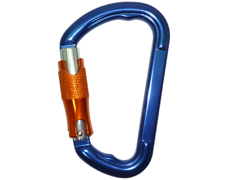
A12116KTL
Carabiner • Material: Aluminum Alloy • Breaking Strength: 25kN • Opening: 22.5mm • Length: 116.8mm • Width:72.3mm • Weight: 85g
Full specification ↗ (opens handy-man.com.tw in a new tab)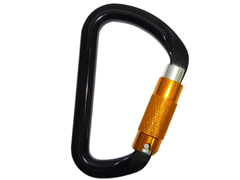
A12117KTL-3
Climbing Carabiner • Material: Aluminum Alloy • Breaking Strength: 25kN • Opening: 23.5mm • Length: 117mm • Width:75mm • Weight: 85g
Full specification ↗ (opens handy-man.com.tw in a new tab)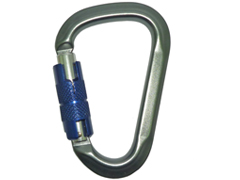
B712K
Carabiner • Material: Aluminum Alloy • Breaking Strength: 25kN8kN8kN • Ø: 12mm • length: 114mm • Width:75mm • Opening: 25mm • Weight: 75g
Full specification ↗ (opens handy-man.com.tw in a new tab)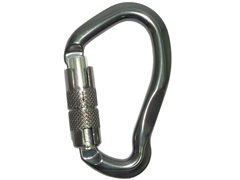
B212K
Auto-locking Carabiner • Material: Aluminum Alloy • Breaking Strength: 23kN • Ø: 10mm • Opening: 20mm • Length: 107mm • Width: 66mm • Weight: 75g
Full specification ↗ (opens handy-man.com.tw in a new tab)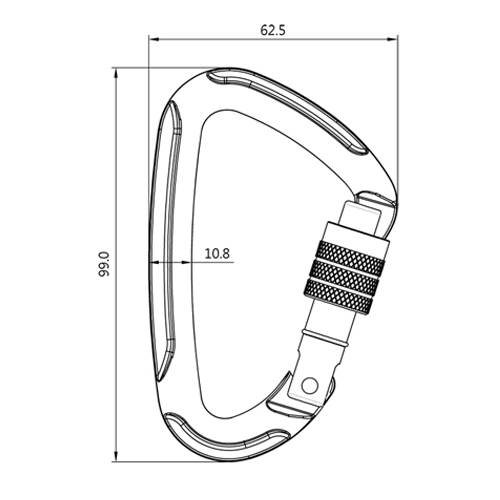
A750KSG
Carabiner • Material: Aluminum 7075 • Breaking Strength : 24kN 7kN 7kN • Opening: 19m • Length : 99mm • Width : 62.5mm • Weight : 50g
Full specification ↗ (opens handy-man.com.tw in a new tab)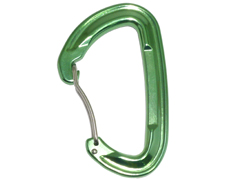
A740WR
Carabiner • Material: Aluminum Alloy • Breaking Strength: 24kN 8kN 9kN • Length: 94.5mm • Width: 57.8mm • Opening: 28mm • Weight: 30g
Full specification ↗ (opens handy-man.com.tw in a new tab)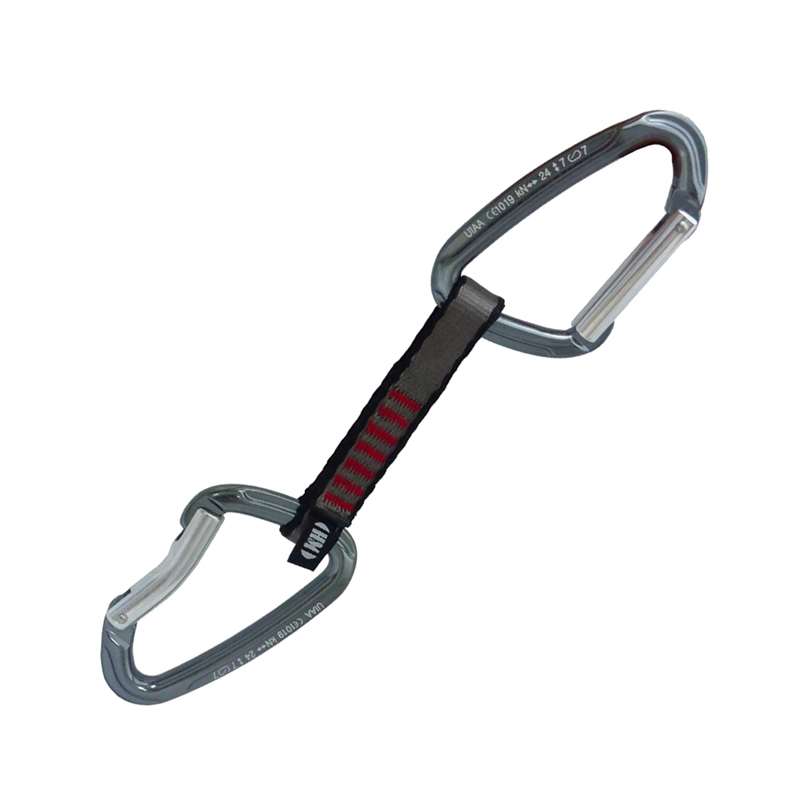
A750QD
Quikcdraw Including one bent-gate , one straight-gate, and one sling(11cm) • Material : Aluminum Alloy • Weight : 95g • Carabiners breaking strength : 24kN 7kN 7kN • Gate opening : 23-26mm
Full specification ↗ (opens handy-man.com.tw in a new tab)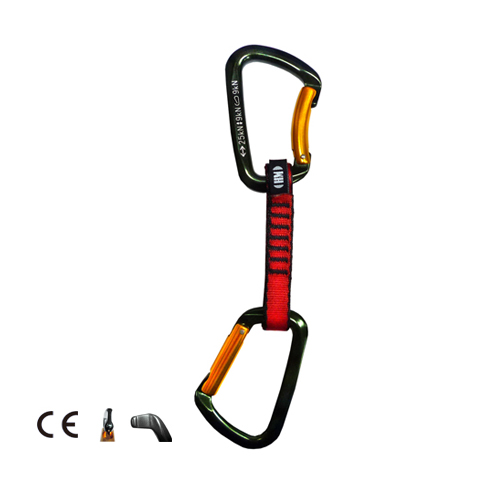
A715QD
Quikcdraw Quickdraw consists of one wire bent-gate carabiner(A715-d), one bent-gate carabiner(A715-b), and one nylon sling • Material : Carabiner - Aluminum Alloy Webbing - Nylon • Breaking Strength Carabiner - 22kN Webbing - 25kN Available in 3 size : 11, 17 and 25 cm
Full specification ↗ (opens handy-man.com.tw in a new tab)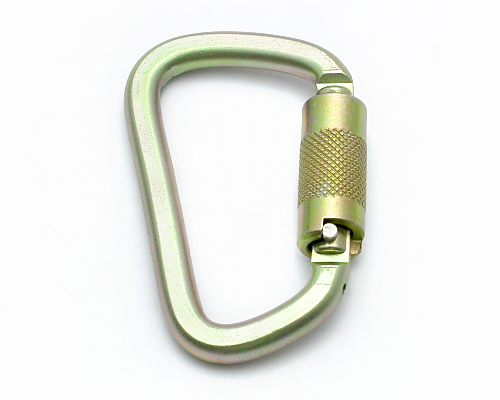
3727(3600LBS)
Carabiner • Material: Steel • Breaking Strength: 50kN • Ø: 11mm • Opening: 25mm • length: 113mm • width: 71mm
Full specification ↗ (opens handy-man.com.tw in a new tab)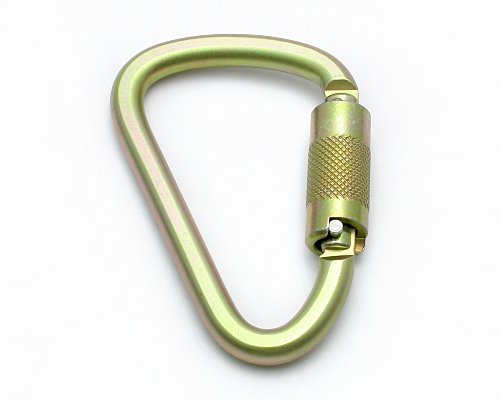
382Z(3600LBS)
Carabiner • Material: Steel • Breaking Strength: 45kN • Ø: 11mm • Opening: 26mm • length: 125mm • width: 80mm
Full specification ↗ (opens handy-man.com.tw in a new tab)
ANSI-2200TL
D Type ANSI Carabiner • Material: Galvanized • Closure Type: Twist-lock gate • Breaking Strength: 50kN • Length: 113mm • Width: 63mm • Diameter: 12mm • Opening: 17mm • Captive-eye comes with the pin uninstalled.
Full specification ↗ (opens handy-man.com.tw in a new tab)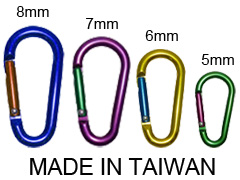
L-246
Carabiner Keychains • Material:Aluminum • Size: Available in 4 sizes (5mm~8mm) • Made in Taiwan • Not for climbing
Full specification ↗ (opens handy-man.com.tw in a new tab)Product pages open on handy-man.com.tw, the manufacturing site of our parent company.
Related Insights
What Does kN Mean? Minimum Breaking Strength vs Working Load Limit
A kN is a unit of force, not mass: 1 kN is about 224.8 lbf, or 101.97 kg under gravity. This guide explains minimum breaking strength, working load limit, safety factors and the three kN marks on a connector.
Read more →Surface Treatment Guide: Anodising, Plating and Passivation
Choosing a surface treatment for metal parts comes down to the base metal plus the service environment. A practical guide to anodising, plating, passivation, salt spray testing and RoHS compliance.
Read more →OEM Carabiner Manufacturing: Aluminium vs Steel and Certification
How an OEM carabiner manufacturer chooses between 7075-T6 aluminium and steel, and why the body is hot forged rather than machined. Covers EN 12275, EN 362 and the kN markings on the spine.
Read more →The Complete CE Guide: EU PPE Regulation 2016/425 Explained
To sell personal protective equipment in Europe, CE certification is mandatory. This guide covers the scope of the EU PPE Regulation, certification categories, the testing process, and documentation requirements.
Read more →What Is UIAA Certification? Essential Standards for Climbing Gear
UIAA is one of the most important certification standards for climbing equipment worldwide. We cover its importance, applicable products, test standards, and how certification is obtained.
Read more →Questions buyers ask about carabiners
- Can you manufacture carabiners under our own brand?
- Yes. We manufacture carabiners under our customers’ names, with their marking, colours and packaging. A programme can start from a carabiner in the existing range or from a new design, and certification to EN 12275, EN 362, UIAA 121 or ANSI/ASSP Z359.12 is carried out on your product by the body you select.
- Should we choose aluminium or steel carabiners?
- Aluminium is lighter and is the norm for climbing and for weight-sensitive work-at-height equipment. Steel is heavier but more abrasion-resistant and often lower in cost, which suits high-wear industrial, construction and rigging use. Either can meet EN 362 or Z359.12 when the section is designed for it.
- What is the difference between EN 12275 and EN 362?
- EN 12275 covers connectors for mountaineering and climbing; EN 362 covers connectors used as PPE against falls from a height at work. Both are used for CE marking under PPE Regulation (EU) 2016/425, but their classes and requirements differ, so a carabiner sold for both uses needs to be tested to both.
- Can one carabiner be certified to both EN 12275 and ANSI/ASSP Z359.12?
- It can, but it has to be designed for it from the start. Z359.12 requires 3,600 lbf (16 kN) on the gate face and gate side, which most climbing carabiners are not built for, so dual-standard carabiners are usually heavier, steel or large aluminium locking designs.
- Do keychain carabiners need certification?
- No, because they are not PPE — which is exactly why they must be marked and sold as “not for climbing”. We keep accessory designs visibly different from load-rated ones so retailers and end users cannot mistake one for the other.
- Do you make quickdraws?
- Yes. Quickdraws are supplied as finished assemblies of two carabiners and a sling, typically a straight gate for the bolt end and a bent or wire gate for the rope end, in your colours and packaging. The carabiners and the finished assembly are certified to the standards your market requires, with testing by the body you select.
Start your carabiner programme
Send the shape, gate and standard you have in mind — or a carabiner you already sell — and we will come back with a DFM review, finish options and a route to certification.