When you brief an OEM carabiner manufacturer, the aluminium-versus-steel decision comes down to carried weight, wear life, corrosion exposure and unit cost. Specify 7075-T6 aluminium when the connector is carried on the body all day - climbing racks, quickdraws, arborist kits, fall arrest sets - because it reaches roughly 570 MPa tensile strength at about a third of the density of steel. Specify 316 stainless or plated carbon steel where the connector is installed once and left in service: fixed anchors, rope access, rescue, marine and tower work, where abrasion resistance and salt exposure outweigh the extra mass. Both routes certify to the same standards - EN 12275 for mountaineering connectors, EN 362 for fall protection PPE - so the choice is engineering and commercial, not regulatory.

Which alloys are actually used for carabiners?
Four material families cover almost every certified carabiner in production.
- 7075-T6 aluminium (Al-Zn-Mg-Cu) - roughly 570 MPa ultimate tensile strength at a density near 2.81 g/cm3. The default for lightweight certified connectors, but less corrosion tolerant than 6061 and more sensitive to stress-corrosion cracking.
- 6061-T6 aluminium (Al-Mg-Si) - around 310 MPa ultimate tensile strength, with better formability, corrosion resistance and anodised colour consistency where a larger cross-section is acceptable.
- 316 stainless steel - excellent resistance to chlorides and marine air with no plating to wear through, but roughly 8.0 g/cm3, slow to machine and the highest piece price of the four.
- Zinc-plated carbon or low-alloy steel, quenched and tempered - best strength per unit cost and best abrasion resistance for high-cycle industrial use, though corrosion protection depends on the plating, which EN 362 checks with a 48-hour neutral salt-spray test.
At 2.7-2.8 g/cm3 against 7.9-8.0 for steel, a steel connector of equivalent rating typically weighs two to three times its aluminium counterpart. Fatigue is the property that gets missed: steel has a true endurance limit below which load cycles do essentially no damage, while aluminium does not - which is why aluminium connectors carry generous sections and a defined retirement date.
Why is a carabiner body forged rather than machined?
Forging aligns grain flow with the shape of the part: the metal fibre follows the curve of the spine and wraps the nose and hinge, so the highest-stress radii are carried by continuous grain rather than the exposed end grain a cutter leaves behind. It also closes porosity and refines grain size, raising fatigue life and letting the designer hit a kN target with less material. A typical sequence runs:
- Cut billets from extruded 7075 or 6061 rod, heat to roughly 380-450 C, forge the blank in a closed die.
- CNC machine the gate slot, nose profile, hinge and rivet bores and any keylock detail.
- Solution heat treat and age to T6: for 7075, typically solution treatment near 470-480 C, a fast quench, then ageing around 120 C for about 24 hours.
- Deburr and vibratory tumble, then anodise - Type II sulphuric anodising for colour, hard anodising where the rope-bearing surface wears.
- Assemble gate, spring, rivets and locking sleeve under controlled riveting force, with a function check on every unit.
- Laser mark the CE data, kN ratings and batch number, then destructively test batch samples on all three axes.
Which gate and locking mechanism does the application require?
Locking gates are required wherever an unintended opening is itself the hazard; non-locking gates suit connectors clipped and unclipped constantly under supervision.
- Snapgate, straight or bent - a solid machined gate for quickdraws and racking; lightest and fastest to clip, no locking.
- Wiregate - a loop cold formed from stainless spring wire: roughly half the gate mass, less gate flutter under shock loading, no icing.
- Screwgate - a manual threaded sleeve; simple and low cost, but it depends on the user locking it.
- Twist-lock, two actions - the practical minimum under EN 362, which requires a self-locking gate to lock automatically and to need two different deliberate manual actions to open.
- Triple-action, three actions - push or lift, twist, then open. Standard for industrial fall protection, rope access and rescue.
Class Q screwlinks are the exception: EN 362 requires at least four full turns of the sleeve to disengage the threads. A keylock nose removes the hook and notch so the connector cannot snag on hangers or slings, at the cost of tighter tolerance between nose and gate tip.
What do EN 12275, EN 362, UIAA 121 and ANSI Z359.12 require?
The applicable standard is set by market and use case, not by the product.
- EN 12275:2013 (mountaineering connectors) classifies by type: Type B basic 20 kN major axis / 7 kN minor / 7 kN gate open; Type H (HMS) 20 / 7 / 6; Type K (via ferrata) 25 / 7 / 8; Type X (oval) 18 / 7 / 5.
- EN 362:2004 (PPE fall-protection connectors) classifies by function - Class A anchor, B basic, M multi-use, T termination, Q screwlink. Classes A, B, M and T require 20 kN gate closed and locked, 15 kN unlocked; minor axis is 7 kN for Class B and 15 kN for Class M; Class Q requires 25 kN closed and 10 kN minor.
- ANSI/ASSP Z359.12-2019 works in pounds: 5,000 lbf (22.2 kN) on the major axis held one minute with the gate opening no more than 0.125 in (3.1 mm), and 3,600 lbf (16 kN) on the minor axis.
- UIAA 121 tracks EN 12275 but adds requirements such as an edge-loading test for Type K. Our separate guide explains what the UIAA label certifies alongside CE marking.

What do the three kN numbers on the spine mean?
They are the certified minimum breaking strengths on the major axis with the gate closed, on the minor axis, and on the major axis with the gate open, each beside its own pictogram - typically around 24 / 8 / 7 kN on an aluminium locking connector. The open-gate figure is the one buyers underestimate: a gate held open by a sling or hanger cuts usable strength to roughly a quarter of the headline rating. EN 12275 waives that requirement only where an automatic gate-locking device is fitted. Alongside them sit the CE mark and notified body number, the standard reference and type letter, the manufacturer name, a batch number and the instruction pictogram.
What can a brand customise on an OEM carabiner?
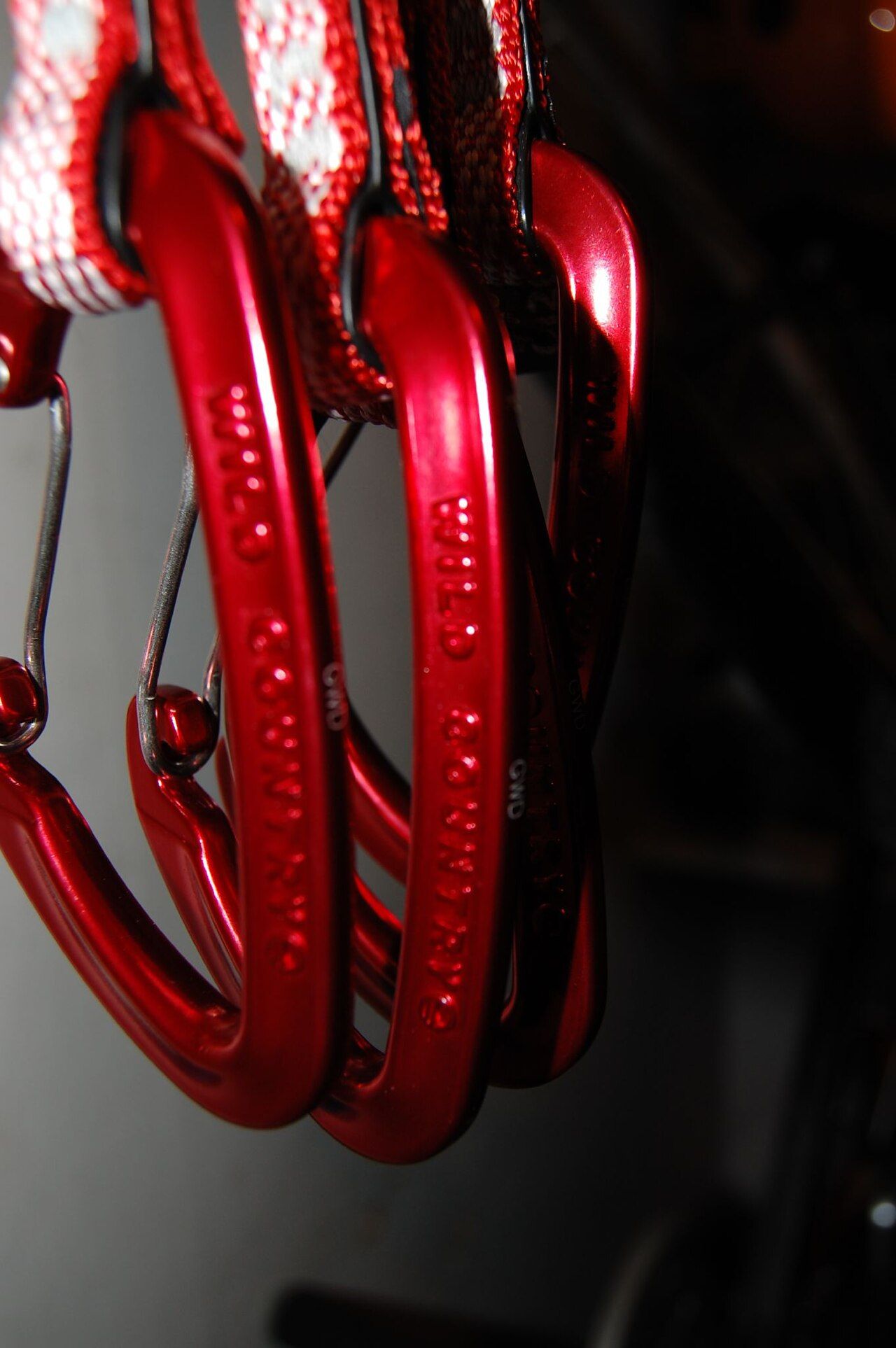
Most of it is fixed at die design, not at the end of the line. Body shape - D, offset-D, oval or HMS pear - plus gate opening and internal clearance are die decisions, and so is embossed branding: a name raised in the forging die costs effectively nothing per unit, while laser etching handles logos and batch codes. Anodising covers matched colour codes, two-tone bodies and matte or polished finishes. Gate type, keylock or notched nose and a captive pin for harness attachment complete the list.
How does a carabiner go from drawing to certified production?
Drawing review, tooling, forged samples, in-house testing, then third-party certification - normally measured in months rather than weeks, dominated by tooling and certification rather than production. Manufacturability review comes first: section thickness against the target kN, draft angles, die parting line, gate and nose geometry.
Parts machined from bar are useful for form and fit, but any sample used to generate strength data must come from a forged blank with production heat treatment, or the numbers will not repeat in production. After destructive testing on all three axes plus gate function cycling, the design is frozen and submitted for EU type-examination by a notified body under Regulation (EU) 2016/425. A carabiner is Category III PPE, so type-examination alone is not enough: ongoing production surveillance under Module C2 or Module D is also required. The certificate comes from an accredited third party, not from the factory; the factory job is to make the product testable, repeatable and documented.
Working with Power Honour
Power Honour has manufactured safety hardware in Taiwan for more than 30 years, with hot and cold forging, CNC machining, heat treatment, anodising and plating, sub-assembly and testing under one roof, so a carabiner programme need not be split across four suppliers. We are ISO 9001 certified and experienced in building to CE EN standards, UIAA, ANSI/ASSP Z359 and PPE Regulation (EU) 2016/425. Send us a drawing, a target kN rating and your certification market, and we will return a manufacturability review and a proposed process route.