Fall Protection & Industrial Safety Hardware
Ladder Vertical Lifeline System Components
13 products
This range supplies the parts of vertical wire-rope lifelines on fixed ladders and via ferrata ladders. It includes the SS625 family of stainless steel cable grabs for Ø 8 mm or Ø 10 mm wire, which are listed as meeting EN 353-2, with standard, anti-panic and double anti-panic versions; polyurethane and stainless spring shock absorbers; rope guides; a ladder anchor point fixed with U-pins; and supporting hardware such as stainless steel 316 wire rope clips and turnbuckles and AISI 304 U-bolts. In Europe, guided fall arresters are covered by EN 353-1 for rigid anchor lines and EN 353-2 for flexible anchor lines; in the United States, ANSI/ASSP Z359.16 sets requirements for climbing ladder fall arrest systems. The range can be supplied as OEM or private label, or adapted to a drawing.
Products
13 products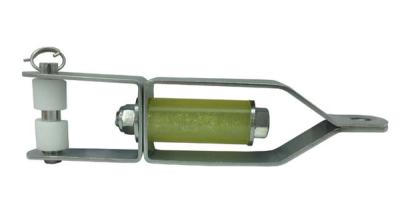 SA01
SA01 Stainless Steel and PU Shock Absorber for Vertical Lifelines
The SA01 is a shock absorber for vertical ladder lifelines on 8 mm wire rope, built from stainless steel with a polyurethane (PU) element. It is installed in the lifeline to reduce the forces transmitted to anchors when a fall is arrested.
View product SA02
SA02 Via Ferrata Shock Absorber for Ladder Lifelines, Stainless Steel and PU
The SA02 is a via ferrata shock absorber for ladder vertical lifeline systems on 8 mm wire cable. Made from stainless steel and polyurethane (PU), it is fitted in the line to reduce fall arrest forces.
View product SA03
SA03 Via Ferrata Spring Shock Absorber for Ladder Lifelines
The SA03 is a via ferrata shock absorber for ladder vertical lifelines, made from stainless steel with a stainless steel spring. It fits 8 mm wire cable and reduces fall arrest forces in the system.
View product SA04
SA04 Via Ferrata Spring Shock Absorber for Ladder Lifelines
The SA04 is a via ferrata shock absorber for ladder vertical lifeline systems, built from stainless steel with a stainless steel spring. It is compatible with 8 mm wire cable and is used to reduce fall arrest forces.
View product SS413_1
 AISI 304 Stainless Steel U-Bolts
The SS413_1 is a range of AISI 304 stainless steel U-bolts used to mount fittings to tubes, ladder stiles and other round or square sections. Ten versions are listed from M4 to M12 thread, with B dimensions from 60 mm to 150 mm.
View product SS4820_1
 Stainless Steel 316 Jaw and Jaw Turnbuckle
The SS4820_1 is a stainless steel 316 jaw and jaw turnbuckle for tensioning wire rope lifelines and rigging. Seven sizes are listed from M5 to M16, each with minimum and maximum lengths.
View product SS625
SS625 Stainless Steel Cable Grab for 8 or 10 mm Wire
The SS625 is a stainless steel cable grab, a guided fall arrester that travels on the wire rope of a vertical lifeline and locks if the user falls. It is offered for Ø 8 mm or Ø 10 mm wire and it is listed as meeting EN 353-2.
View product SS625-AP
 Stainless Steel Cable Grab with Anti-Panic System
The SS625-AP is a stainless steel cable grab with an anti-panic system for vertical wire-rope lifelines. It fits Ø 8 mm or Ø 10 mm wire, and it is listed as meeting EN 353-2.
View product SS625-AP-EC
 Stainless Steel Cable Grab with Double Anti-Panic
The SS625-AP-EC is a stainless steel cable grab with a double anti-panic function for vertical wire-rope lifelines. It is offered for Ø 8 mm or Ø 10 mm wire, and it is listed as meeting EN 353-2.
View product SS785
SS785 Stainless Steel 304 Ladder Anchor Point with U-Pins
The SS785 is a stainless steel 304 ladder anchor point fixed with U-pins, used as an anchorage for wire-rope lifelines on ladders. It measures 228 mm long and 90 mm high on a 248 × 50 mm base and weighs 623 g.
View product SS795
SS795 Stainless Steel 304 Rope Guide for Vertical Lifelines
The SS795 is a stainless steel 304 rope guide for vertical lifeline systems. It holds the wire rope in position along a ladder or route, and it weighs 200 g.
View product SS9201_1
 Stainless Steel 316 Wire Rope Clip
The SS9201_1 is a stainless steel 316 wire rope clip for making eyes and terminations in wire rope. It is listed in eleven sizes from 2 mm to 19 mm, with threads from M3 to M14.
View product SS9301_1
 Stainless Steel 316 Frame Turnbuckle with Two Jaw Ends
The SS9301_1 is a stainless steel 316 frame turnbuckle with jaw fittings at both ends, used to tension wire rope lines. Seven sizes are listed from M5 to M16, with overall lengths L1 from 190 mm to 450 mm.
View product
Frequently asked questions
- What is the difference between EN 353-1 and EN 353-2?
- EN 353-1 covers guided type fall arresters including a rigid anchor line, usually attached to or integrated in a ladder. EN 353-2 covers guided type fall arresters including a flexible anchor line secured to an upper anchor point. The fall arrester must be certified together with the anchor line type it runs on, so confirm which standard your system needs before selecting a cable grab.
- What does an anti-panic function on a cable grab do?
- An anti-panic function is intended to make the fall arrester lock on the line even if a falling user instinctively grabs the device, which could otherwise hold it open. The SS625-AP has an anti-panic system and the SS625-AP-EC has a double anti-panic function, while the SS625 is the standard version. The user instructions explain how each is attached and checked.
- Why are rope guides needed on a vertical cable?
- Rope guides hold the cable in line with the ladder between the top and bottom anchors. They reduce sideways movement and wind slap, protect the cable and structure from wear, and help the cable grab run smoothly. Their spacing is set in the system design.
- How should wire rope clips and turnbuckles be installed?
- Wire rope clips must be used in the number, orientation and tightening torque specified for the rope size, and checked again after the rope has bedded in. Turnbuckles should be tensioned to the value in the system documentation and then locked so they cannot unwind. Both are listed here in stainless steel 316 with full dimension tables.
- What does ANSI/ASSP Z359.16 cover?
- ANSI/ASSP Z359.16 sets requirements for climbing ladder fall arrest systems with flexible or rigid carriers permanently attached to a ladder or adjacent structure. It covers design, performance, marking, testing, instructions and inspection, for users within a capacity range of 130 to 310 lb. North American buyers typically reference it when specifying ladder systems.
- What should a ladder lifeline RFQ include?
- Give the wire diameter (8 mm or 10 mm), ladder height and profile, the quantity of each component, the standard the system must meet and any marking or documentation requirements. Drawings of the ladder fixing points help confirm anchor and rope guide details.
How these are made
EN 353-1 vs EN 353-2: Guided Type Fall Arresters Explained
EN 353-1 covers guided type fall arresters on a rigid rail or tensioned wire rope. EN 353-2 covers flexible fibre or wire rope lines hung from an upper anchor, now in its 2024 edition.
Read more →Wind Turbine Fall Protection: EN 353-1 Ladder Systems and Offshore Hardware
Wind turbine fall protection centres on EN 353-1 ladder systems, EN 795 anchor points and EN 341/EN 1496 rescue kit. Here is what European brands and distributors should specify, from system compatibility to offshore corrosion.
Read more →Horizontal vs Vertical Lifeline Systems for Fall Protection
Horizontal vs vertical lifelines: a horizontal line lets a worker move along an edge, a vertical line protects a climb. How to choose, clearance and OSHA rules.
Read more →Need this in a different specification?
Different size, material, finish, strength rating or gate, or a part that is not here at all. Send a drawing or a sample and we will come back with a DFM review and a quotation.
- A reply within two business days from our team in Taipei.
- NDA on request before drawings or specifications change hands.
- An engineering and DFM review, not a sales pitch — we will say so if we are the wrong fit.
Prefer email? Write to service@fall-protect.com.