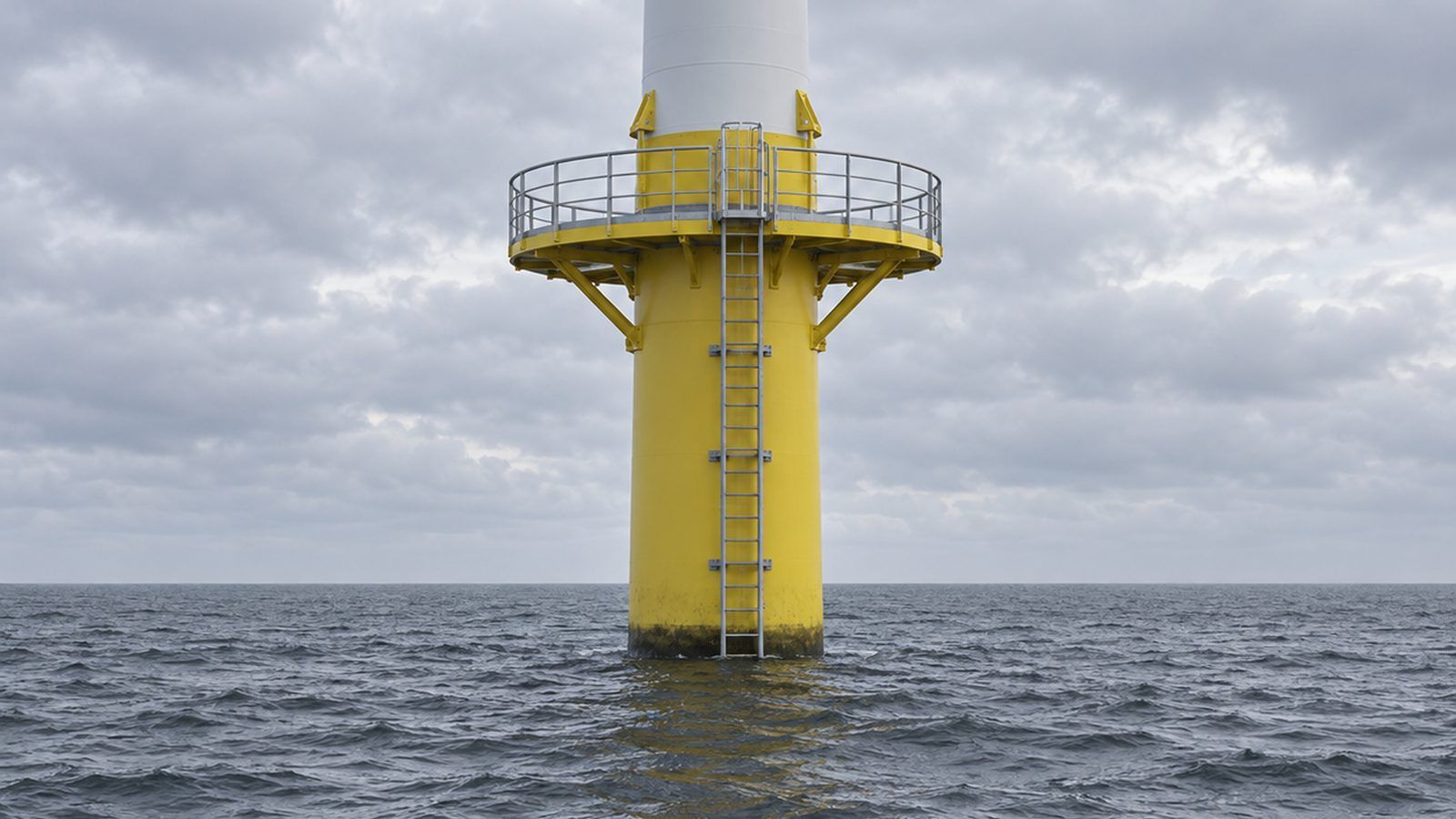
Wind turbine fall protection is built around the tower ladder: an EN 353-1 guided type fall arrester running on a rigid anchor line, either a rail or a tensioned wire rope, with which it is tested and certified as one product. Around it sit EN 795 anchor devices in the nacelle and hub, EN 360 self-retracting devices, EN 362 connectors, EN 361 harnesses, and rescue equipment to EN 341 and EN 1496. For European brands and distributors, sourcing turns on three decisions: keeping every arrester matched to its certified anchor line, choosing materials for the site’s ISO 12944 corrosivity category (C5 on exposed coasts, CX offshore), and supplying instructions that support periodic examination at least every 12 months under EN 365.
Why is wind driving European demand for fall protection hardware?
Because every turbine is a vertical workplace, and Europe keeps building them. WindEurope’s 2025 statistics record 19.1 GW installed in Europe last year, 17.2 GW onshore and 2.0 GW offshore, taking the fleet to 304 GW; its outlook, a forecast rather than a certainty, reaches 439 GW by 2030, including 73 GW offshore.
The operating fleet matters as much: WindEurope counts 34 GW already more than 20 years old, rising to 65 GW by 2030, and most wind farms reaching the end of their support contracts opt for lifetime extension rather than repowering. Lifetime extension often involves reassessing access and fall protection, sustaining a retrofit market for arresters, anchor lines and anchor points.
Where does fall protection sit in a wind turbine?
At every level from the tower door to the hub, with a different standard at each stage.
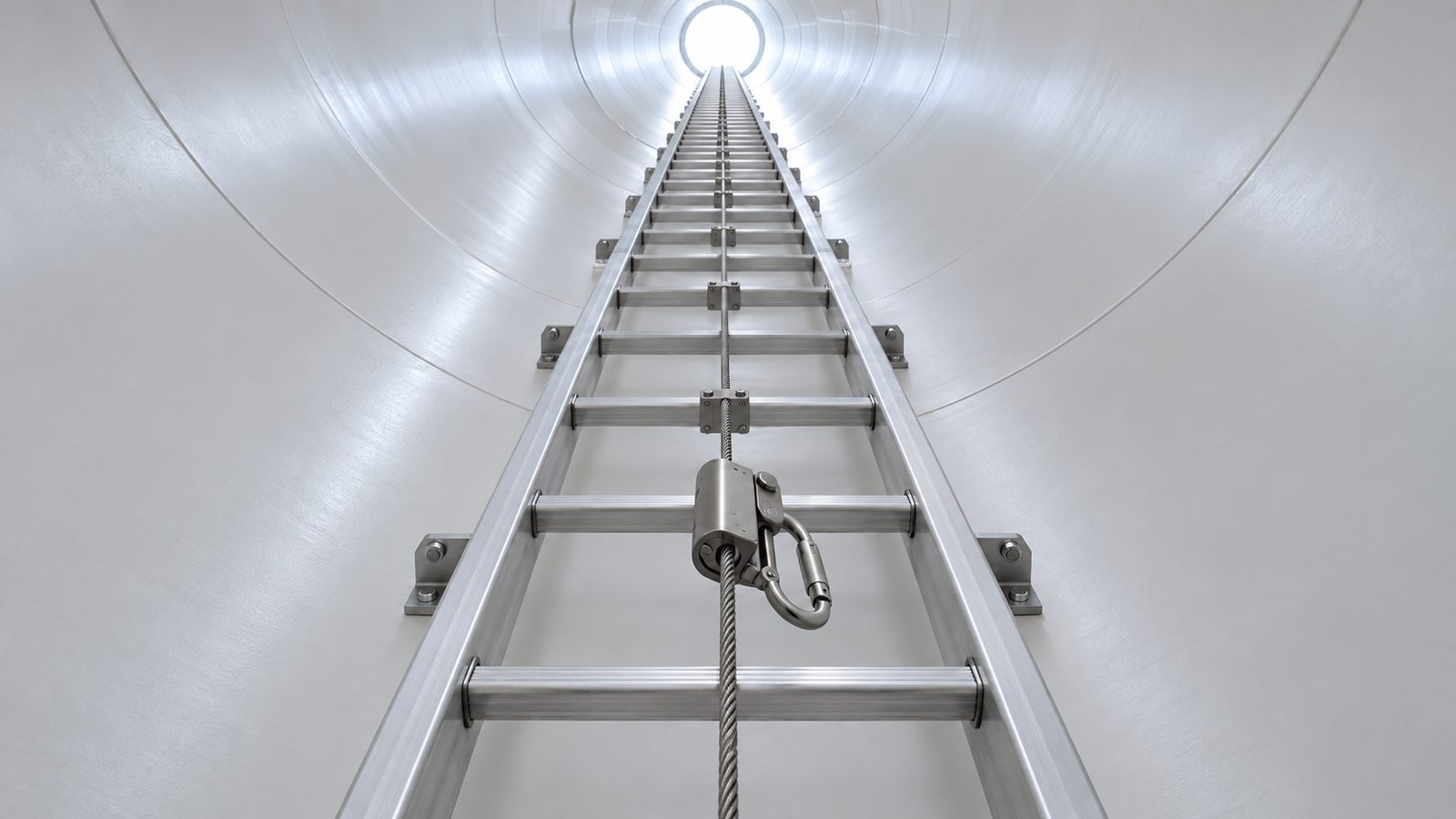
- Tower ladder. A guided type fall arrester on a rigid anchor line to EN 353-1:2014+A1:2017, the core of any wind turbine ladder system. The standard defines the anchor line as a rail or tensioned wire rope fixed at both ends; wire rope must be at least 8 mm, in stainless or galvanised steel. The assembly must sustain 15 kN static and limit arrest force to 6 kN on lines up to 15° from vertical. Multi-user lines are outside its scope.
- Platforms, hatches and service lifts. EN 50308 covers turbine ladders and platforms; service lifts fall under EN 81-44:2024, usually with the ladder and arrester retained alongside.
- Nacelle roof and hub. Anchor devices to EN 795:2012: fixed Type A points, Type C or D horizontal lines, and transportable Type B anchors. When the Commission cited EN 795 in the Official Journal, it excluded permanently fixed anchors as not PPE, so a fixed nacelle anchor is assessed with the turbine rather than CE marked.
- Personal equipment. Self-retracting devices to EN 360:2023, connectors to EN 362:2004, and full body harnesses to EN 361:2002, whose front attachment point takes the arrester.
What rescue equipment belongs in a wind turbine fall protection system?
Descender devices to EN 341 and rescue lifting devices to EN 1496, specified with the fall-arrest system rather than after it. A successful arrest leaves a technician suspended, and at hub heights well over 100 m the team on site must raise, release and lower the casualty with kit already in the turbine.
EN 341:2011, now under revision, grades rescue descenders by the descent energy they absorb: Class A up to 7.5 MJ, Class B up to 1.5 MJ, Class C up to 0.5 MJ. One 150 m descent with 100 kg absorbs roughly 0.15 MJ, so the class decides how many full-height evacuations a device supports. EN 1496:2017 rescue lifting devices come as Class A, lifting only, or Class B, lifting with limited lowering, often used to lift a casualty just enough to release a locked arrester.
Rescue loads pass through the same anchors, connectors and harness attachments as fall arrest, and the descent line must reach the ground from the highest exit point. Many operators also require the Working at Heights module of GWO Basic Safety Training, covering vertical fall arrest, self-retracting devices and rescue from height, so kit should match what technicians trained on.
Why must an EN 353-1 fall arrester stay with its own anchor line?
Because EN 353-1 treats them as one product: a note to its definitions says arrester and anchor line are tested, certified and intended to be used together. Locking geometry, the anti-inversion feature and any energy absorber are matched to one rail profile or one rope diameter and construction. A runner from another system may slide on the line yet fail to lock in time; even if it worked, the combination is uncertified.
For wind turbine ladder safety this is the most avoidable field error. Distributors should hold arresters by system, not generic type, and every guide, bracket, tensioner, stop and termination should carry a part number tied to that system. On retrofits, a current arrester belongs on an older line only if the system manufacturer has certified that pairing; otherwise both are replaced as a set.
What does offshore corrosion demand of fall protection hardware?
More than certification proves. EN 353-1:2014 requires metallic components to pass a 48-hour neutral salt-spray test to EN ISO 9227, up from 24 hours in the 2002 edition. That is a floor. ISO 12944-2:2017 replaced C5-I and C5-M with C5, very high, and CX, extreme, which covers offshore structures. ISO 12944-9 qualifies offshore paint systems with a 4,200-hour cyclic test, far beyond a 48-hour PPE test.
ISO 9223:2012, using the same C1 to CX scale for metals, puts zinc loss at 4.2 to 8.4 µm a year in C5 and 8.4 to 25 µm in CX, against the 85 µm mean ISO 1461 requires on galvanised steel over 6 mm thick, so bare galvanising in the splash zone lasts years, not decades.
- 316/316L stainless steel. The default for ropes, arrester bodies, pins, springs and fasteners inside the tower and nacelle; with a PREN of about 24 it can pit and crevice-corrode where salt stays wet.
- Duplex stainless such as 2205. PREN about 35 and roughly twice the yield strength of 316L, for external ladders, boat-landing hardware and splash-zone brackets.
- Hot-dip galvanised steel to ISO 1461. Economical onshore; offshore it is normally painted over, and holes drilled after galvanising rust first.
- Anodised aluminium. Light rails and ladders, but anodic to stainless steel, so it needs isolation wherever stainless touches it.
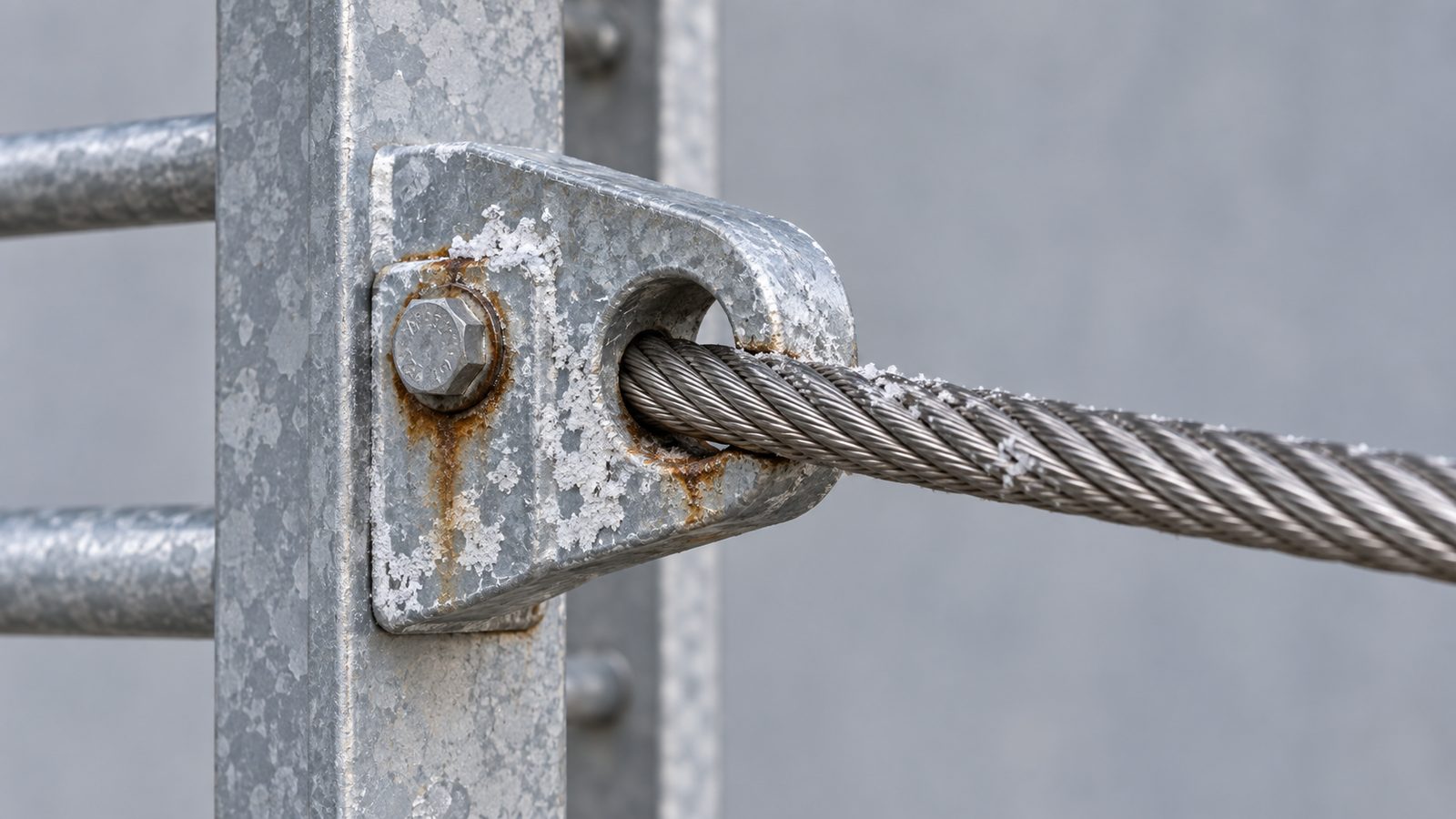
Corrosion concentrates at joints. A stainless cable consumes the zinc of a galvanised bracket; a stainless bolt pits an aluminium rail. EN 353-1 requires wire rope terminations not known to cause dissimilar-metal corrosion with the rope. Crevices under cable guides, ferrules and joint plates hold a wet chloride film; isolating washers and free-draining geometry do more than any finish. Zinc-plated parts also need passivates that meet the EU’s tightening hexavalent chromium restrictions; our materials and surface treatment guides go deeper.
How often should wind turbine fall protection be inspected, and what does corrosion look like?
At least every 12 months, and more often offshore. EN 365:2004 requires manufacturers’ instructions to state that interval, with examination by a competent person following the manufacturer’s procedure; salt, vibration and heavy use justify shorter intervals. Typical findings:
- Arresters whose locking cam returns sluggishly, with pitted pivot pins or salt packed around springs.
- Broken wires, rust bleed or pitting at rope terminations, ferrules and the lower tensioner.
- Fretting where the rope passes through guiding brackets, worsened by tower vibration.
- White corrosion on aluminium and zinc, loose rail-joint fasteners, and rust staining around anchor bases.
What should you specify when sourcing wind turbine fall protection hardware?
Something a notified body and a technician can both act on. Fall arrest equipment is Category III PPE under Regulation (EU) 2016/425, certified by EU type-examination plus ongoing production surveillance; your specification sets what the certificate must cover.
- Standard and edition. EN 353-1:2014+A1:2017, the EN 795 type, EN 360:2023, and the EN 341 and EN 1496 classes.
- System compatibility. Which arresters are certified with which rail or rope, and how retrofits are handled.
- Material and coating for the corrosivity category. C5 or CX, splash-zone parts identified, salt-spray hours beyond the 48-hour minimum where needed, isolation at dissimilar-metal joints.
- Temperature range. EN 353-1 includes a cold-condition test at −30 °C; state the site range if it goes beyond.
- Documentation and instructions. EN 365 instructions, declaration of conformity, material certificates and inspection records, in the market’s languages.
- Spare-part identification. Part numbers tied to the system, lot or serial traceability, and identification that stays legible after years of salt.
Working with Power Honour
Power Honour manufactures ladder vertical lifeline systems, rope grabs, horizontal lifeline systems, connectors and harness hardware in Taiwan, with forging, casting, machining and finishing in-house, ISO 9001 systems, and experience with CE EN standards and Regulation (EU) 2016/425. For a wind programme we manufacture to the CE EN requirements your brand specifies, with certification through your notified body. Send a drawing with the standard and corrosivity category, and we will return a process route, material proposal and test plan.