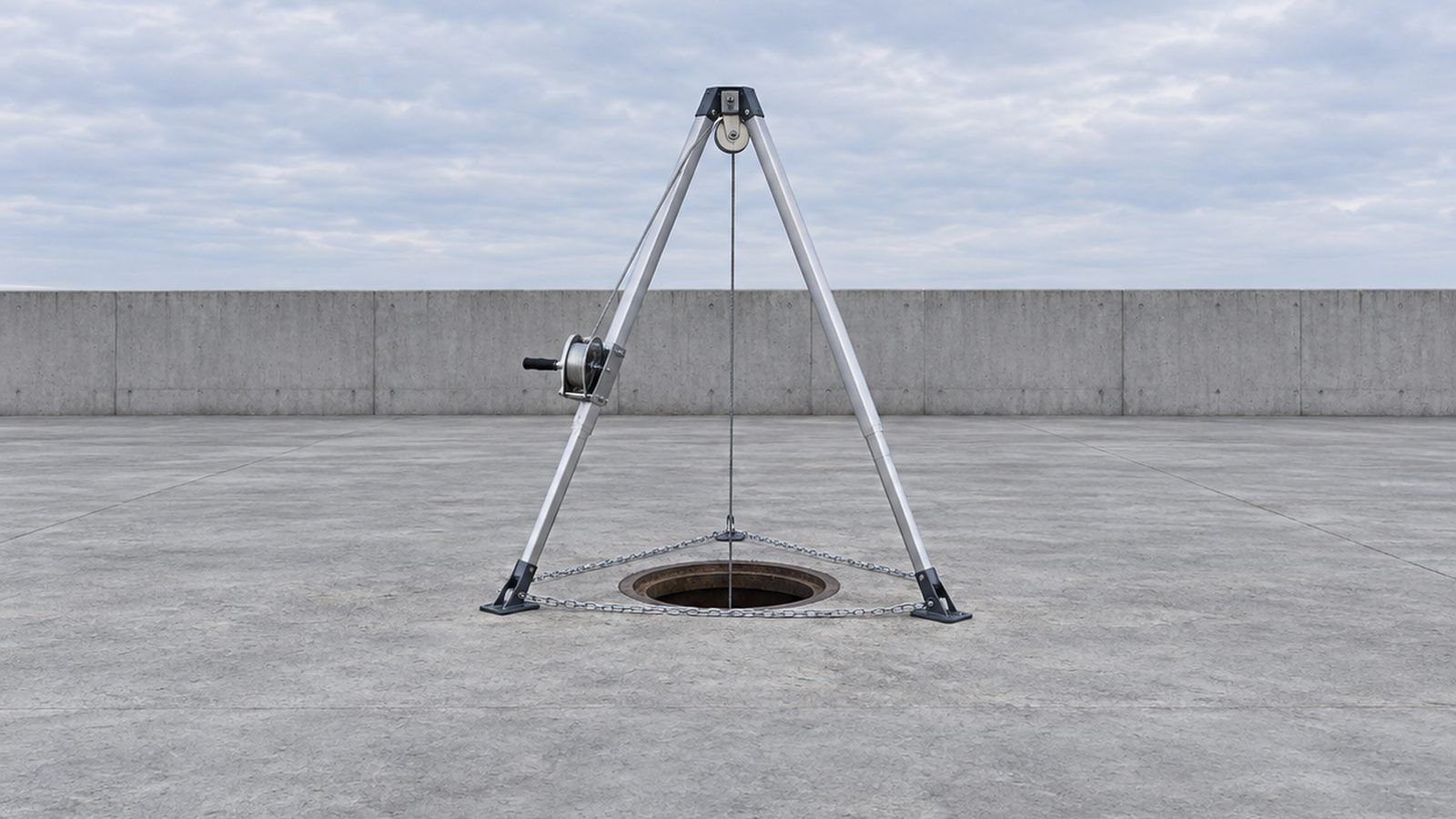
A confined space rescue tripod is one link in a load path, not a stand-alone product. A confined space retrieval system runs from the anchor at the opening — tripod or davit arm — through a winch or retrieval self-retracting lifeline, through connectors and a retrieval line, to the entrant’s harness attachment, and almost all of it is load-rated metal. OSHA 29 CFR 1910.146(k)(3) requires a mechanical device be available to retrieve personnel from vertical permit-required spaces more than 5 feet (1.52 m) deep. For a brand building an own-brand entry line, sourcing it is mostly a metals decision: what is forged, what is cast, what is extruded, and how each part is proof tested.
What does OSHA require, and what is only a consensus standard?
OSHA 29 CFR 1910.146 is law; the equipment standards around it are not. It defines a retrieval system as the retrieval line, a chest or full-body harness, wristlets if appropriate, and a lifting device or anchor for non-entry rescue, with the line attached at the centre of the entrant’s back near shoulder level or above the head. It does not tell a manufacturer how to build the hardware. That comes from consensus standards, binding through a purchase specification or CE marking rather than the OSH Act — our companion piece on OSHA versus ANSI covers the split properly.
- ANSI/ASSP Z359.4 — assisted-rescue and self-rescue systems: winches and hoists, descent control devices, rope tackle blocks, rescue-capable SRLs.
- ANSI/ASSP Z359.18-2017 — anchorage connectors; Type A units withstand a 5,000 lbf (22.2 kN) static load.
- EN 795:2012 Type B — transportable temporary anchor devices: 12 kN static for all-metallic construction, 18 kN with non-metallic load-bearing parts, held three minutes.
- EN 1496 — rescue lifting devices: Class A raises only, Class B raises and lowers under control, with EN 360, EN 361, EN 362 and EN 1497 covering the rest of the chain.
What is inside a confined space rescue tripod?
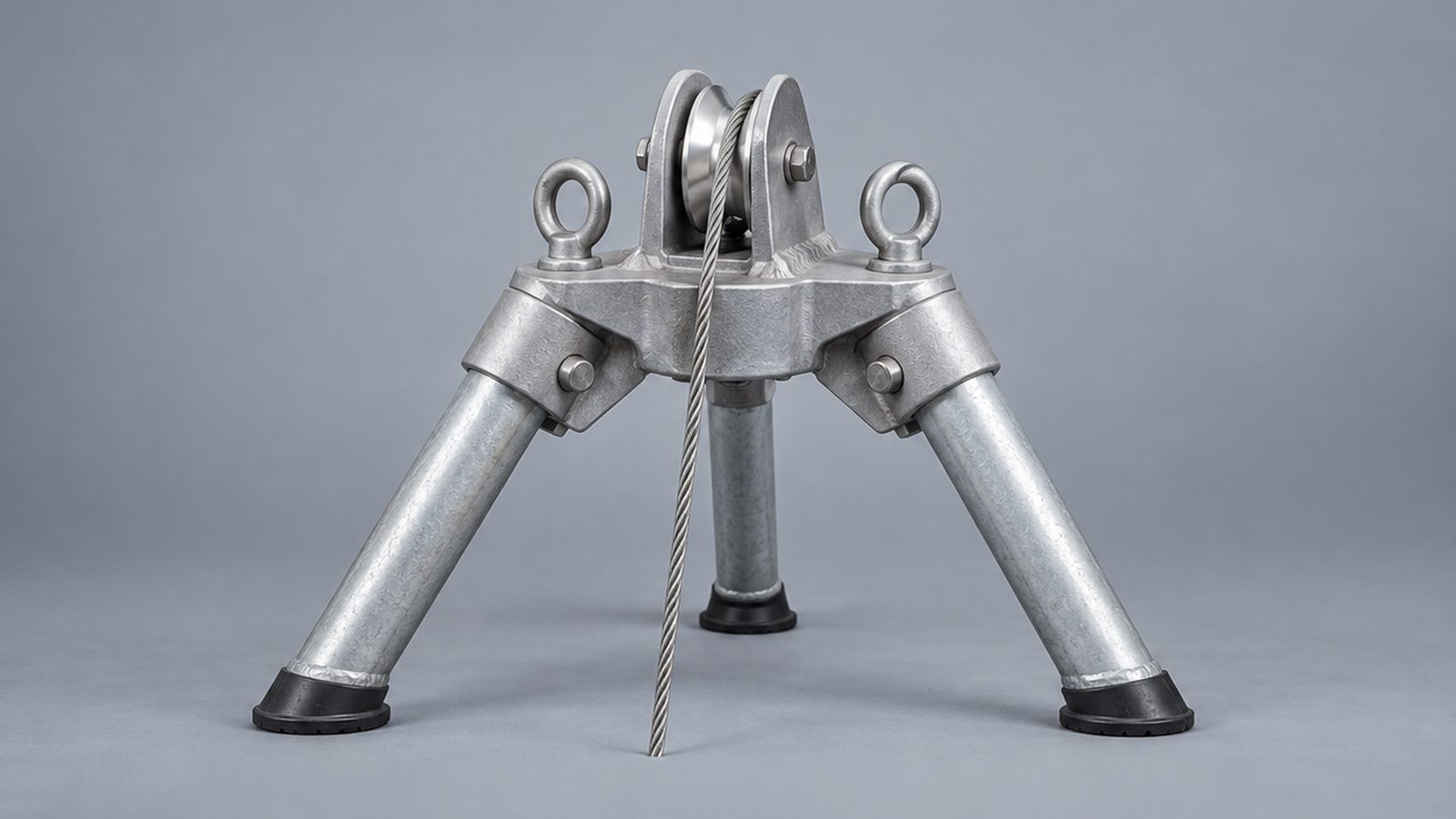
A tripod is five part families made by four processes: legs, head, leg locks, anti-spread restraints and feet.
- Legs. Extruded aluminium tube in two or three sections, 6000-series in a T6 temper — stiffness-to-weight at low tooling cost, and the part brands most often specify too thin.
- The head. The most loaded component, usually a casting: three leg sockets at a fixed angle, anchor eyes, one or two sheaves for the winch line. Casting gives the geometry; machining finishes the bores and eye faces.
- Leg locks. A spring detent pin through drilled tube, or a clamp collar — small machined or cold-formed parts where consistency beats strength.
- Anti-spread restraints. Chain or webbing between the feet with machined or forged end fittings — structural, not an accessory.
- Feet. Cast or forged, rubber pad for hard floors and spike for soft ground, pivoting so the foot lies flat at any leg angle.
Legs and straps are extrusions: cheap to change, easy to second-source. Heads, feet, sheaves and pin fittings are cast, forged or machined, carrying tooling, dimensional control and heat-lot traceability — which is where a precision metal supplier earns its place.
Why is a davit arm mechanically harder than a tripod?
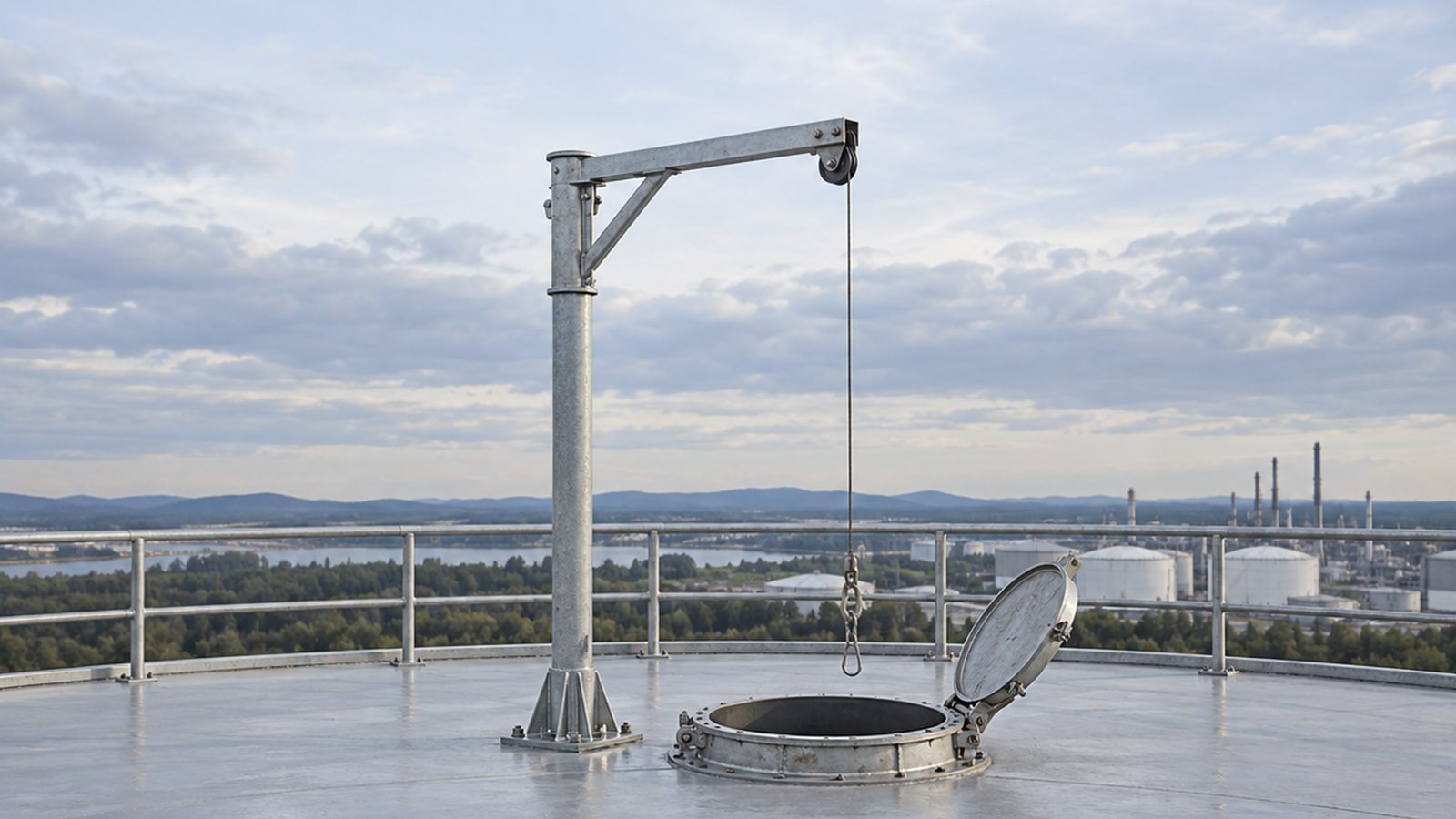
Because the load is offset. A tripod puts the entrant almost directly beneath the head, so the legs see near-axial compression. A davit puts it at the end of a cantilevered arm, sometimes a metre from the mast centreline: the same vertical load becomes a large bending moment in the arm, bending plus torsion in the mast, and a prying couple levering the mast out of its base socket.
Arm and mast are therefore thick-wall tube, gusseted at the knee where the moment peaks. Adjustable offset means a row of machined pin holes and a load pin sized on double shear, not an ordinary bolt. The base is what buyers under-specify most: a sleeve socket cast into concrete, a bolt-down flange, or a portable weighted base, reacting that couple through its bearing faces. Pivot bushings and the rotation lock need machined fits: clearance in a cantilever becomes movement at the rope end.
What separates a personnel winch from a material-handling winch?
A brake that fails safe, a gear train that cannot back-drive, and a design factor roughly twice as high. A material winch is sized to lift a load; a man-riding winch assumes the load is a person who will fall if anything lets go. Man-riding winches are commonly built to something like a 10:1 design factor where a material winch is designed to about 5:1; ASME B30.23 is the North American code for personnel lifting systems.
On a personnel-rated unit expect a self-locking worm or planetary gear set, an automatic load brake holding at any point without operator input, no free-spool release, a handle that cannot spin back, and a drum whose flange height and rope anchor pocket keep the rope on the drum when a slack line is shock-loaded.
Two rules follow. A winch not certified for personnel must never raise or lower a person, whatever its capacity; and on a dual-rated device the personnel rating is always the lower figure, a design limit rather than a conservative suggestion. Many systems now use a retrieval SRL with an integral rescue winch instead; our self-retracting lifeline guide covers those internals.
Which connector and rigging hardware carries the load?
Everything between the head and the harness, usually the cheapest part of the bill of materials.
- Shackles and anchor eyes at the head or arm tip, forged rather than cast where the load is high and the section small.
- A swivel, so rope torque does not spin a suspended entrant — a control problem in a live retrieval, not a refinement.
- Pulleys and rope tackle blocks, with side plates, axle and becket each rated separately.
- Self-closing, self-locking snap hooks and carabiners at every subsystem end — ANSI/ASSP Z359.12 governs connecting components in North America, EN 362 in Europe.
- The anchor attachment, which on a fixed installation is a permanent anchorage connector in its own right — see our Z359.18 article.
Aluminium or steel, and what survives a sewer?
Aluminium for what is carried to the job, steel for what stays. 6000-series extrusions and cast aluminium heads dominate the portable market, usually hard anodised, because a tripod has to be carried to the manhole. Permanent davit masts and base sockets are more often galvanised or plated carbon steel, where cost per unit strength wins.
Environment decides the rest: wastewater means hydrogen sulphide and permanent wet, marine entry means chlorides, tank entry can mean solvent carryover. Stainless steel — 316 rather than 304 where chlorides are present — is the usual answer for fasteners, pins and springs, creating a galvanic couple against an aluminium body to manage by design. Ask for neutral salt spray results to ISO 9227 or ASTM B117 on the finish you are buying.
What goes in the specification when you source it?
More than a capacity figure. A rated capacity with no stated test method behind it is not a specification but a marketing number.
- Rated capacity and its test. The load, direction and duration, whether it is a static hold, a dynamic drop or a cyclic test, and the clause behind it.
- Design factor and what it applies to. Meaningless until you say whether it is taken on minimum breaking strength, on yield, or on a tested ultimate.
- Proof loading, per unit or per batch. For personnel-rated winches and davit arms, per-unit proof loading with a retained record is normal and worth paying for; for cast heads and feet, a sampling plan tied to a traceable casting lot.
- Traceability and identification. Heat or lot number tied to a unit serial, material certificates retained, the permanent identification each standard requires, and the ability to find every unit in a batch if one fails.
- Documentation. Test reports, declaration or certificate of conformity, instructions for use with inspection intervals, and removal-from-service criteria.
That last group is not paperwork: it is what a brand’s quality and legal teams must produce if a retrieval system becomes part of an incident investigation, and far easier to specify at quotation than to reconstruct later. Our article on qualifying a safety-hardware supplier covers auditing that before the first order, and our ANSI/ISEA 121 piece covers the tool tethering that belongs on the same permit.
Working with Power Honour
Confined space entry hardware sits close to the centre of what Power Honour does: forged shackles, eyes and pin fittings; cast tripod heads and feet; CNC-machined sheaves, sockets and load pins; heat treatment, anodising and plating; and proof-load testing — under one roof in Taiwan, with ISO 9001 systems and thirty years of manufacturing to ANSI/ASSP Z359, CE EN and PPE Regulation (EU) 2016/425. Send a drawing, or simply the capacity and standard you must meet, and we will return a process route for each part and the test plan behind the rating.