Mountaineering & Climbing Hardware
Climbing Hangers & Chain Anchors
11 products
This category covers the fixed hardware used to equip climbing routes, belay stations and climbing walls. It includes bent-plate hangers in steel or stainless steel for 10 mm and 12 mm bolts, anti-rotation hangers with six protuberances around the bolt hole, hangers with captive rings for lowering and rappelling, an aluminium hanger for 8 mm anchors, and chain anchor assemblies with seven-link chains, rings, bolts and hooks, including a two-hanger station. Listed ratings run from 15 kN to 30 kN depending on model and material. In Europe, rock anchors are assessed under EN 959, which sets minimum radial and axial strengths for the installed anchor, and anchor devices for fall protection under EN 795. All items can be supplied OEM or private label, or configured to a customer drawing.
Products
11 products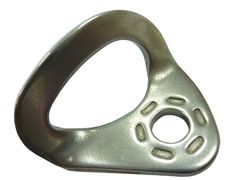 705H
705H Anti-Rotation Rock Climbing Hanger
The 705H is a rock climbing hanger with six protuberances around the bolt orifice that keep it from spinning. Offered in steel at 25 kN or stainless steel at 30 kN for 10 mm and 12 mm bolts, it is used on bolted sport routes, belays and climbing walls.
View product 715
715 Climbing Hanger in Stainless Steel or Steel
715 is a climbing hanger available in stainless steel or steel for 10 mm and 12 mm bolts, rated at 30 kN in stainless steel and 26 kN in steel. It is the clipping point on bolted sport routes, belay stations and climbing walls.
View product 715H
715H Anti-Rotation Rock Climbing Hanger
715H is a rock climbing hanger with six protuberances around the bolt hole that stop the hanger from spinning on the rock. It is available in steel (25 kN) or stainless steel (30 kN) for 10 mm and 12 mm bolts, for sport routes and climbing walls.
View product 725
725 Climbing Hanger with Ring
The 725 is a climbing hanger with an attached ring, available in stainless steel or steel for 10 mm and 12 mm bolts. Rated at 26 kN in stainless steel and 18 kN in steel, it is used for lower-off, rappel and belay stations where the rope runs through the ring.
View product 730
730 Climbing Hanger in Stainless Steel or Steel
730 is a climbing hanger offered in stainless steel or steel for 10 mm and 12 mm bolts. It provides a clipping or attachment point on bolted climbing routes, belay stations and climbing walls.
View product 735
735 Rock Climbing Chain Anchor in Steel or Stainless Steel
The 735 is a rock climbing chain anchor with a seven-link chain, rings and bolts, available in steel or stainless steel. Rated at 30 kN in steel and 26 kN in stainless steel for 10 mm and 12 mm bolt holes, it is used to build belay and lower-off stations.
View product 736H-SS
 Stainless Steel Chain Anchor with Hook
736H-SS is a stainless steel chain anchor with a seven-link chain, rings, bolts and a hook, available for 10 mm and 12 mm bolt holes. The hook lets climbers clip the rope directly at a lower-off or top-rope station.
View product 745-SS
 Rock Climbing Hanger in Steel or Stainless Steel
The 745-SS is a rock climbing hanger available in steel or stainless steel for 10 mm and 12 mm bolts. It is rated at 25 kN in steel and 30 kN in stainless steel and provides the clipping point for quickdraws on bolted climbing routes and walls.
View product 755
755 Rock Climbing Hanger, CE EN 959
The 755 is a rock climbing hanger available in steel or stainless steel, rated at 25 kN in both, for 10 mm and 12 mm bolts. Ring and chains are optional, so it can be used as a single clipping point or as part of a belay or lower-off station, and it is listed with CE certification to EN 959.
View product A765
A765 Aluminium Alloy Hanger for 8 mm Anchors
A765 is a lightweight aluminium alloy hanger for 8 mm anchors, 4 mm thick and weighing 23 g, with a listed breaking strength of 15 kN. Hangers of this kind are used in caving and light rigging, where low weight matters and hangers are often carried and placed by the team.
View product SS735-2H
 Stainless Steel Two-Hanger Chain Anchor with Hooks
The SS735-2H is a stainless steel climbing anchor station made up of two hanger bolts, chains, two hooks and a ring. Available for 10 mm and 12 mm hanger bolts, it is used as a two-point lower-off or top-rope anchor, and it is listed with CE approval to EN 959 and EN 795.
View product
Frequently asked questions
- Steel or stainless steel: which hanger material should I choose?
- Zinc-plated steel suits dry indoor climbing walls and training structures. Stainless steel is the normal choice for outdoor rock because it resists corrosion over the long life of a fixed anchor. Hanger and bolt should be of compatible materials, since dissimilar metals in contact can corrode galvanically.
- Are stainless steel anchors suitable for sea cliffs?
- Not always. The UIAA has warned that stress corrosion cracking has caused stainless steel anchor failures, including 316 grade, in sea-side climbing areas, sometimes within months or years and without visible signs. In such environments, route developers usually specify titanium or special high-alloy anchors and follow local guidance.
- What does EN 959 require?
- EN 959 is the European standard for rock anchors used in mountaineering and climbing. It requires the anchor, tested as installed in a concrete block, to withstand at least 25 kN in the radial (shear) direction and 15 kN in the axial (pull-out) direction. Because the test covers the hanger, bolt and installation together, a hanger's own rating is only part of the picture.
- What are anti-rotation hangers for?
- Hangers such as 715H and 705H have six protuberances around the bolt hole that grip the rock or wall surface. They keep the hanger from spinning under repeated clipping and loading, so the clipping eye stays in the orientation in which it was installed.
- Ring, hook or chain: how do lower-off stations differ?
- A ring hanger such as 725 lets the rope be threaded for lowering or abseiling. A hook, as on 736H-SS and SS735-2H, lets climbers clip the rope directly without threading. Chains such as 735 allow the station to hang in line with the load and allow two anchors to be linked. Rings and hooks wear as rope runs over them and should be inspected and replaced as part of anchor maintenance.
- What should an RFQ for hangers and anchors include?
- Give the model code or drawing, material and finish, bolt diameter, whether bolts, rings or chains are to be supplied, and the marking required. State the certification route, for example EN 959 for rock anchors, and the intended environment, such as indoor wall, inland crag or coastal site.
How these are made
Surface Treatment Guide: Anodising, Plating and Passivation
Choosing a surface treatment for metal parts comes down to the base metal plus the service environment. A practical guide to anodising, plating, passivation, salt spray testing and RoHS compliance.
Read more →Material Selection Guide: Aluminium, Steel, Stainless, and Titanium for Safety Hardware
Choosing the right material for load-bearing safety hardware involves balancing weight, strength, corrosion resistance, cost, and certification test requirements. Here is a practical comparison.
Read more →Need this in a different specification?
Different size, material, finish, strength rating or gate, or a part that is not here at all. Send a drawing or a sample and we will come back with a DFM review and a quotation.
- A reply within two business days from our team in Taipei.
- NDA on request before drawings or specifications change hands.
- An engineering and DFM review, not a sales pitch — we will say so if we are the wrong fit.
Prefer email? Write to service@fall-protect.com.