Stainless Steel Rigging Hardware
Stainless Steel Turnbuckles & Terminals
9 products
Turnbuckles, also called rigging screws, adjust the length and tension of wire rope, rod and cable. This category covers open-frame turnbuckles with jaw ends (SS9301) or eye and hook ends (SS930), a closed-body jaw and jaw turnbuckle (SS4820), pipe turnbuckles (SS4824, SS4823) and the terminals that complete a wire system: eye (SS935), welded fork (SS933), jaw (SS4825) and threaded terminals with nut (SS932). All are made in AISI 316 stainless steel except SS4820, whose grade (304 or 316) is confirmed at quotation. Typical uses are architectural wire balustrades, shade sails, fences, signage and marine rigging. German dimensional standards such as DIN 1480 for forged open-body turnbuckles and DIN 1478 for pipe bodies are common references, and ASTM F1145 covers turnbuckles in the US market. Power Honour can supply the range under a private label or to a drawing.
Products
9 products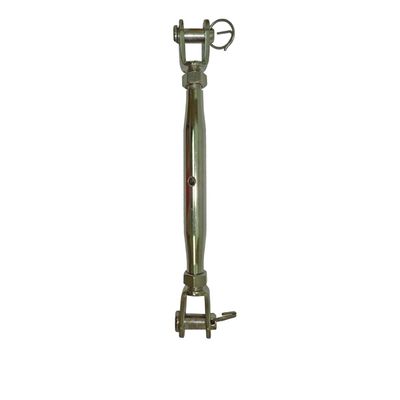 SS4820
 Stainless Steel Jaw and Jaw Turnbuckle
The SS4820 is a stainless steel jaw and jaw turnbuckle with a pinned jaw at each end, in seven sizes with threads from M5 to M16. It is used to tension wire rope and rigging between two fittings, with a minimum and maximum length listed for each size.
View product SS4823
 316 Stainless Steel Pipe Turnbuckle, Jaw and Terminal
The SS4823 is a pipe turnbuckle in AISI 316 stainless steel with a jaw at one end and a terminal at the other, listed in six thread sizes from M5 to M16. It lets a wire be terminated and tensioned in one fitting on balustrades, shade sails and marine rigging.
View product SS4824
 316 Stainless Steel Pipe Turnbuckle, Eye and Hook Ends
The SS4824 is a pipe turnbuckle, with a closed tubular body, made from AISI 316 stainless steel in eye and eye, hook and eye, and hook and hook versions. Six thread sizes from 5 mm (3/16 in.) to 16 mm (5/8 in.) are listed for tensioning wire rope and cable.
View product SS4825
 316 Stainless Steel Jaw Terminal
The SS4825 is a jaw terminal in AISI 316 stainless steel, listed in six thread sizes from M5 to M16. It provides a pinned jaw end on a threaded fitting, for connecting turnbuckle bodies and wire or rod rigging to padeyes, tangs and eyes.
View product SS930
SS930 316 Stainless Steel Frame Turnbuckle, Eye and Hook Ends
The SS930 is a frame-type turnbuckle in AISI 316 stainless steel, offered in three end combinations (eye and eye, hook and eye, hook and hook) and eight sizes from 4 to 19. It is a general-purpose tensioner for wire rope, cable and rigging lines.
View product SS9301
 316 Stainless Steel Frame Turnbuckle with Two Jaws
The SS9301 is an AISI 316 stainless steel frame (open-body) turnbuckle with a jaw at each end, offered in seven sizes with threads from M5 to M16. It is used to adjust tension in stainless wire rope and rigging connected to padeyes, tangs and eye terminals.
View product SS932
SS932 316 Stainless Steel Threaded Terminal with Nut
The SS932 is a threaded terminal with a screwed nut, made from AISI 316 stainless steel in four thread sizes from M6 to M12 for wire of 3 mm to 6 mm. It gives a wire a threaded stud end that can be passed through a post or bracket and tightened to set tension.
View product SS933
SS933 316 Stainless Steel Welded Fork Terminal
The SS933 is a welded fork (jaw) terminal in AISI 316 stainless steel, listed in seven sizes from M3 (1/8 in.) to M9 (3/8 in.). It terminates a wire rope with a pinned fork end that connects to padeyes, tangs and turnbuckles.
View product SS935
SS935 316 Stainless Steel Eye Terminal for Wire Rope
The SS935 is an eye terminal in AISI 316 stainless steel for terminating wire rope, listed for five wire sizes from M3 (1/8 in.) to M8 (5/16 in.). It gives a wire an eye end for connection to turnbuckle jaws, shackles and padeyes in balustrade, shade-sail and marine rigging.
View product
Frequently asked questions
- Frame or pipe turnbuckle: what is the difference?
- A frame (open-body) turnbuckle lets you see how much thread is engaged at each end, which makes setting and checking tension straightforward. A pipe (closed-body) turnbuckle hides the threads inside a tube for a cleaner look, which is popular on architectural balustrades. Both types can carry jaw, eye, hook or terminal ends.
- Which end fittings should I choose?
- Jaw ends pin directly to padeyes, tangs and eye terminals, and eye ends connect through a shackle or thimble. Hook ends are quick to fit but can disengage if the line goes slack, so they suit lighter, non-critical uses. Terminal ends (eye, fork or threaded) attach directly to the wire and remove a separate fitting from the assembly.
- How are wire terminals attached?
- Terminals of this kind are generally swaged or crimped onto the wire with suitable tooling, or fitted with a mechanical system, depending on the design. The attachment method, die size and wire construction all affect the strength of the termination, so they should be agreed with the supplier. The terminals in this range are supplied with dimensions but no published load ratings.
- Why are most of these turnbuckles listed in AISI 316?
- Turnbuckles and terminals are usually installed outdoors, often near the sea, and threads and crevices are where corrosion starts. The molybdenum in 316 improves resistance to chloride pitting compared with 304. For SS4820 the grade should be confirmed when quoting.
- What should a turnbuckle RFQ include?
- Give the code, thread size, end combination, quantity, and the minimum and maximum length needed. For wire systems, state the wire diameter and construction and how terminals will be attached. Thread-hand requirements, finish and private-label packaging should also be listed.
How these are made
G80 Lifting Components: ASTM A952, ASME B30 and What Importers Check
G80 lifting components, the forged hooks, master links and coupling links in Grade 80 chain slings, are specified under ASTM A952 and used within ASME B30.9. Here is what the grade means and what to verify before stocking them.
Read more →Material Selection Guide: Aluminium, Steel, Stainless, and Titanium for Safety Hardware
Choosing the right material for load-bearing safety hardware involves balancing weight, strength, corrosion resistance, cost, and certification test requirements. Here is a practical comparison.
Read more →Need this in a different specification?
Different size, material, finish, strength rating or gate, or a part that is not here at all. Send a drawing or a sample and we will come back with a DFM review and a quotation.
- A reply within two business days from our team in Taipei.
- NDA on request before drawings or specifications change hands.
- An engineering and DFM review, not a sales pitch — we will say so if we are the wrong fit.
Prefer email? Write to service@fall-protect.com.