Fall Protection & Industrial Safety Hardware
Tool Tether Lanyards
4 products
Tool tether lanyards keep hand tools attached to a worker or a structure so they cannot fall onto people or equipment below. The tethers in this category use 20 mm nylon webbing with a stretchable bungee section and aluminium hooks, in single-hook versions with a bungee loop for fitting to the tool and double-hook versions for tools that already have an attachment point. Swivel hook models let the tool rotate without twisting the tether, with twist lock or triple lock gates. Typical users are tower, wind, utility, construction and maintenance crews. In the US, ANSI/ISEA 121-2018 sets design, testing and labelling requirements for dropped object prevention equipment such as tool tethers. Tool tethers are not personal fall protection. The range can be supplied OEM or private label, with lengths and fittings adapted to a drawing.
Products
4 products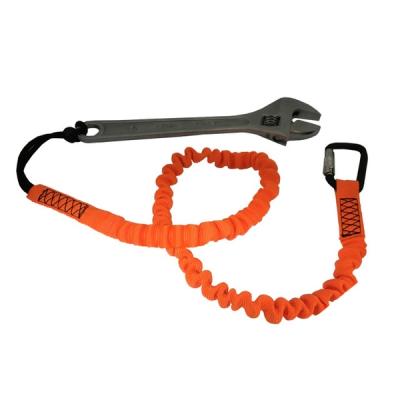 HTE-1H-A103KTL
 Tool Tether Bungee Lanyard with Aluminium Hook
The HTE-1H-A103KTL is a tool tether bungee lanyard with one aluminium hook at one end and a bungee loop at the other, built on 20 mm nylon webbing. It keeps hand tools attached to the user or a structure when working at height, and is a dropped-object control, not personal fall protection.
View product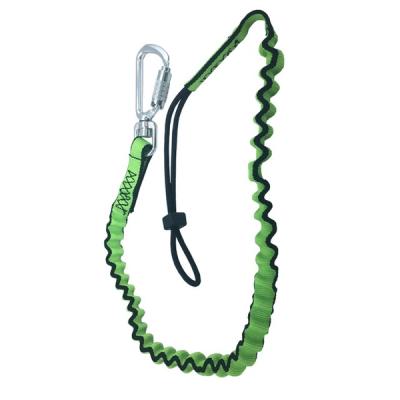 HTE-1H-A204KTL
 Tool Tether Bungee Lanyard with Aluminium Swivel Hook
The HTE-1H-A204KTL is a tool tether bungee lanyard with one aluminium swivel hook and one bungee loop on 20 mm nylon webbing, 103 cm long when relaxed. The swivel lets the tool turn without twisting the tether, and the lanyard is used to stop hand tools being dropped at height.
View product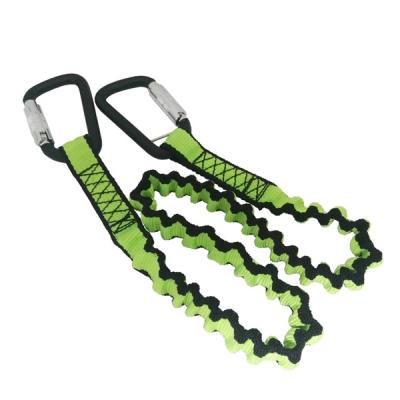 HTE-2H-A103KTL
 Tool Tether Bungee Lanyard with Two Aluminium Hooks
The HTE-2H-A103KTL is a tool tether bungee lanyard with an aluminium hook at each end, made on 20 mm nylon webbing with a relaxed length of 81 cm. It is used to connect a tool fitted with an attachment point to a belt, harness tool loop or structure, preventing dropped tools at height.
View product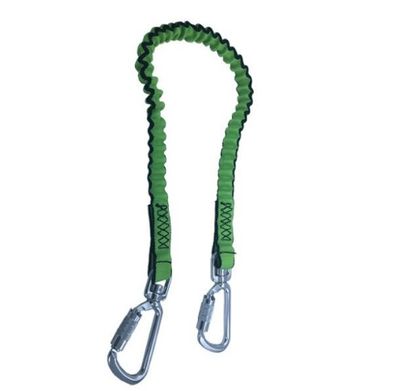 HTE-2H-A204KTL
 Tool Tether Bungee Lanyard with Two Aluminium Swivel Hooks
The HTE-2H-A204KTL is a tool tether bungee lanyard with an aluminium swivel hook at both ends, on 20 mm nylon webbing with a relaxed length of 103 cm. It connects tools that have their own attachment point to a belt, harness tool loop or structure to prevent dropped objects at height.
View product
Frequently asked questions
- Can a tool tether be used as a fall protection lanyard?
- No. Tool tethers are designed to hold tools, not to arrest a falling person, and they must never be connected to a harness as personal fall protection. The kN rating quoted for a hook refers to the hook alone, not to the tether as a fall arrest device.
- Which standard covers tool tethers?
- In the US, ANSI/ISEA 121-2018, the American National Standard for Dropped Object Prevention Solutions, covers anchor attachments, tool attachments, tool tethers and containers. It sets minimum design, performance testing and labelling requirements. Brand owners should decide early whether their tethers will be tested and labelled to it.
- Single hook or double hook: which do I need?
- A single hook tether with a bungee loop suits tools without a built-in attachment point, because the loop is fitted around the tool. A double hook tether suits tools that already have a ring, tail or attachment collar, and lets the other end clip to a belt, harness tool loop or structure. Swivel hooks are useful for tools that are turned repeatedly.
- How is the tool weight capacity determined?
- Capacity depends on the whole system, including the tether, the hooks, the tool attachment and the anchor point, and is established by drop testing. Buyers should specify the heaviest tool the tether must hold and ask for test evidence at that weight. The tether should then be labelled with its rated capacity.
- What can be customised for OEM orders?
- Webbing colour, tether length, hook type and gate style, labels and packaging can usually be specified. Different end fittings or lengths can be made to a drawing. Share your capacity target and labelling requirements at the RFQ stage so testing can be planned.
How these are made
Self-Retracting Lifeline (SRL) Manufacturing: An OEM and Standards Guide
How is a self-retracting lifeline built and certified? A manufacturing guide to SRL brake mechanisms, EN 360 and ANSI/ASSP Z359.14 Class 1 vs Class 2, lifeline media, and what to specify to an OEM.
Read more →Horizontal vs Vertical Lifeline Systems for Fall Protection
Horizontal vs vertical lifelines: a horizontal line lets a worker move along an edge, a vertical line protects a climb. How to choose, clearance and OSHA rules.
Read more →Need this in a different specification?
Different size, material, finish, strength rating or gate, or a part that is not here at all. Send a drawing or a sample and we will come back with a DFM review and a quotation.
- A reply within two business days from our team in Taipei.
- NDA on request before drawings or specifications change hands.
- An engineering and DFM review, not a sales pitch — we will say so if we are the wrong fit.
Prefer email? Write to service@fall-protect.com.