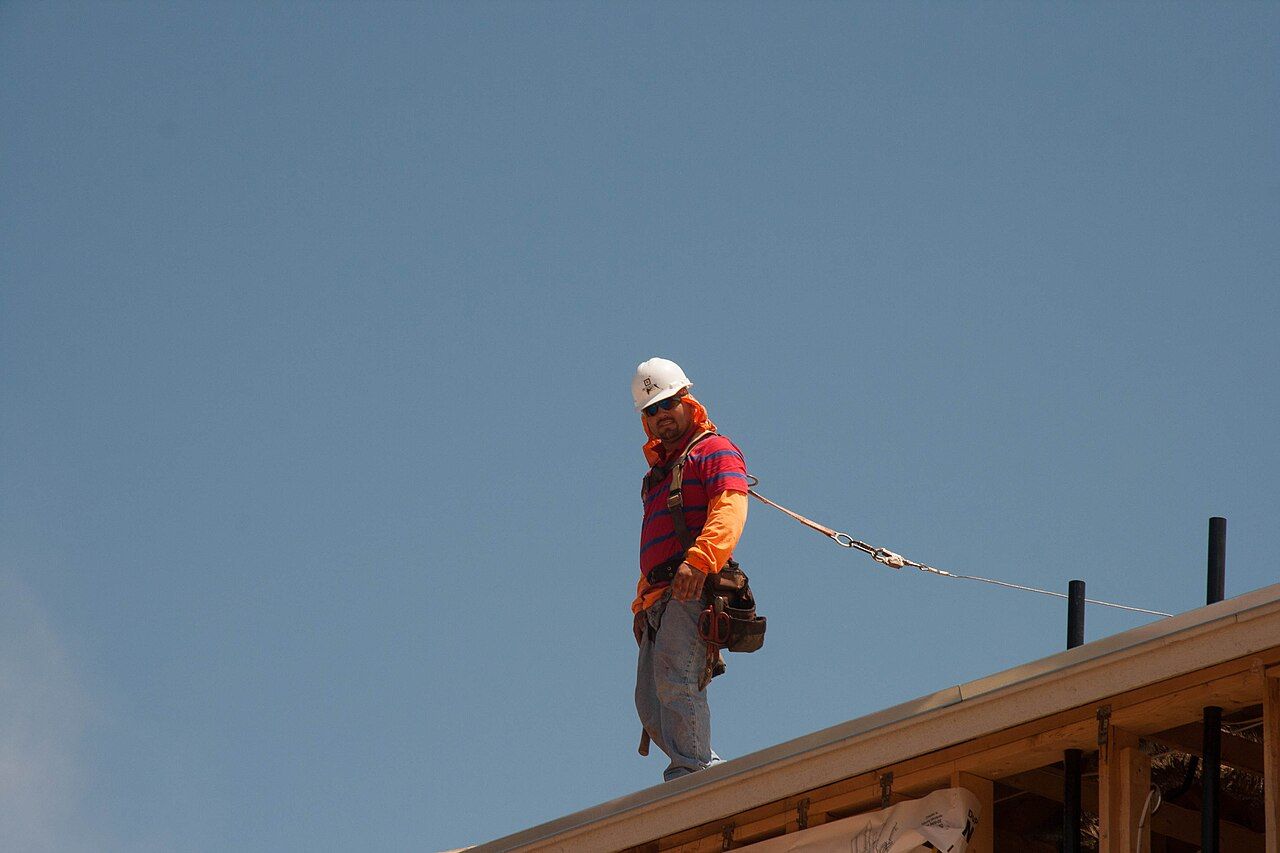
A self-retracting lifeline (SRL) is a fall-arrest device that pays out and rewinds a cable or webbing line under spring tension and locks within a fraction of a second when the line accelerates, arresting a fall in far less distance than a shock-absorbing lanyard. Inside, a centrifugal brake throws pawls outward against a ratchet ring once the drum exceeds a set speed, and an energy absorber limits the peak load passed to the worker. In Europe SRLs are certified to EN 360, retractable type fall arresters, which caps arrest force at 6 kN and arrest distance at about 2 m; in North America, to ANSI/ASSP Z359.14, which since 2021 labels every device Class 1 or Class 2.

How does a self-retracting lifeline work inside the housing?
An SRL works on the principle of a seat-belt retractor, scaled up to arrest a falling worker. The line is wound on a drum held under tension by a coiled power spring, so it follows the worker without slack. When payout speed passes a threshold set by the brake geometry and pawl return springs, centrifugal force swings the pawls outward, they bite into a ratchet ring in the housing, and the drum stops. A hard stop alone would overload the spine, so energy is absorbed either by an internal friction clutch slipping at a calibrated torque, or by an external tear-stitched webbing pack at the connector end. General-industry devices favour the internal route; leading-edge and personal designs add the external absorber.
What does EN 360 require of a retractable type fall arrester?
EN 360 requires the device to arrest a defined test mass within a defined distance and below a defined force, hold it statically, and still lock after conditioning:
- Dynamic performance: a 100 kg test mass is dropped 600 mm with the lifeline clamped. Arrest force must not exceed 6 kN and the line must not deploy more than 1.4 m, so the fall is arrested within about 2 m of release.
- Static strength: a synthetic rope or webbing lifeline must hold at least 15 kN for three minutes, a steel wire rope lifeline at least 12 kN.
- Locking after conditioning: the device must still lock after roughly two hours at 50 degrees Celsius and 85 percent humidity, two hours at minus 30 degrees Celsius, and several hours under water spray.
- Corrosion: metallic components undergo a neutral salt spray test.
EN 360:2023 replaced the 2002 edition and pushed testing closer to real use: factor 0 and horizontal-working scenarios, full pay-out of the line, lighter minimum user masses, and a full dynamic test after conditioning rather than only a locking check.
What is the difference between a Class 1 and a Class 2 SRL?
Class 1 and Class 2 describe where the device may be anchored relative to the worker. ANSI/ASSP Z359.14-2021 was approved in June 2021 and became mandatory on 1 August 2023, replacing the older Class A and B split. Class 1 covers anchorage at or above the dorsal D-ring with free fall limited to 2 ft (0.6 m) - conventional overhead SRLs. Class 2 covers anchorage above, at, or up to 5 ft (1.5 m) below the dorsal D-ring with free fall up to 6 ft (1.8 m), and all leading-edge devices sit here.
The old classes were defined by arrest distance, 24 in for Class A and 54 in for Class B. The 2021 revision standardised that at 42 in (1.07 m) for both classes, with average arrest force of 1,350 lbf (about 6 kN), maximum arrest force of 1,800 lbf (about 8 kN), and a static hold of 3,600 lbf (about 16 kN) for one minute. Class 2 carries extra duties: synthetic lifelines of at least 5,000 lbf tensile strength, a dynamic edge test with a 310 lb mass, an energy absorber on the lifeline in most configurations, and a separate orange warning card. ANSI also retired the SRL-LE designation, so edge capability now rides on the Class 2 label and the device types are SRL, SRL-P and SRL-R. Our wider ANSI/ASSP Z359 guide covers how these sub-standards fit together.
How do leading-edge and personal SRLs differ from a standard SRL?
They differ in where the device sits, how far it may fall before locking, and therefore what the lifeline is made of. A standard SRL is anchored overhead, carrying from a few metres to thirty metres or more of line. An SRL-P is a compact personal unit at the harness dorsal D-ring, often twin-leg for 100 percent tie-off, its short housing limiting the line to two or three metres. A leading-edge device is any SRL whose lifeline may be dragged across a structural edge during a fall; in Europe that is verified against VG11 sheet CNB/P/11.060, over an edge of just 0.5 mm radius. Small-diameter wire rope concentrates the arrest load on that edge and can be cut, while wide webbing spreads the contact, so edge-rated devices usually run webbing with an integral tear-out absorber and accept a longer arrest distance.

The realistic options:
- Galvanised wire rope, commonly 4 to 5 mm in 7x19 construction: best abrasion and cut resistance, tolerant of sparks, but heavy and dependent on a correctly swaged terminal.
- Stainless wire rope, typically AISI 316: for offshore, chemical and washdown work, at higher cost and slightly lower strength per diameter.
- Polyester or nylon webbing: light, compact on the drum and kinder to edges, but weaker against abrasion, UV and heat.
- UHMWPE (Dyneema-type) cored webbing: high strength-to-weight and low stretch, allowing a smaller drum, but it softens near 145 degrees Celsius and creeps under load.
Which SRL parts does a precision metal OEM actually make?
Most of an SRL by mass, and all of its load path, is precision metal:
- Housing halves: volume programmes typically die-cast aluminium, lower-volume or corrosion-critical ones machined aluminium or investment-cast stainless. The housing must survive impact abuse and still hold brake geometry after a fall.
- Drum and side plates: concentric with the brake ring, with a termination pocket for the lifeline.
- Pawls, pivots and ratchet ring: investment cast or machined, then heat treated; hardness and finish decide how repeatably the brake engages.
- Swivel eye and anchorage attachment: hot forged or investment cast, carrying full arrest load while rotating to stop the line twisting.
- Connector hardware: self-closing, self-locking snap hooks and carabiners meeting the gate-strength requirements of EN 362 and Z359.12.
How is an SRL tested and certified?
Certification combines dynamic drop testing, static proof testing, environmental exposure and third-party assessment. Drop rigs run the EN 360 100 kg test and, for Class 2, the 310 lb edge test; static rigs apply the EN 15 kN or 12 kN hold or the 3,600 lbf ANSI hold; neutral salt spray to ISO 9227 or ASTM B117 qualifies plating and alloys. Most brands add their own retraction cycle test, since a device that stops rewinding is pulled from service even though it would still arrest a fall.
For CE marking, fall arrest equipment is Category III PPE under Regulation (EU) 2016/425: EU type-examination (Module B) by a notified body, then surveillance under Module C2 or D. A factory cannot self-declare. Power Honour is ISO 9001 certified and manufactures to CE EN, UIAA and ANSI/ASSP Z359 requirements, but is not a notified body; the certificate normally sits with the brand named on the product.
What should you specify when briefing an SRL OEM?
Give the OEM the duty cycle, not just a drawing:
- Target standards and class: EN 360, Z359.14 Class 1 or Class 2, or both, plus rated user weight range
- Working length, lifeline media and diameter, terminal type
- Anchorage interface: swivel eye, integrated carabiner, or bracket for mast, davit or tripod
- Environment: offshore salt, foundry heat, turbine nacelle or washdown, which decides alloy, plating and seals
- Marking: CE plus notified body number, Class 1 or Class 2 labelling, the Class 2 warning card, serial and date traceability
- Service and commercial frame: inspection and recertification responsibility, pilot and ramp volumes, and who holds the CE technical file
Working with Power Honour
Power Honour is a Taiwan-based OEM/ODM precision metal manufacturer with more than 30 years in safety hardware, running CNC machining, hot and cold forging, investment and gravity casting, stamping, heat treatment, surface treatment and sub-assembly in house across aluminium, stainless steel, carbon steel, titanium and brass. For an SRL programme that covers housings, drums, pawls and ratchet rings, swivel eyes and connector hardware. Send us the drawings, target standard and intended environment, and we will return a manufacturability assessment.