Fall Protection & Industrial Safety Hardware
Overhead Lifeline System Components
4 products
Overhead lifelines carry the anchorage above the user, who connects to a trolley running on the cable. This category covers stainless steel components for overhead systems on 8 mm wire rope: the SS980 ball-bearing trolley with an SS304 case and sheave and a breaking strength above 15 kN, the SS977 trolley supplied with an SS316 M12 shackle, the FB-3000 wire cable bracket and the FB-8000 corner bracket for 90 degree inside turns. They belong to the via ferrata lifeline range, and the same principle is used over loading bays, platforms and maintenance areas. In Europe, flexible lifelines of this kind are commonly assessed as EN 795 Type C anchor devices; in the United States, lifelines must be designed and installed under the supervision of a qualified person. The components can be supplied as OEM or private label.
Products
4 products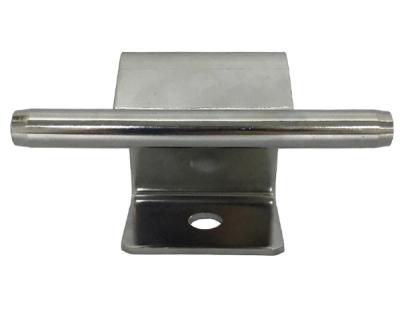 FB-3000
 Stainless Steel Wire Cable Bracket for Overhead Lifelines
The FB-3000 is a stainless steel wire cable bracket for overhead lifeline systems using 8 mm wire rope. It supports the cable along its run, and it belongs to the via ferrata lifeline range.
View product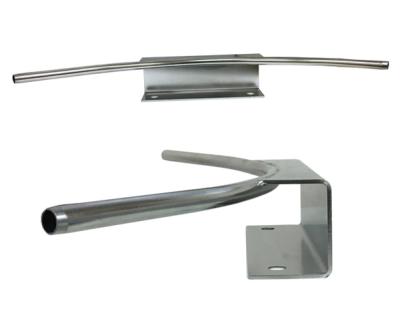 FB-8000
 Stainless Steel Corner Bracket for Overhead Lifelines
The FB-8000 is a stainless steel corner bracket for overhead lifeline systems using 8 mm wire rope. It guides the cable around 90 degree inside turns, and it belongs to the via ferrata lifeline range.
View product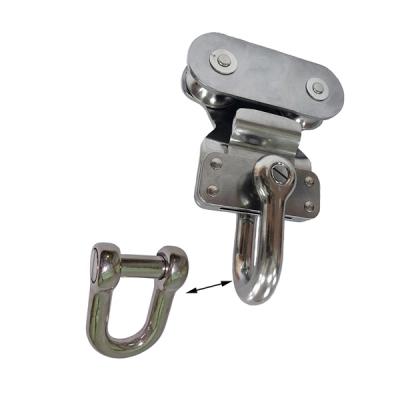 SS977
SS977 Overhead Lifeline Trolley with SS912 Shackle
The SS977 is an overhead lifeline trolley with ball bearing, supplied with an SS912 shackle for connecting the user's lanyard. The trolley is stainless steel 304, the M12 shackle stainless steel 316, and the assembly runs on 8 mm cable and weighs 854 g.
View product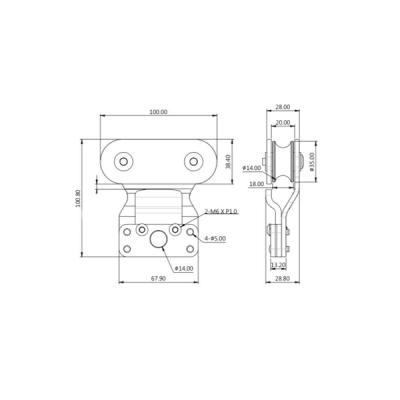 SS980
SS980 Stainless Steel Overhead Lifeline Trolley with Ball Bearing
The SS980 is a ball-bearing overhead trolley with a stainless steel 304 case and sheave, designed to run on 8 mm wire rope lifelines. It has a breaking strength above 15 kN and weighs 646 g.
View product
Frequently asked questions
- When is an overhead lifeline preferred to one at foot level?
- An anchorage above the user reduces the free-fall distance before the system starts to arrest a fall, which lowers the clearance needed below. Overhead lines are also used where there is nothing suitable to anchor to at foot level, for example over vehicle loading bays or along platforms. The choice depends on the work area and the system design.
- Why do the trolleys use ball bearings?
- A ball-bearing sheave lowers rolling resistance, so the trolley follows the user along the cable instead of dragging behind. This makes the system easier to use and reduces sideways pull on the user's lanyard. Both the SS980 and SS977 trolleys in this range have ball bearings.
- Can these trolleys be used with other manufacturers' cables and brackets?
- Compatibility must be checked component by component, because cable diameter, bracket profile and trolley geometry have to match. Lifeline certification normally applies to a defined combination of components, so mixing parts from different systems can invalidate it. Ask for drawings and confirm the combination with the system designer.
- What should an overhead lifeline RFQ include?
- Specify the cable diameter, the number of trolleys, intermediate and corner brackets, the structure the brackets will fix to and the standard the system must meet. For the SS980, also state which gate opening option is required, (A) 5.5 ± 0.3 mm or (B) 4.7 ± 0.3 mm.
How these are made
Fall Clearance Calculation: Lanyards, SRLs and Lifelines
Fall clearance calculation adds free fall, deceleration, harness stretch, D-ring height and a safety margin: about 18.5 ft below the anchor for a 6 ft lanyard, far less for an overhead SRL.
Read more →Horizontal Lifeline System Components: Parts, Loads, Standards
Horizontal lifeline system components are end anchors, an energy absorber, a tensioner, 8 mm wire rope, terminations, brackets and travellers. Here is why end anchor loads exceed the arrest force.
Read more →Horizontal vs Vertical Lifeline Systems for Fall Protection
Horizontal vs vertical lifelines: a horizontal line lets a worker move along an edge, a vertical line protects a climb. How to choose, clearance and OSHA rules.
Read more →Need this in a different specification?
Different size, material, finish, strength rating or gate, or a part that is not here at all. Send a drawing or a sample and we will come back with a DFM review and a quotation.
- A reply within two business days from our team in Taipei.
- NDA on request before drawings or specifications change hands.
- An engineering and DFM review, not a sales pitch — we will say so if we are the wrong fit.
Prefer email? Write to service@fall-protect.com.