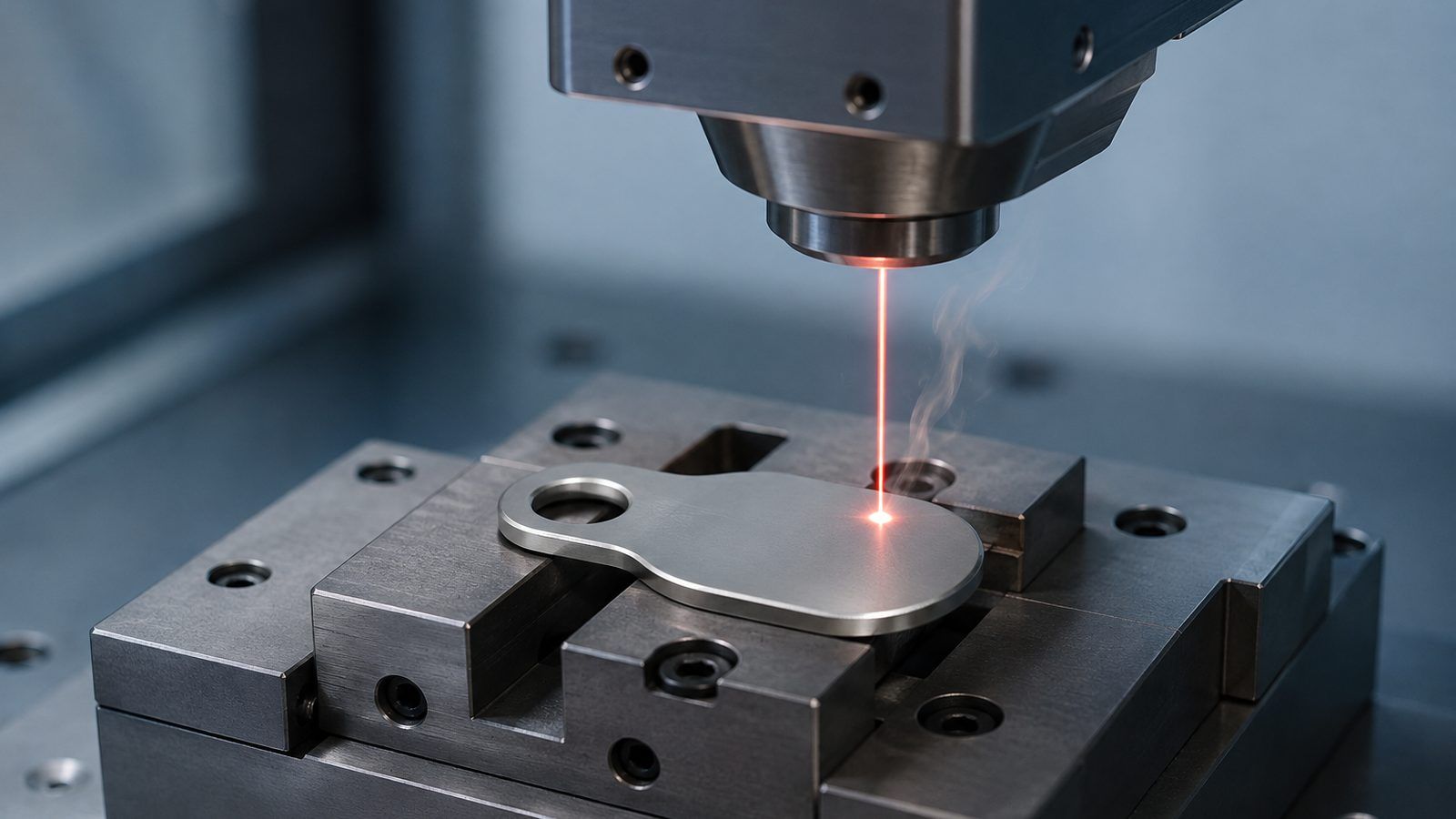
Private label pet hardware means one of two quite different things, and they cost very different amounts. Either you take a proven catalogue part and make it yours through finish, colour and a logo, or you develop a proprietary part on new tooling that no other brand can buy. The first is a purchasing decision; the second is a capital investment in dies that only repays itself across volume. Which route is right depends on your annual quantities, how much real differentiation the hardware buys you, and how much of the brand’s identity lives in the metal — and for most pet brands the honest answer is a branded stock part first, bespoke tooling later.
The customisation ladder for private label pet hardware
Knowing which rung you are standing on makes every conversation with a manufacturer shorter. From cheapest to most expensive:
- Stock part, custom finish or colour. No tooling, no engineering, no new part number at the factory. You are buying the same clip as everyone else in a colour they are not using.
- Stock part with a laser-etched or stamped logo. A small marking charge plus a one-off fixture or marking file. This is where most brands get the best return per dollar spent.
- Modified existing tooling. A changed eye, a wider throat, a longer body, a different gate profile. An insert is replaced or the die re-sunk locally rather than cut from scratch, so you get something competitors cannot order at a fraction of new-tool cost.
- Fully bespoke part on new tooling. Your drawing, your dies, your part number, and a validation programme to go with it.
Most pet brands should start on the second or third rung. Going straight to the top ties up cash in steel for a part you have not yet proven customers want.
How do you put a logo on metal without weakening the part?
Three methods dominate on small hardware, and the choice depends less on looks than on where the mark sits and what the part carries.
- Laser marking or etching. A fibre laser anneals a dark mark into steel, or ablates the dyed layer of anodised aluminium to reveal bright metal beneath. No dedicated tooling, fine detail, changeable between batches. Deep engraving removes material and is a machining operation, not a cosmetic one.
- Stamping or coining during forming. The logo is sunk into the forging or stamping die, so every part leaves the press branded at effectively zero unit cost. The trade-off is permanence: changing the mark means re-cutting the die or swapping an insert, and the detail must survive the material flow of the forming operation.
- Pad printing or infill paint. Cheap, full colour, and sitting on top of the surface — which means it abrades. Fine on a face that never rubs against webbing or a floor; a warranty problem on one that does.
The constraint designers most often miss is that a logo is a notch. An engraved or stamped feature on a load-bearing surface reduces the local cross-section and concentrates stress at its edges, and sharp-cornered characters are where fatigue cracks prefer to start. On a leash clip the tension path runs through the eye, the spine and the gate throat: keep marks off those faces, put them on the flat of the body or a non-structural swivel plate, and keep them shallow with rounded forms. If the mark cannot be moved, the part must be tested with the mark on it — our guide to strength testing and load ratings for pet hardware covers how.
Can colour and finish carry the brand on their own?
Often, yes, and it is the cheapest differentiation available. Aluminium takes sulphuric acid anodising and dye, giving an integral colour rather than a coating that chips; steel takes zinc or zinc-nickel plating, electroless nickel or an organic coating; stainless is normally passivated and left bright or bead-blasted matte. Our surface treatment guide covers the processes. Two points matter commercially.
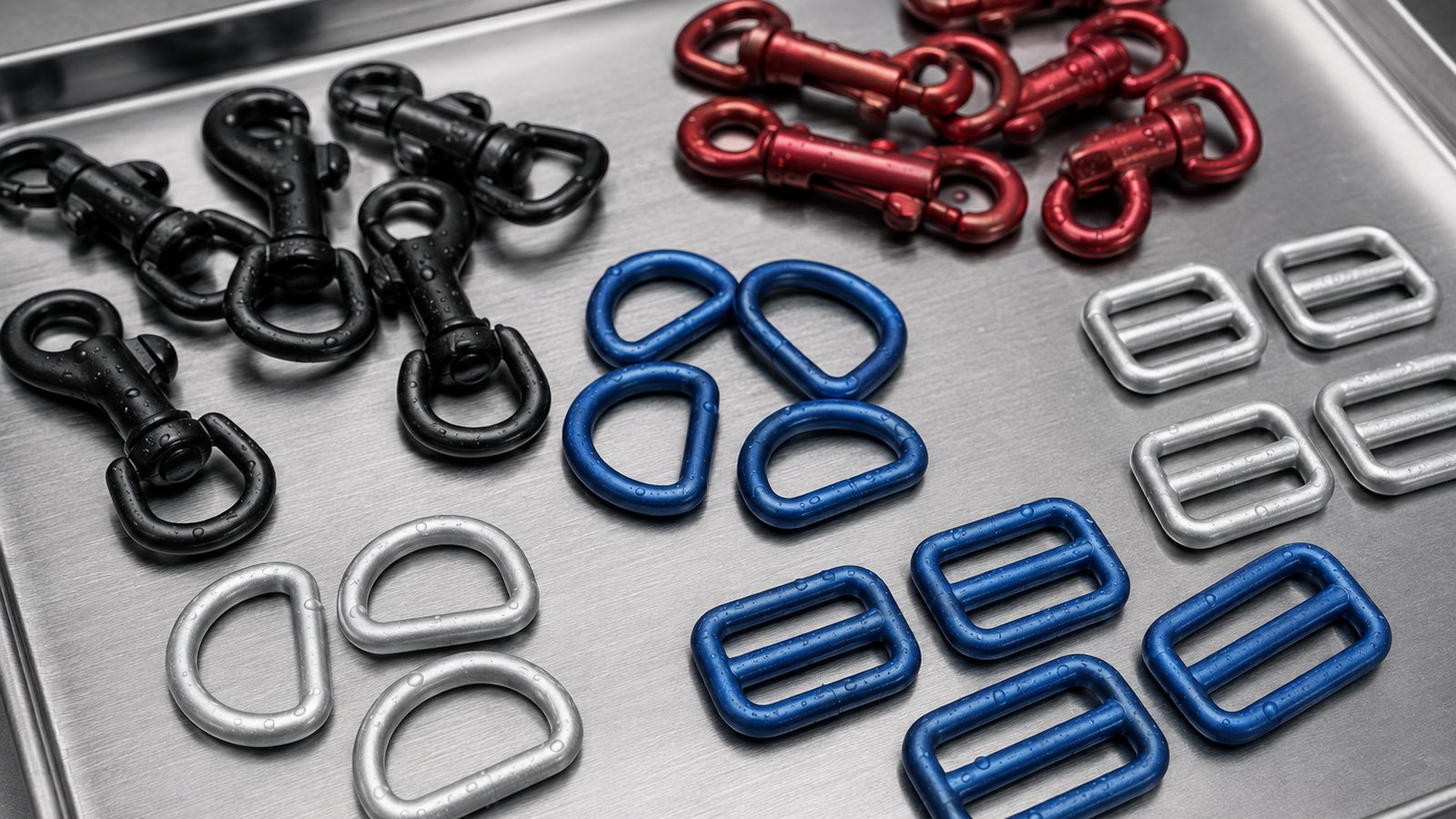
First, colour on metal is never as repeatable as ink on paper. Dye lots, bath age, alloy batch and temper all shift the result, and a hue that matched in March can drift by the autumn order. Specify a physical colour master with agreed light and dark limit samples, keep one set at the factory and one with you, and approve production against those under a defined light source rather than on a screen. Second, finishing grows the part: an anodic film forms partly into and partly out of the original surface, and plating adds thickness on every face. Close-fitting features — a gate swinging past a nose, a pin through a bore — need that allowance designed in.
What is tooling, and who owns it?
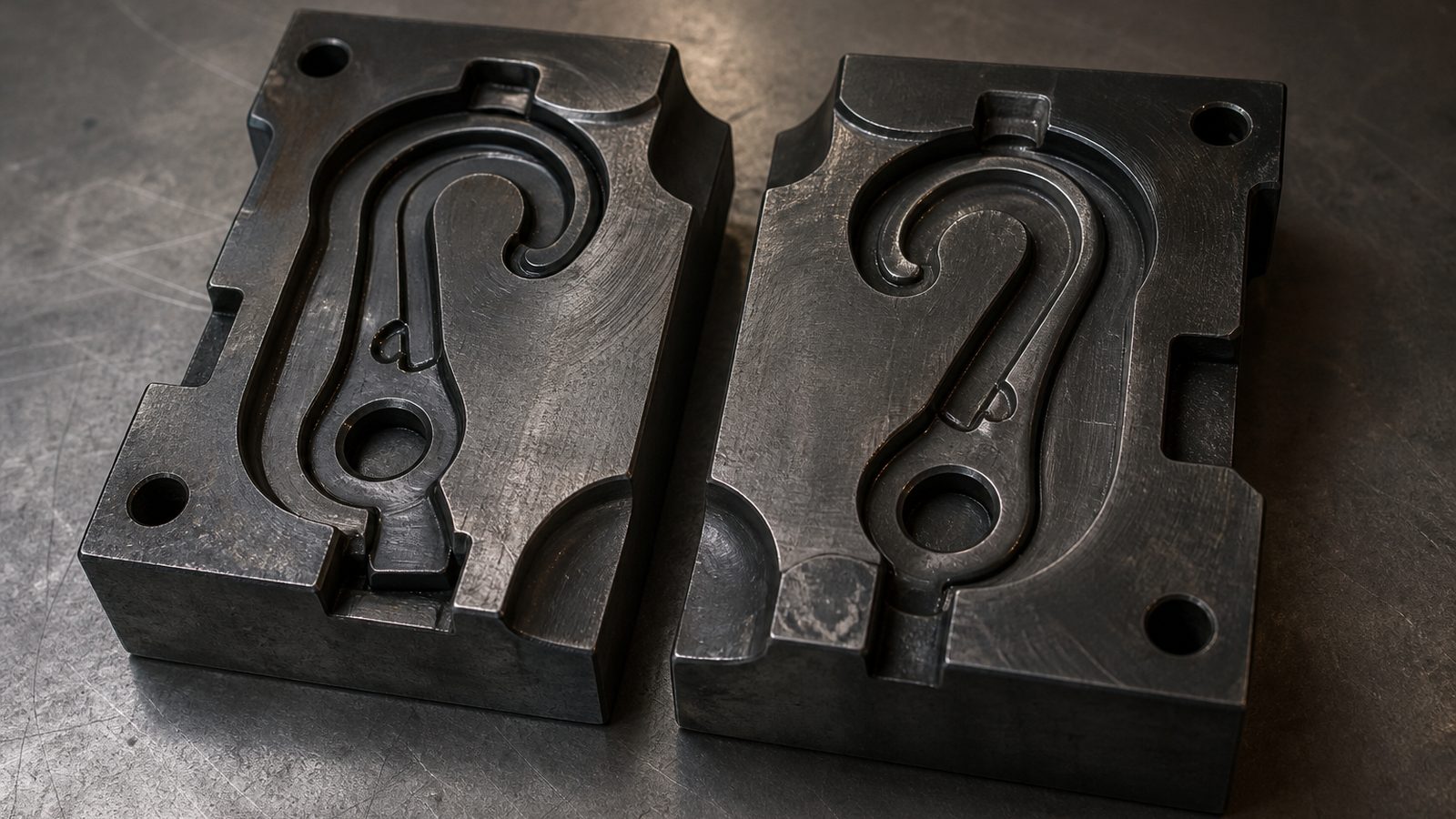
Tooling is the negative of your part cut into hardened steel. A forging die is a matched pair of tool-steel blocks with the cavity sunk into them, run hot or cold depending on material and geometry. Investment casting tooling is a die that injects the wax patterns, not the metal. A stamping die ranges from a single blanking station to a progressive die that forms, pierces and cuts off in one pass. All are cut, hardened, tried out and corrected before a single saleable part exists — which is why tooling dominates the up-front cost, and why the piece price falls with quantity as that cost spreads across more parts.
Ownership should be settled in writing before the first sample is cut, not after a relationship sours. Agree who pays for the tool, who owns it, where it is stored, who maintains and refurbishes it, what happens if you move production, and how long it is held after your last order. A tool you paid for but cannot move is not really yours. Put it in the same document as your drawing and quality requirements; the RFQ package guide on this site sets out what that should contain.
What does a realistic development programme look like?
- Concept and DFM review. Your sketch or model meets an engineer who says which features are expensive, what draft and radii the process needs, and where the part should split.
- Tooling design and first samples. The die is cut and tried out; early samples show real material flow, parting lines and dimensions.
- Pilot run. A short run on production tooling, in the production sequence, with production finishing.
- Validation testing. Strength, cycle life, corrosion and fit on the finished product, using pilot parts.
- Production, with the pilot data as the baseline for incoming inspection.
Skipping the pilot is where brands get hurt. Hand-finished samples always look better than the fiftieth part off a warm die, and the problems that only appear at volume — finishing variation, fixture marks, a spring that binds once the coating goes on — then surface after you have committed to a full order. Our design-for-manufacturing guide, the article on prototype-to-production risk and the piece on MOQs and pilot runs each go further.
When does custom tooling actually pay for itself?
Do the arithmetic before the emotion. Take the tooling cost, divide it by the number of parts you honestly expect to sell over the tool’s life — not the optimistic forecast — and add that to the quoted piece price. If the result is still competitive with the branded stock part you would otherwise buy, tooling makes sense; if not, you are paying for exclusivity, and should know that is what you are buying. Tooling earns its keep when a part is shared across several SKUs, when the geometry solves a problem no catalogue part solves, or when the hardware is a visible part of the product identity. It rarely does on modest, seasonal or single-SKU volumes, where a stock part in your colour with your mark on it delivers most of the perceived difference for a fraction of the cost.
Can a custom pet hardware design be protected?
Partially. A trademark protects your mark, a registered design or design patent protects the appearance of the part, and a utility patent protects a genuinely novel mechanism. None of them stops a competitor making a clip that does the same job in a slightly different shape, and cross-border enforcement is slow and expensive. In practice a distinctive functional geometry is a stronger moat than a logo: a copier must commission their own tooling and prove their own part, which costs them what it cost you. Tooling exclusivity written into the supply agreement — no parts from your dies sold to anyone else — is worth more than most brands realise.
What to bring to a first conversation with a manufacturer
- A sketch, a 3D file, or the physical sample you want to improve on.
- The target strength or working load, and any standard the finished product is sold against.
- Realistic annual volume and first-order quantity.
- A target landed cost, so the engineer can steer you to the right process rather than guess.
- Finish and branding intent: colour, mark, placement, and whether it must survive abrasion.
Bring those five and the first reply is an engineering conversation rather than a request for more information. The RFQ guide expands each into a full quotation request; the pet hardware OEM overview, the dog car restraint article and the guide to trigger snaps, bolt snaps and swivel carabiners cover the product side.
Working with Power Honour
Power Honour is a Taiwan-based OEM and ODM manufacturer with more than thirty years in safety-critical metal hardware, running forging, investment and gravity casting, stamping, CNC machining, heat treatment and surface treatment in-house under an ISO 9001 system. For a private label programme that means the tooling, the part and the finish sit with one supplier rather than being passed between a forge, a plater and a trading company. Send a drawing, a sample or a sketch with your target volumes, and we will tell you honestly which rung of the ladder your project belongs on.