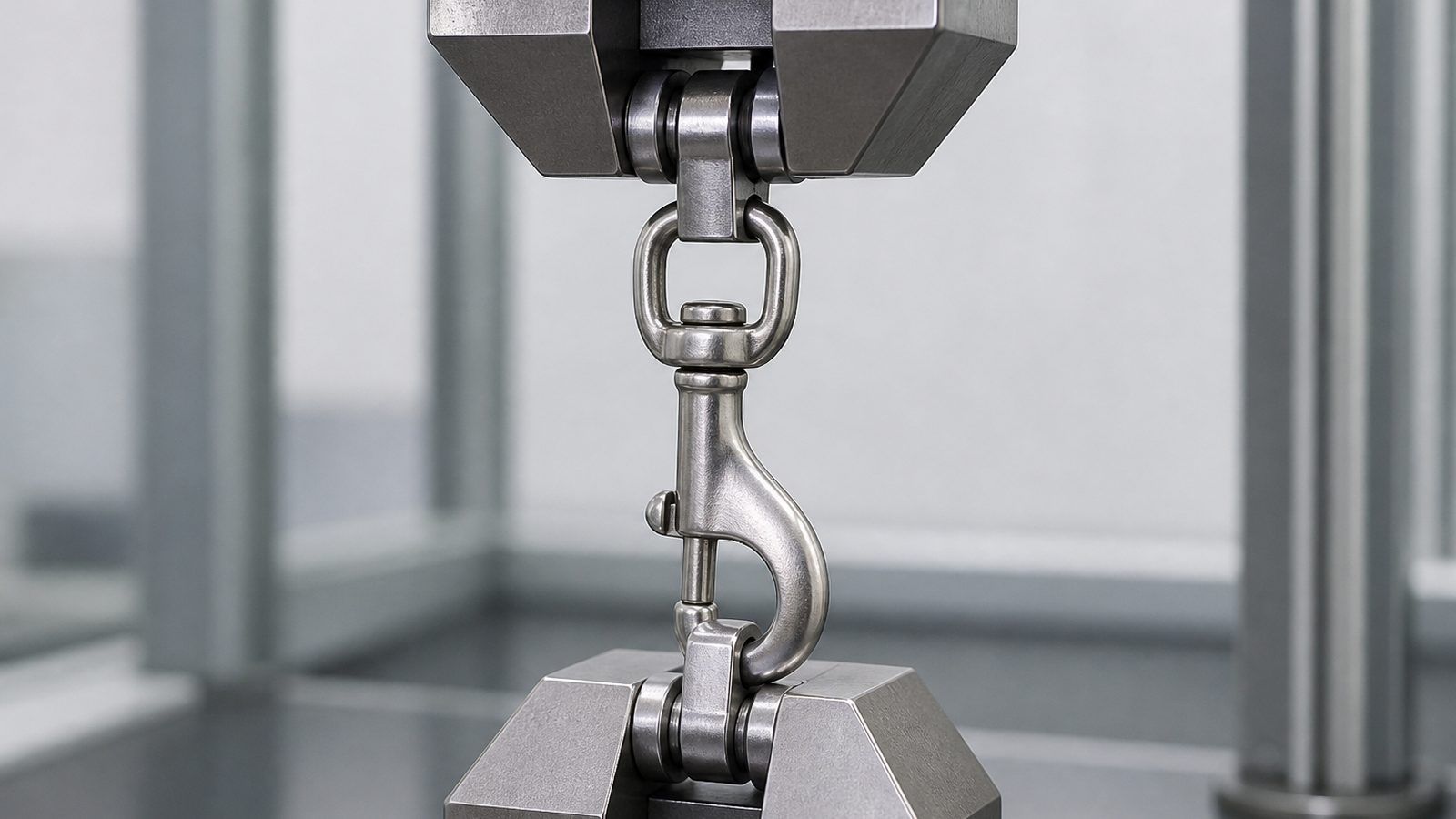
Dog leash breaking strength is a minimum breaking force, measured in a stated direction, on a stated number of samples, on a machine whose force reading is traceable to a calibration standard. A defensible specification reads roughly like this: the snap hook shall reach a minimum breaking strength of N kN pulled along its spine with the gate closed, on a load frame verified to ISO 7500-1 or ASTM E4, at a defined crosshead rate, five samples per production lot, peak force and failure mode recorded for each. Strip any of those qualifiers away and the number stops meaning much, because the same clip pulled across its gate rather than along its spine can let go at a fraction of the headline figure. And because there is no mandatory strength standard for pet hardware, the brand — not a regulator, not the supplier’s catalogue — has to set that floor.
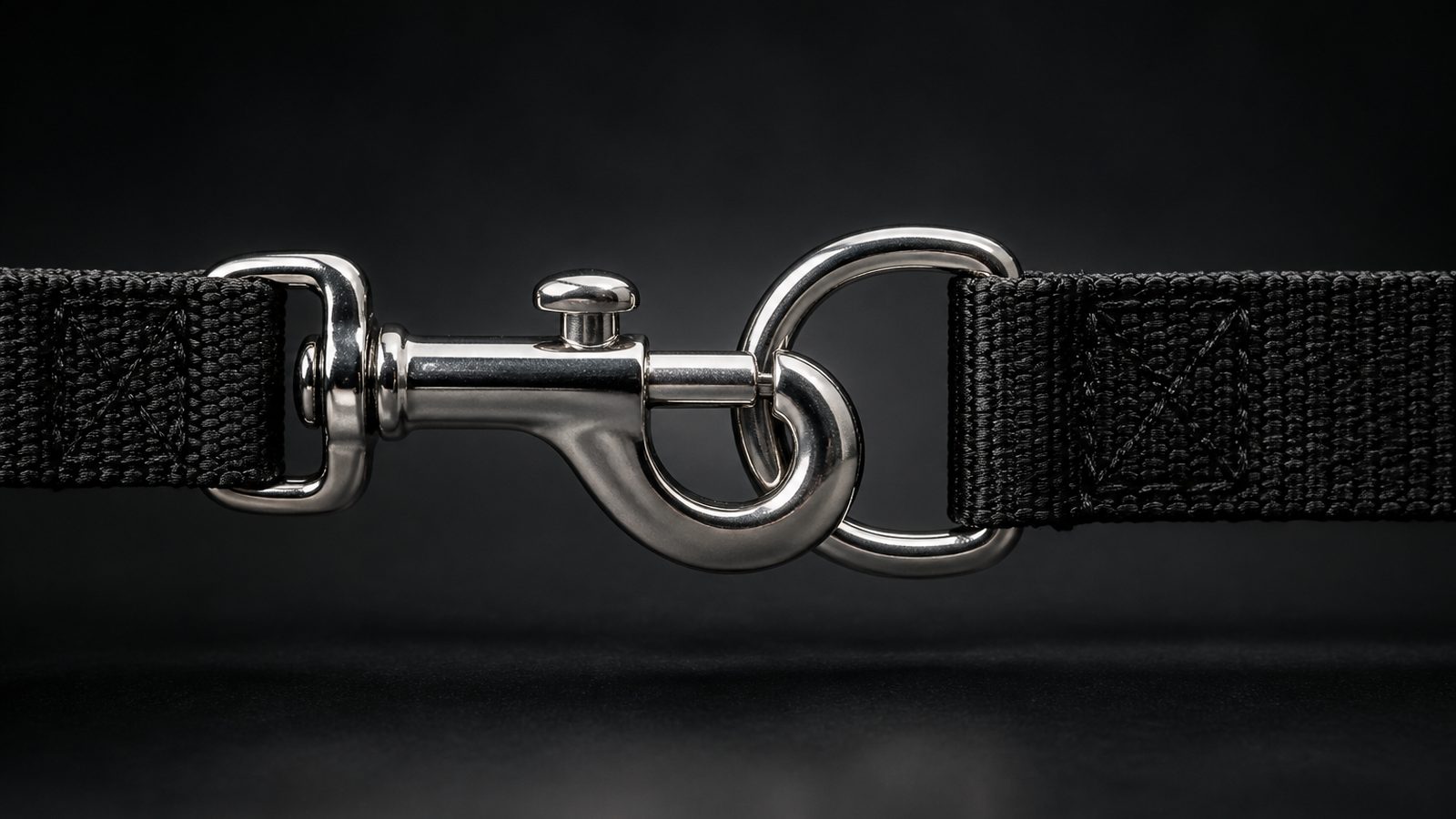
Is there a mandatory strength standard for dog leashes and collars?
No. Nothing in pet hardware corresponds to EN 362 for a fall-protection connector or EN 12275 for a climbing carabiner, where a stated kN figure, axis and test method are conditions of sale. Pet accessories sit under general product safety law instead: in the EU, the General Product Safety Regulation (EU) 2023/988, in application since December 2024, which requires a product to be safe without prescribing a breaking load for a leash clip. In the US the Consumer Product Safety Commission mostly acts after the fact. In September 2008 it recalled roughly 223,000 retractable dog leashes because the metal clasp could, in the Commission’s words, "bend or break while in use", letting the cord recoil into the handler’s face.
Voluntary standards are arriving. ASTM International’s consumer products committee F15 set up a pet products subcommittee, F15.05, which published F3725 for dog harnesses used in motor vehicles in 2025 — vehicle restraint and Center for Pet Safety crash testing are covered in a companion article — with work items in development for collars, harnesses and leashes. The direction of travel is clear, but today no brand can point at a published number and say the law demands it. That vacuum is why marketing figures here are unreliable, and why your own floor, written into the purchase order, is the only thing that makes a claim enforceable.
How strong does a dog leash clip actually need to be?
Stronger than the dog, by a margin you choose deliberately. Body weight underspecifies the part badly: a dog hanging from a hook is a static load, and almost nothing in service is static. A lunge is dynamic — the animal accelerates, the lead runs out, and that kinetic energy must be absorbed over whatever distance the system allows. A short, stiff lead stops the dog in centimetres and drives the peak force up; a longer lead or an elastic section spreads the event out and lowers it. The peak in a lunge is therefore a multiple of the dog’s weight, and the size of that multiple comes from geometry and stiffness, not from the animal. Anything involving a moving vehicle is another order of magnitude again.
Our kilonewton explainer covers the unit and the gap between minimum breaking strength and working load limit. Applied here, the method is: define the worst credible event for the product, set an MBS with real margin above it, name the loading direction, and say how many samples per lot must clear it.
What does a proper tensile test on pet hardware look like?
A calibrated load frame pulling one part to destruction while force and displacement are recorded, in fixturing that does not itself change the answer:
- Machine. Force-measuring system calibrated and graded to ISO 7500-1, or ASTM E4 in the United States, certificate in date and range suited to the load. A frame sized for structural steel resolves a 3 kN clip poorly.
- Fixturing. Pins, shackles or webbing loops must load the part the way service does. A hook pulled over a sharp undersized mandrel fails early; over a generous soft pin it fails late. Put the fixture on a drawing.
- Direction, orientation and crosshead rate, all stated. Without them two labs will not agree, and neither result is comparable to a competitor’s claim.
- Output. Peak force and failure mode, with a photograph of the broken sample. A peak alone hides how the part behaved on the way there.

Why does pull direction change the number so much?
Because a connector is a slender loop optimised to carry tension along its length, and loading it any other way puts a thin section into bending instead. Climbing quantifies this openly: EN 12275 requires a basic class B carabiner to hold 20 kN along its major axis with the gate closed, but only 7 kN across the minor axis and 7 kN with the gate open. Same part, about a third of the strength, purely because of direction. A leash bolt snap, trigger snap or swivel carabiner behaves identically — rotate it so the collar ring bears on the gate or latch and the load runs through a sprung component that was never a structural member. Most pet-hardware claims quote one number without saying which condition produced it, so asking for both separates suppliers who have tested from those who have not.
What must a batch test report contain to be worth anything?
Enough to tie the number to the goods in the container. One pull during development proves the design on that day, from that tool; it says nothing about a lot shipping eighteen months later on a different heat of steel. Destructive sampling belongs per production lot, backed by in-process checks and mill certificates traceable to the heat — the three-stage quality control and material traceability guides on this site cover those records. A report worth keeping shows:
- Part number and revision, and the lot or heat number the samples came from.
- Machine identification, calibration certificate number and expiry date.
- Pull direction, fixture, loading rate and any hold time.
- Sample size with every individual peak force listed, not an average and not the single word pass.
- Failure mode per sample, plus tester, date and signature.
Reports that prove nothing follow a pattern: no lot reference, so nothing connects the certificate to the shipment; a single specimen; a peak suspiciously identical to the marketing claim; a line reading test load applied, pass, with no recorded peak; a date earlier than the lot itself.
What do failure modes tell you, and why does corrosion count as one?
How a part lets go is as informative as the number it reached:
- Brittle fracture. A flat, granular break with no deformation, typical of zinc die-cast under shock. It arrives without warning and scatters widely between samples.
- Ductile yielding. The part stretches and necks before separating, typical of forged steel or properly heat-treated stainless. Safer: the hook visibly distorts, the owner sees it, and there is time before separation.
- Gate or latch deformation. The frame survives but the gate springs open under load, a functional failure well below frame strength.
- Spring fatigue. After thousands of cycles the spring no longer closes the gate, though a static pull still passes.
- Weld failure on a ring, or thread stripping on a screw gate. An unwelded D-ring is a light-duty part whatever its wire diameter.
Corrosion belongs on that list because it removes cross-section and creates crack initiation sites, and pet hardware lives in seawater, rain, urine and sand. Neutral salt spray testing to ASTM B117 or ISO 9227 exposes samples to a sodium chloride fog of about 5 percent at 35 degrees C, commonly for 24 to 1,000 hours. The criterion that matters is functional, not just visual: afterwards, does the gate close, does the swivel turn, does the part still make its breaking strength. Our surface treatment guide covers how plating and passivation drive that result.
What to write into the purchase specification
- Minimum breaking strength in kN or lbf, stated as a minimum, separately for spine-with-gate-closed and for gate or side loading.
- Test method: machine calibration standard, loading rate, fixture drawing, hold time.
- Sampling: samples per lot, acceptance rule, and the action when a sample fails.
- Records: report contents, retention period, and your right to witness testing or send parts for third-party retest.
- Corrosion and cycling: salt spray standard and duration, gate cycle count, functional acceptance.
- Change control: no change of material, plating, tooling or subcontractor without re-qualification.
Working with Power Honour
Power Honour has spent more than thirty years making load-bearing metal hardware to CE EN, UIAA and ANSI/ASSP Z359 test methods, with forging, investment casting, CNC machining, heat treatment, surface treatment and documented batch testing under one ISO 9001 system. The discipline behind a defensible kN figure on a climbing connector transfers straight to a leash snap, a collar ring or a harness buckle: same load frame, same lot traceability, same failure-mode records. Send us the drawing or a sample with the number you need to defend, and we will come back with the test regime and sampling plan we would build to.