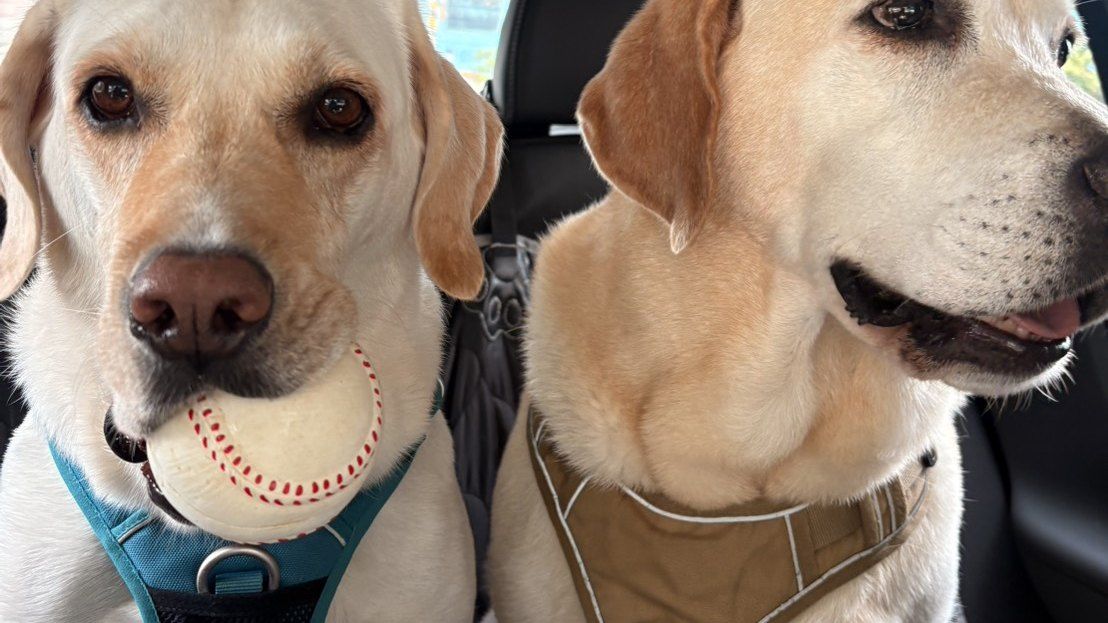
Dog car restraint hardware is the metal in the load path between a dog’s harness and the vehicle: the tether connector, the swivel, the seatbelt-tongue or LATCH attachment, and, on a zipline, the runner and its end fittings. Webbing spreads the load, but the metal carries it and transfers it into the car, so in a collision the connector and its anchorage decide whether the system holds. The bar is set by crash loads, not leash loads: AAA’s widely quoted figure is that an unrestrained 60 lb dog in a 30 mph impact generates roughly 2,700 lbf, around forty-five times its body weight. The only independent benchmark in the category is Center for Pet Safety (CPS) certification, a voluntary third-party programme adapted from the FMVSS 213 child-restraint protocol. There is no US federal safety standard for pet travel restraints, so an unqualified “crash tested” claim means only what the brand behind it decides it means.
What is actually in the load path?
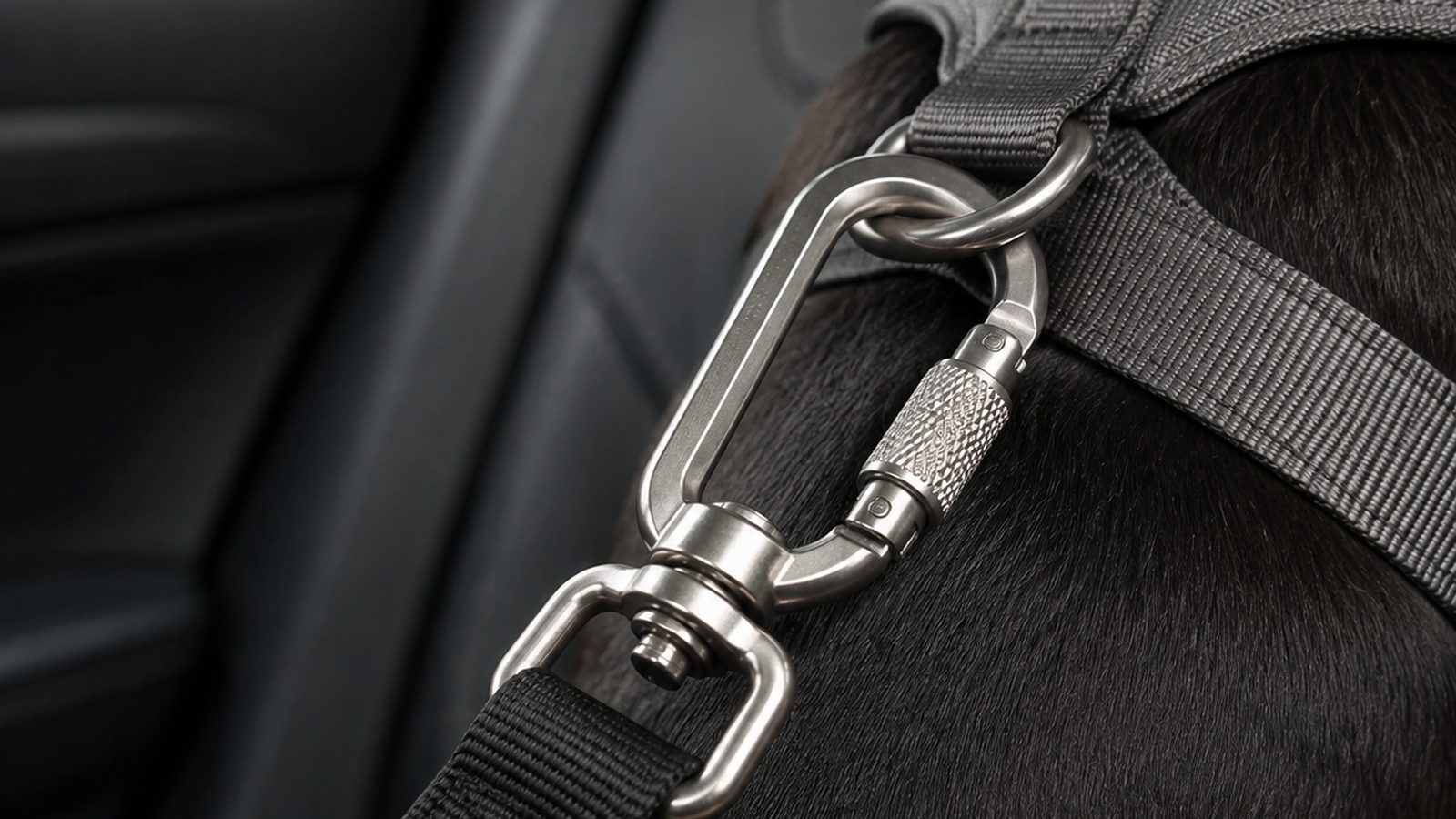
Four parts, and usually only one of them is specified properly:
- The harness attachment point: a D-ring or sewn webbing loop on the back or chest.
- The connector: a carabiner, snap hook or trigger snap, often with an integrated swivel. This one part concentrates the entire load.
- The tether webbing and its adjuster, typically 20-25 mm polyester through a metal or acetal slider.
- The vehicle attachment: a seatbelt loop, a moulded seatbelt tongue that clicks into the buckle, or a hook onto a LATCH or ISOFIX lower anchor.
A zipline adds a runner on an overhead line plus two end fittings clamping that line to fixed points in the cabin. Kurgo markets its Auto Zip Line with all-steel hardware and a swivel carabiner on the tether leg, a fair marker of where the category has settled.
Why crash loads, not walking loads, set the specification
Because the multiplier is essentially deceleration in g, and a 30 mph frontal impact decelerates the cabin far harder than any dog can pull. A hard tug on a leash is a fraction of body weight; a crash pulse is tens of g, so the same animal presents an effective load two orders of magnitude higher. AAA’s 2,700 lbf figure is body weight times peak deceleration, not a measured breaking load.
Two consequences follow. A walking-grade trigger snap does not become a restraint component by being sewn onto a tether. And the load arrives off-axis, because the dog is rarely aligned with the tether at impact, so the connector sees minor-axis and gate-face loading rather than the clean major-axis pull a catalogue rating describes. Our guide to kN ratings and working load limits covers why one headline number is the least useful figure on a spec sheet.
What does Center for Pet Safety certification actually test?
CPS is an independent US non-profit that publishes crash-test protocols for pet travel products and certifies specific models against them. Its Safety Harness Crash Test Protocol, published in 2014, is adapted from FMVSS 213, the federal child-restraint standard, borrowing its bench-seat fixture and roughly 30 mph (48 km/h) frontal sled condition. Weighted, instrumented canine simulants stand in for live animals. The protocol judges three things:
- Containment: the simulant must stay on the seat and stay connected before, during and after the event, not merely survive it.
- Excursion: how far it travels forward, against limits derived from FMVSS 213, which caps head excursion at 813 mm (32 in) for child restraints.
- Structural integrity: webbing and hardware must not fail to the point of separation.
Three qualifications matter commercially. CPS certifies by product category, principally harnesses, carriers and travel crates, and the certified list changes, so check the current one. It states that it takes no funding from pet product manufacturers, which is what gives the mark independence. And it is voluntary: participation signals a commitment to the protocol, to quality-control monitoring and to truthful marketing, not compliance with any law. A tether or zipline sold on its own generally falls outside the certified categories; Kurgo’s own page for the Direct to LATCH Swivel Tether says that product is designed to prevent distracted driving and is not crash tested.
If a standard now exists, why do crash-tested claims still vary?
Because the standard is voluntary. ASTM F3725-25, a consumer safety specification for dog harnesses used in motor vehicle safety, was published in 2025 by the F15.05 pet products subcommittee, and a further work item covering collars, harnesses and leashes is in development. Neither is law. Nothing stops a competitor printing “crash tested” after one sled run without following either, so a brand that has done the engineering still has to say which protocol it met. In the 2013 CPS harness study only one harness tested performed acceptably; the rest were judged insufficient in design, materials or overall performance. Any of them could have used the phrase.
A defensible claim therefore has to be defined by the brand: protocol, simulant masses, seat fixture, pass criteria, and the hardware specification underneath. That definition becomes a purchasing document the factory can be held to. The discipline lives in the specification, not the sticker.
Is the swivel a convenience feature or a structural one?
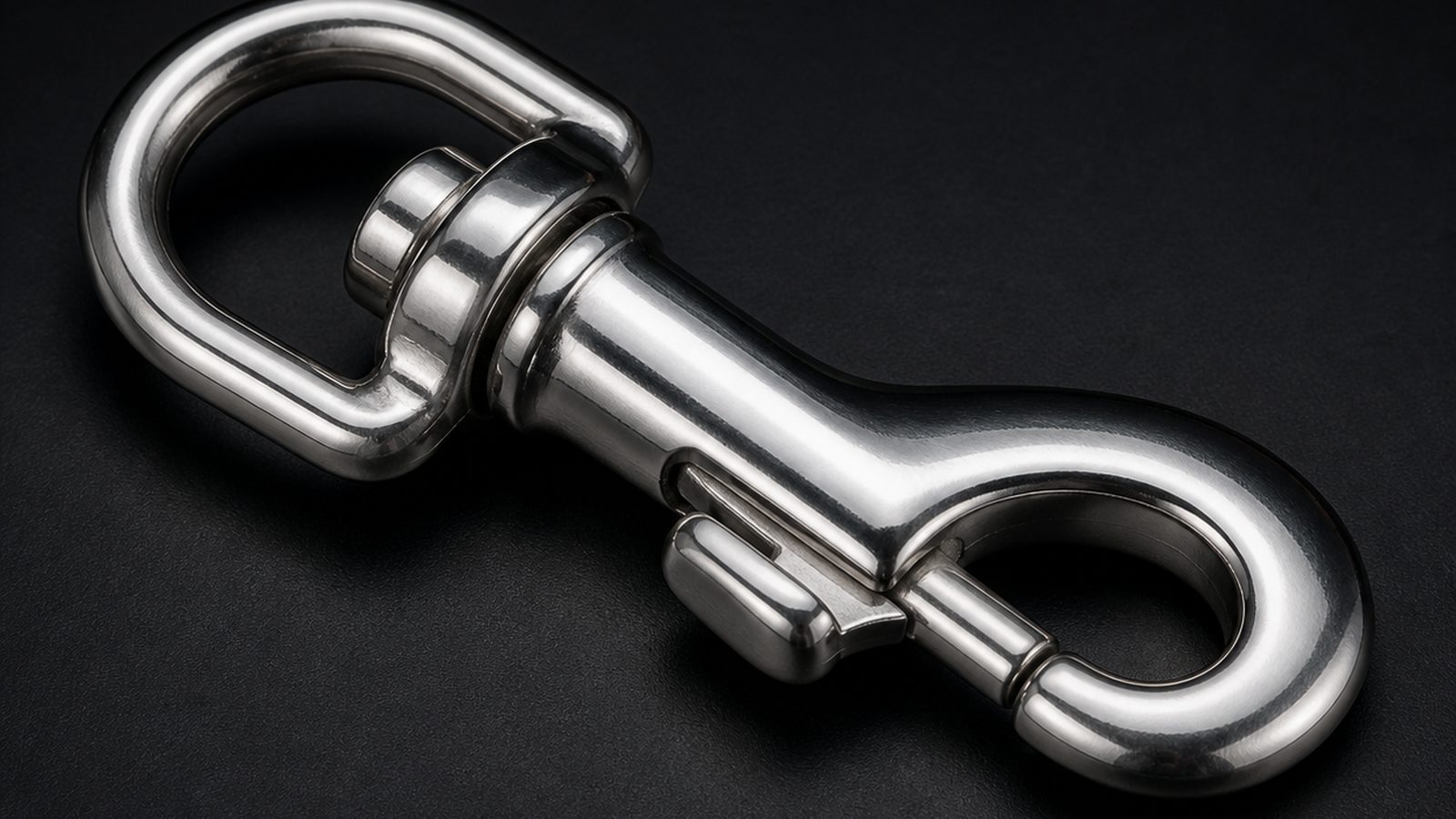
Structural. Marketing calls it tangle-free; mechanically it stops accumulated rotation reaching parts never designed for torsion. A dog turning in a seat winds the tether, and without a rotating joint that twist ends up in the gate hinge, the harness D-ring and the webbing adjuster, all of which lose strength loaded out of plane.
An under-specified swivel is worse than none, because it fails quietly. Kurgo markets its Swivel Tether around an anti-twist swivel and an aluminium screw-gate carabiner it describes as an arborist-grade leash latch withstanding up to 4,500 lb of force: a brand claim rather than a certified rating, but a useful marker of the stated bar. Specify a swivel rated to at least the connector’s own minimum breaking strength, rotation verified under load, and a bearing that survives grit and hair. Seizure is the realistic failure mode, and a seized swivel has turned the assembly back into a rigid tether while the label still promises otherwise.
Screw gate, auto-locking or trigger snap?
For a vehicle the failure mode that matters is not the connector breaking but the gate opening, so specify a gate that one accidental movement cannot release.
- Trigger or bolt snap: fast and one-handed, but a single spring-loaded action. A paw, a seat edge or the seatbelt webbing can roll it open. Fine on a leash, weak in a car.
- Screw gate: a manual sleeve, two deliberate actions, cheap and reliable. The weakness is the user, because a sleeve left unscrewed is just a snap hook.
- Auto-locking or twist-lock: self-closing and self-locking with no user step. Higher cost and more mechanism to validate over cycle life, but the safest default for a restraint clipped in a hurry.
Fall protection settled this argument long ago. EN 362 requires a connector gate to need at least two deliberate manual actions to open, and ANSI/ASSP Z359.12 loads snap hooks and carabiners to 16 kN (3,600 lbf) on the gate face and gate side and 22.2 kN (5,000 lbf) on the major axis, each held for a minute. A pet restraint does not need those figures, but it needs that logic: gate strength and minor-axis strength are separately specified numbers, not by-products of the headline rating.
What does the car environment do to materials and finish?
More than a leash clip ever sees, and in full view. A parked cabin in summer sun runs far above ambient, UV through glass degrades polymer sliders and coatings, saliva is mildly corrosive and constant, and owners clean with whatever is under the sink. Aluminium keeps weight and cost down and anodises well but is softer at the gate interface; stainless resists saliva and cleaners at more weight and cost; plated carbon steel is the cost option and needs a finish that genuinely survives salt spray and abrasion.
Cosmetic finish is a real requirement, not a nicety: this part is handled twice a journey and photographed for the product page, so plating blush, anodising streaks and forging flash become returns and one-star reviews. Agree limit samples before tooling is cut. Our separate guides to aluminium versus steel connectors and to anodising, plating and passivation go deeper into the trade-offs.
What to specify when sourcing dog car restraint hardware
- Minimum breaking strength with the direction stated. Major axis, minor axis and gate-open are three different numbers, and a supplier quoting one is quoting the flattering one.
- Gate strength as a separate held-load requirement, with a maximum permitted gate deflection.
- Swivel rating matched to the connector rating, plus rotation under load and a seizure check after a contamination cycle.
- Cycle life for gate and swivel, with a defined actuation count and a post-test inspection.
- Corrosion testing to a named method and duration, neutral salt spray to ISO 9227 being the usual baseline.
- Documented batch testing and traceability back to mill certificates, so a published claim can be reconstructed two years later.
- A written definition of your crash-test claim, if you make one: protocol, fixture, simulant masses, pass criteria.
Working with Power Honour
Power Honour forges and machines locking connectors, snap hooks and swivels for fall protection and climbing, manufactured to CE EN 362 and ANSI/ASSP Z359 under an ISO 9001 quality system. That is a directly transferable baseline for pet restraint hardware: gate mechanisms, swivel bearings, multi-axis strength testing and batch documentation are the same engineering problems at a different load level. Send us a drawing, a sample, or your target specification and the failure mode you are designing out, and we will come back with a manufacturing view and a quotation.