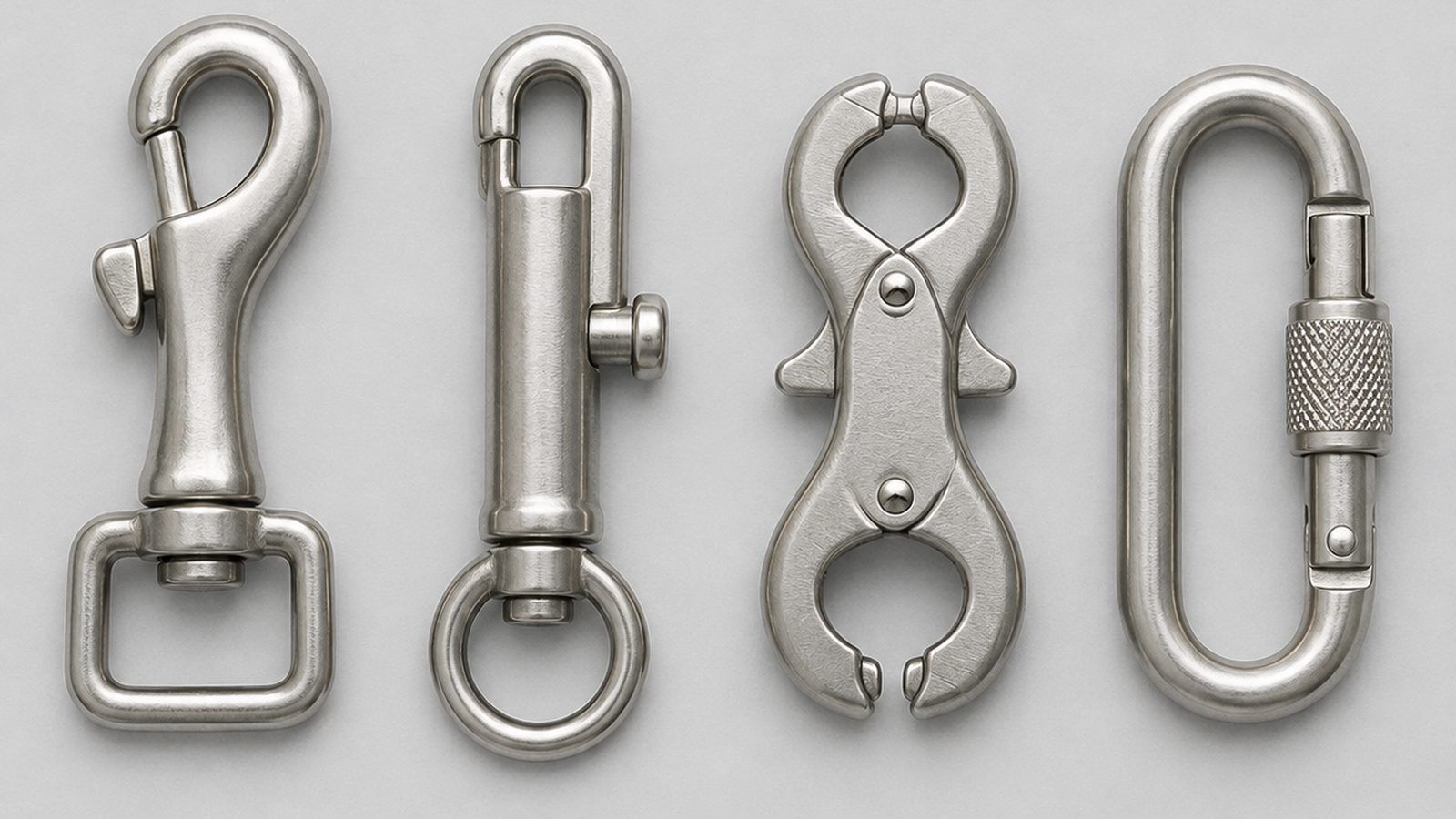
A dog leash snap hook comes in five practical families: the bolt snap and the trigger snap, both thumb-opened against a spring, which cover most leash clips sold; the swivel eye bolt snap, which adds a rotating eye; the scissor or bull snap, whose jaws close on each other; the frog clip, a side-lever hook for training leads; and the locking or screw-gate carabiner for large or escape-prone dogs. The strongest clip and the most convenient clip are not the same part: a locking carabiner carries the highest load for its weight but needs two hands, while the thumb-latch trigger snap is quickest to use and easiest to defeat, because one light gate on one small spring closes its throat.
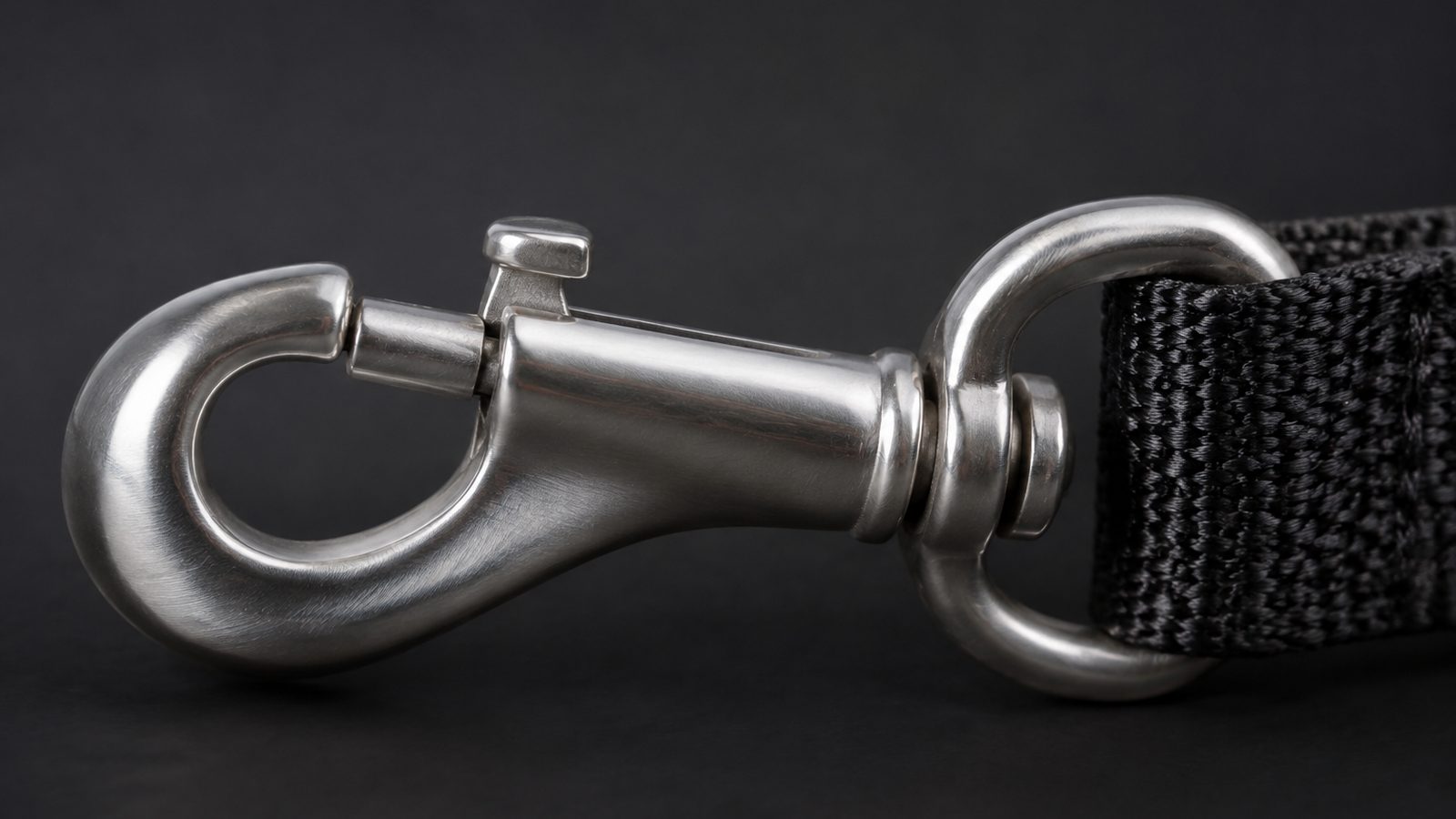
Which dog leash snap hook type should you specify?
Specify by how the gate works, not by trade name — suppliers swap trigger snap and bolt snap inside one catalogue. Each mechanism has its own failure mode:
- Bolt snap — a barrel body with a spring-loaded bolt sliding along its axis. Cheap, standard on light leads and bag straps. The bolt is a small pin on a shallow shoulder, so it is the weakest family at a given size, and the bore traps grit.
- Trigger snap — a hook body with a thumb-pressed pivoting tongue. Stronger at the same size, because load runs through the body and the gate only closes the throat. It fails by being levered open against a crate bar.
- Scissor or bull snap — two jaws hooking under each other, so the closure sits in shear across two members instead of one gate. Much harder to snag open, but heavier, and the pivot collects grit.
- Frog clip — one hook, a wide throat, a side lever. Fast onto a harness ring and easy with gloves; the exposed lever can be knocked open.
- Locking carabiner — a screw-gate or twist-lock sleeve over the gate, the strongest family and the answer for a powerful dog. But a pet carabiner is not a climbing carabiner: unless genuinely certified, packaging must not imply EN 12275 or UIAA approval. Our aluminium-versus-steel carabiner guide covers the climbing product.
Unlike PPE connectors, qualified to EN 362 or ANSI/ASSP Z359.12, pet leash hardware has no mandatory strength standard. The rating on the box is whatever the brand chose to test to, so the test method belongs in the specification.
Why the spring is the part that fails first
The body sees one peak load rarely; the spring is cycled several times a day for years in rain, salt, sand and urine, thin in section and highly stressed. Plated carbon-steel spring wire, music wire to ASTM A228, is cheap and strong and corrodes fast once the plating is scratched at the coil contacts. Stainless in AISI 302 or 304 is the normal upgrade, 316 for coastal lines; it gives up load capacity at the same wire diameter, so allow heavier wire or a longer spring. Geometry counts as much: a torsion spring on an exposed pivot sheds grit, while a compression spring in a blind bore packs with sand until the gate no longer travels its full stroke. A gate that closes ninety percent of the way is an open gate.
Swivel eye or fixed eye: what does a swivel actually solve?
A swivel solves torque, not load. A dog circling on a lead feeds twist into the line continuously; with a fixed eye it accumulates, shortening the lead, hardening the lay of a rope handle and working the stitching. A swivel eye rotates on a post captured in the body — a riveted or staked shoulder, sometimes a shouldered pin on a washer.
Cheap swivels seize predictably: metal-on-metal faces with no thrust washer, plating built up inside the joint, staking pulled too tight, or hair and grit packed into a joint that cannot be flushed. A seized swivel is worse than a fixed eye, because the brand promised rotation and the owner stopped watching for twist. Specify a generous thrust face, a washer where budget allows, and a joint that can be rinsed. Almost no small swivel turns under high load; they work while the line is slack, which is enough.

D-rings and O-rings: why an unwelded ring quietly opens
How the ring is made decides its strength almost completely:
- Bent and unwelded — bar bent to shape, ends butted. Under load the ring straightens toward the load line and the joint springs apart: it does not snap, it splays, and the clip slides out. Plating hides the joint, so it looks identical to a welded ring — the most common silent failure point in cheap collars.
- Bent and welded — the joint is resistance or flash welded, then dressed. A sound weld is strong, but lack of fusion is invisible once the flash is gone. Pull samples with the weld at maximum bending.
- Forged — one piece, grain flow following the shape, no joint. Strongest for its weight, which is why fall-protection D-rings are forged.
- Investment cast — also jointless, usually 304 or 316 stainless, for complex sections or corrosive service. No grain flow, so strength depends on casting soundness; specify a porosity limit.
Then pick the shape for the load path. A D-ring holds the clip on the straight bar, putting it into bending and making the corners critical. An O-ring lets the clip self-align with a shifting dog, but wears one spot of webbing.
Tri-glides, buckles and sizing hardware to the webbing and the dog
Webbing slip is a hardware geometry problem, not a webbing problem. A tri-glide holds by friction generated in a double reverse bend, and that friction depends on bar diameter relative to webbing thickness, bar spacing and surface texture. Bars too large in diameter or too highly polished let webbing creep; too small a radius cuts it at the fold. Match the slot to the webbing within about a millimetre, or the webbing turns on edge and works out. The trade stocks hardware around 10, 15, 20, 25 and 38 mm, so a bespoke width forces bespoke tooling. Cam buckles grip harder because the cam bites, but the teeth abrade webbing. Metal side-release buckles fail by the leg springs taking a set, so route the leash load through a ring where the design allows.
Size hardware to the peak dynamic load, not the dog’s body weight — a medium dog hitting the end of a fixed lead at a run generates several times its static weight in milliseconds. Oversizing is not free margin either: a heavy snap hangs at the chest, costs more and rattles. Undersizing moves the failure to the smallest section.
Why two identical-looking leash clips differ hugely in strength
Because the same outline can be made four ways, and the difference is invisible in a photograph. A zinc die-cast body reproduces crisp detail, plates beautifully and costs little; zinc casting alloys run around 300 MPa tensile, creep under sustained load and are brittle in impact. A quenched and tempered carbon steel forging of the same shape is commonly two to three times stronger and does not creep. Stamped-and-welded rings depend on a weld; forged rings have none. An investment cast swivel housing buys an internal shoulder that would be costly to machine, and machined gates and turned pins buy the consistent gate clearance that decides whether a clip can be levered open.
So put the process on the drawing, not only the finish. Two suppliers quoting one inch trigger snap, nickel plated can ship parts of completely different strength, and the cheaper one often looks better in the sample box. Our articles on hot versus cold forging, on stamping versus machining, and on materials for safety hardware go further.
A dog collar hardware spec checklist for your RFQ
- Clip family and gate mechanism, named and drawn: thumb-latch trigger, sliding bolt, scissor jaw, frog lever, screw-gate.
- Forming process and alloy per part — forged, investment cast, die cast, stamped and welded, or machined — with temper.
- Spring material, wire diameter, and a gate cycle-life target.
- Breaking strength target and pull direction: along the spine gate-closed, and side-loaded where geometry allows.
- Ring construction, with a pull direction that loads the joint or weld.
- Webbing width and thickness, with matching slot dimensions for every tri-glide, slider and buckle.
- Finish, a salt-spray target in hours, and whether finish may enter pivots and bores.
- Marking and logo position, for private-label lines.
Working with Power Honour
Power Honour has spent more than thirty years making load-bearing metal hardware for climbing and fall protection, where a connector survives a certified pull test before it ships. Forging, investment casting, stamping, CNC machining, heat treatment and finishing sit in-house under one ISO 9001 system, so a clip body, its gate and its rings can each be routed to the process that part actually needs. Send a drawing or sample of the leash, collar or harness line you are developing, and we will come back with a process route, a material recommendation and an RFQ.