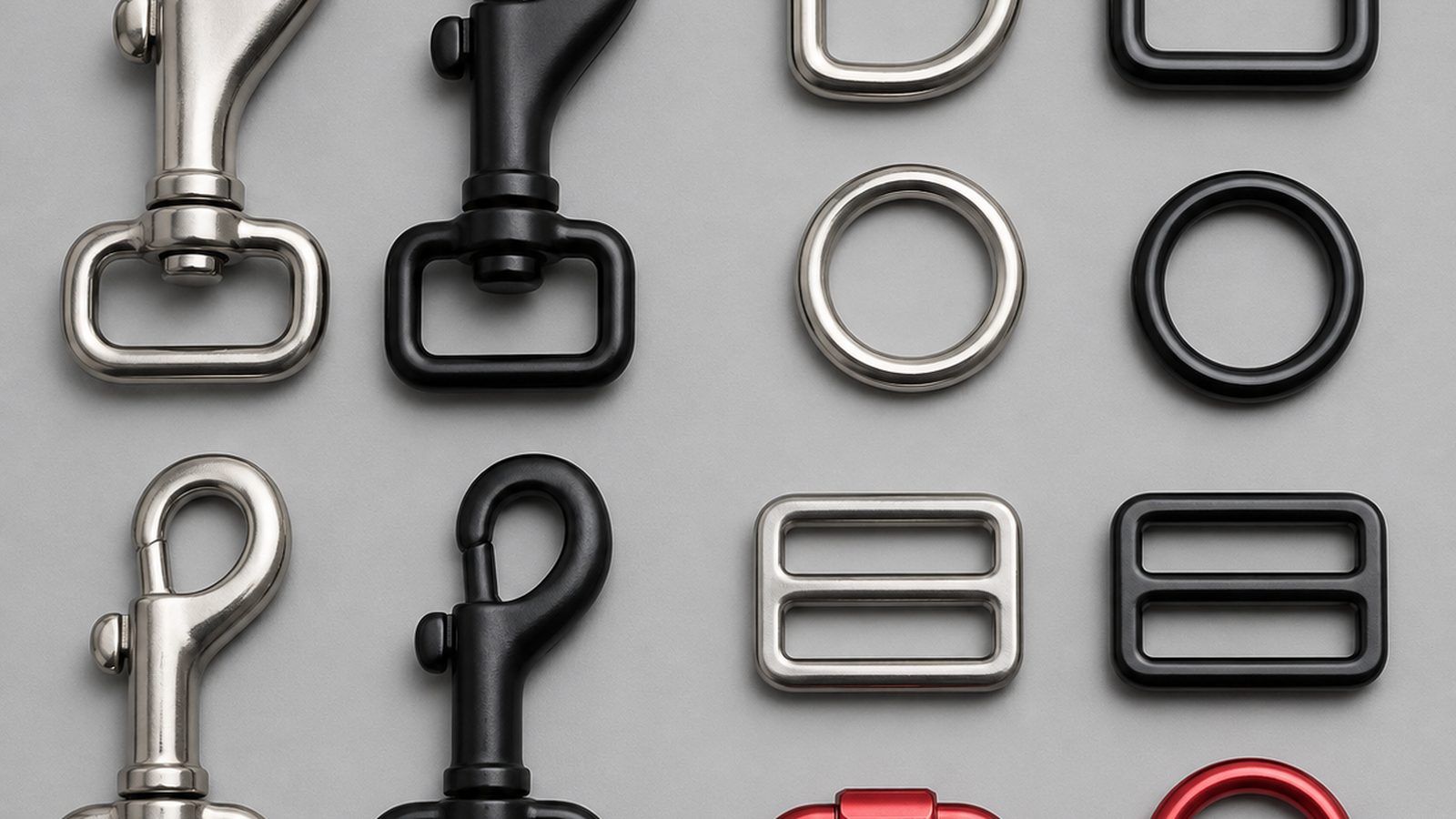
A pet hardware manufacturer makes the load-bearing metal in leashes, collars, harnesses and vehicle tethers: trigger and bolt snaps, swivels, locking carabiners, D-rings and O-rings, tri-glides and sliders, buckles and tie-out hardware. Almost every pet brand sews its own soft goods and buys all of that metal outside, which is why hardware is the least-specified part of the product and the first to fail. These parts are close relatives of climbing and fall-protection hardware: the same forged bodies, gate mechanisms and swivel geometries at lower loads. Hence the PPE language premium brands now borrow: Kurgo sells a car tether with an arborist-grade latch rated to 4,500 lb, which is simply 20 kN, the minimum major-axis strength EN 362 demands of a class B fall-protection connector.
What counts as pet hardware?
Pet hardware is everything on a leash, collar, harness or tether that is not webbing, leather, thread or plastic. A premium leash carries four to six such parts; a harness a dozen.
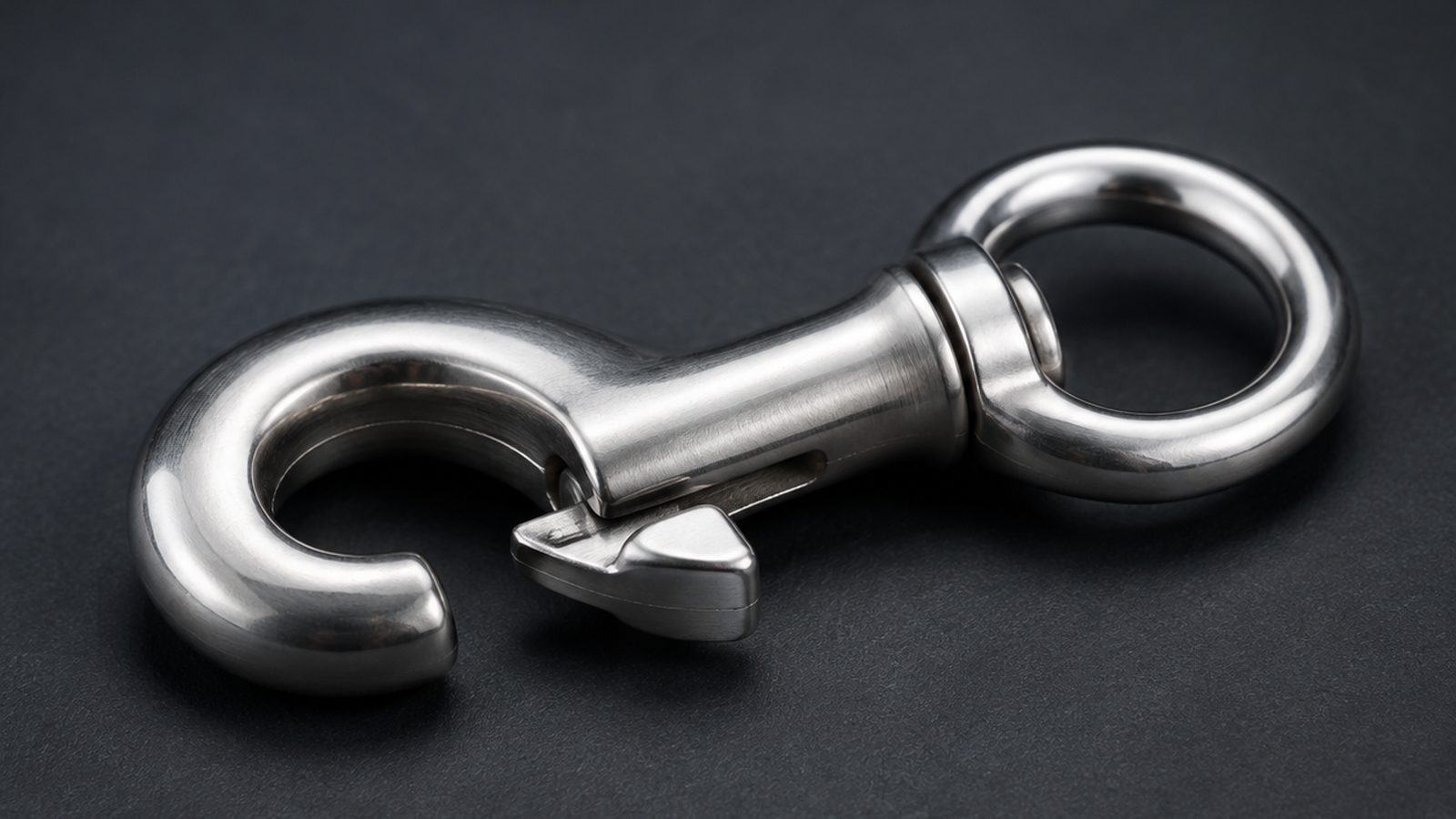
- Snaps and clips — trigger snaps with a thumb-lever gate, bolt snaps with a sliding bolt, fixed- and swivel-eye variants, and locking or screw-gate carabiners
- Swivels — barrel assemblies that let a rotating dog untwist the lead rather than load the stitching
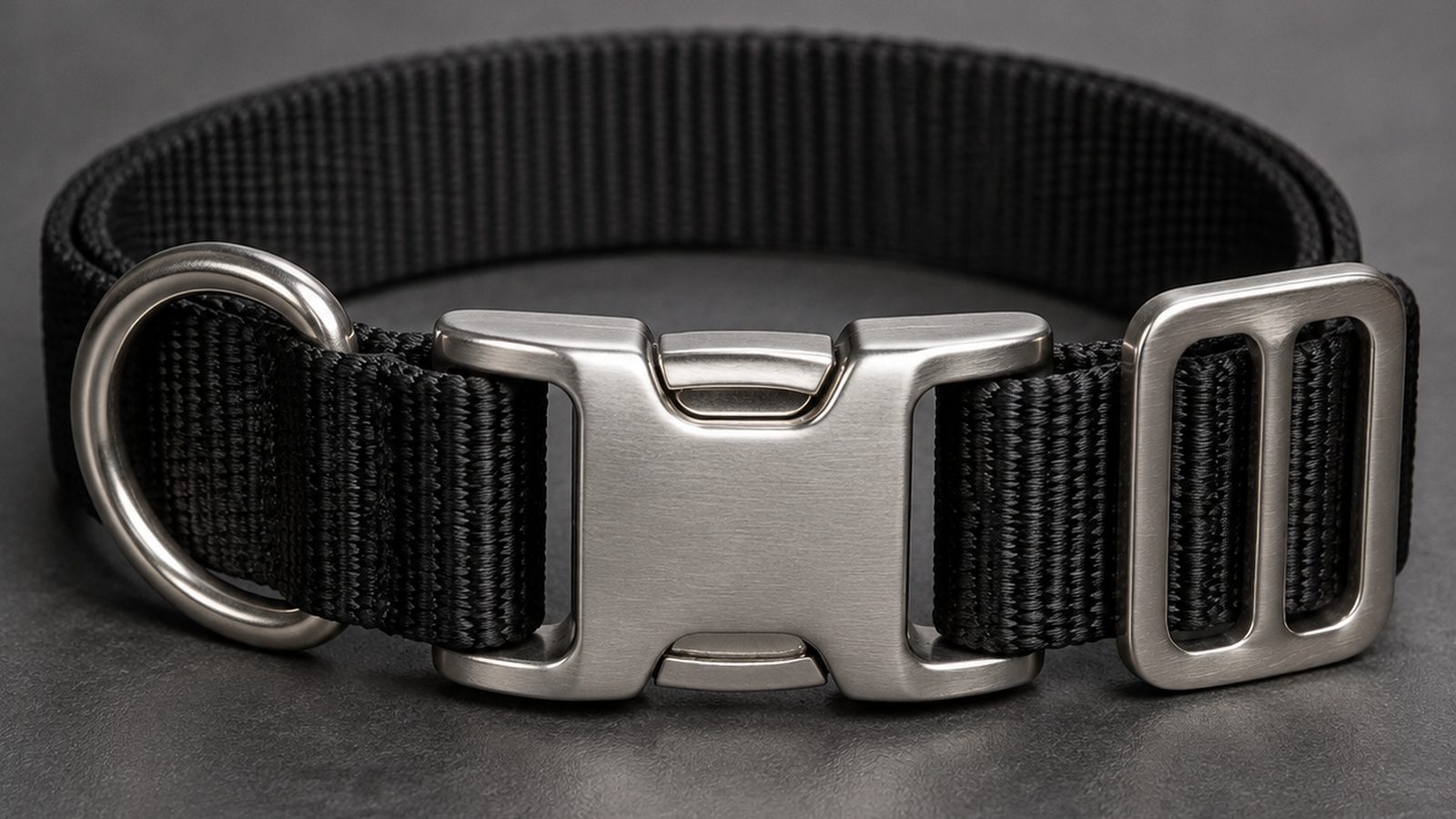
- Rings — welded D-rings, O-rings and triangle rings anchoring the leash to collar or harness
- Adjusters — tri-glides, ladder locks, sliders and keepers that set fit and hold it
- Buckles — side-release buckles, nylon on most lines and metal on premium ones, plus cam types
- Tie-out and zipline hardware — swivel stakes, trolleys and heavy snaps under sustained static load
None of it is made in-house, so the decision gets made on price per piece and lead time rather than a written specification — and the buyer owns a failure mode nobody engineered.
How is pet hardware made, and why does the process matter?
Each part type maps to a forming process, and the process decides how the part behaves when overloaded. Flat parts — rings, tri-glides, sliders — are stamped from strip on a progressive die, correct wherever strength comes from cross-section not geometry. Load-bearing bodies — snap hooks, carabiner frames, swivel yokes — are forged, hot or cold depending on alloy and shape. Complex bodies uneconomic to forge, such as swivel housings, are investment cast. CNC machining then cuts what needs precision: gate pivot bores, thread forms, detent pockets, latch seats. Heat treatment and finishing close the sequence. Separate guides cover forging methods and the stamping-versus-machining trade-off.
The difference between a forged snap and a zinc die-cast one is not marketing. Forging deforms solid metal so the grain flows around the loaded contour of the hook, and a steel part that yields before it breaks gives warning: a hook that opens slightly, a gate that stops seating properly. Zinc die-casting alloys such as Zamak melt below about 390 degrees C, so they cast cheaply into intricate shapes, but the result has porosity at the thermal centre and no grain flow. It fails brittle and without warning, at the gate root or the eye — the difference between a customer noticing a problem and a customer losing their dog.
Which materials belong in which pet products?
Material choice is driven less by strength than by corrosion, weight and cost: loads are modest, the environment hostile — saliva, salt water, sand, road salt.
- 304 stainless steel — the default for rings and adjusters. Good strength, nothing to wear off
- 316 stainless steel — adds roughly 2 to 3 percent molybdenum, which buys real chloride resistance. Worth specifying on coastal, marine and hunting lines, not across the range
- Zinc alloy (Zamak) — cheap, castable, easy to plate, and fit only for decorative parts. It has no place in a snap gate or a tether latch
- Brass — traditional on collars and tags, corrosion-resistant but soft and heavy; keep to low-load parts
- Aluminium 6061 and 7075 — where weight matters. 6061-T6 is general-purpose; 7075-T6 is roughly twice as strong and is what makes a light locking carabiner possible
- Carbon steel — strong and cheap, but wholly dependent on plating, so a poor fit for anything a wet dog wears
What actually goes wrong with cheap pet hardware?
Gate failure comes first: a die-cast trigger snap whose gate root cracks, or a spring that takes a set and stops closing, leaving the dog on an open hook. Then corrosion — rust bleeding onto light webbing after a few beach walks, and stainless that turns out to be a low-grade 200-series substitution rather than the 304 on the purchase order. Swivels seize when grit and salt enter an unsealed barrel, after which every twist of the lead loads the stitching. Plating wears through within a season, reading as a cheap product long before anything breaks.
The commercial weight is unlike most consumer hardware: a failure here does not generate a warranty claim, it generates a loose dog beside a road and a review that names your brand. Enforcement is thin — the US Consumer Product Safety Commission has recalled retractable leashes whose metal clasp could break and strike the handler in the face, and the trigger was injury to the person, not risk to the animal.
Is pet hardware regulated?
Largely, no. There is no mandatory strength standard for a dog leash clip comparable to the way EN 362 governs a fall-protection connector or EN 12275 and UIAA govern a climbing karabiner. CPSC authority in the United States is built around injury to people, so pet products sit largely outside it. ASTM International has formed a pet products subcommittee, F15.05, and is developing consensus standards beginning with dog toys and vehicle restraints, but they are voluntary and still maturing. Independent crash testing by the Center for Pet Safety is the nearest thing to an outside floor; a companion article covers it.
This cuts both ways. Nothing forces a minimum, so a supplier can ship a 40 lb clip on a product marketed for large breeds and break no rule. Nothing stops a brand setting its own floor either — which is where a PPE background earns its place. EN 362 is demanding: a class B connector must hold 20 kN on the major axis with the gate closed and locked, 7 kN on the minor axis, and still open, close and lock after being loaded to 6 kN for 10 seconds. A factory working to that baseline needs no persuading to run destructive batch tests on pet snaps.
What should you specify when sourcing pet hardware?
Write a specification, not a sample approval. A sample tells you what one part looked like on one day.
- Material and temper by designation — 316 rather than stainless, 6061-T6 rather than aluminium, with a mill certificate or positive material identification
- Minimum breaking strength and how it is verified — sample size per lot, test direction, and whether the number is a breaking strength or a working load limit. Our kN rating guide explains why conflating those is dangerous
- Finish and corrosion — plating type and thickness, a neutral salt-spray duration to ASTM B117, and passivation for stainless
- Gate and latch cycle life — agreed open-close cycles with the spring still returning the gate fully, since spring set fails in the field more often than fracture
- Cosmetic and colour consistency across lots — the hardest thing to fix once tooling is cut
- Branding — logo placement and method: laser marking, engraving or a tooled-in feature
Two get fuller treatment elsewhere on this site: snap selection, and strength testing.
OEM or ODM for a pet brand?
With drawings and a specification you are buying OEM. With a requirement but no design — a locking snap at a given strength, finish and weight — an ODM arrangement lets the manufacturer engineer it around existing tooling, usually faster for a first line. Our OEM versus ODM guide covers tooling ownership; a companion article covers private-label pet hardware development.
Working with Power Honour
Power Honour has spent more than thirty years forging, casting, machining and testing safety-critical connectors for climbing, fall protection and industrial PPE, to CE EN standards, UIAA and ANSI/ASSP Z359 under an ISO 9001 quality system. Pet hardware is the same engineering at lower loads, through the same in-house chain of forging, stamping, investment casting, CNC machining, heat treatment and finishing. We welcome enquiries from pet brands and wholesalers developing hardware they can genuinely specify. Send a drawing, a sample, or a target breaking strength and finish, and we will return a manufacturing route and an RFQ.