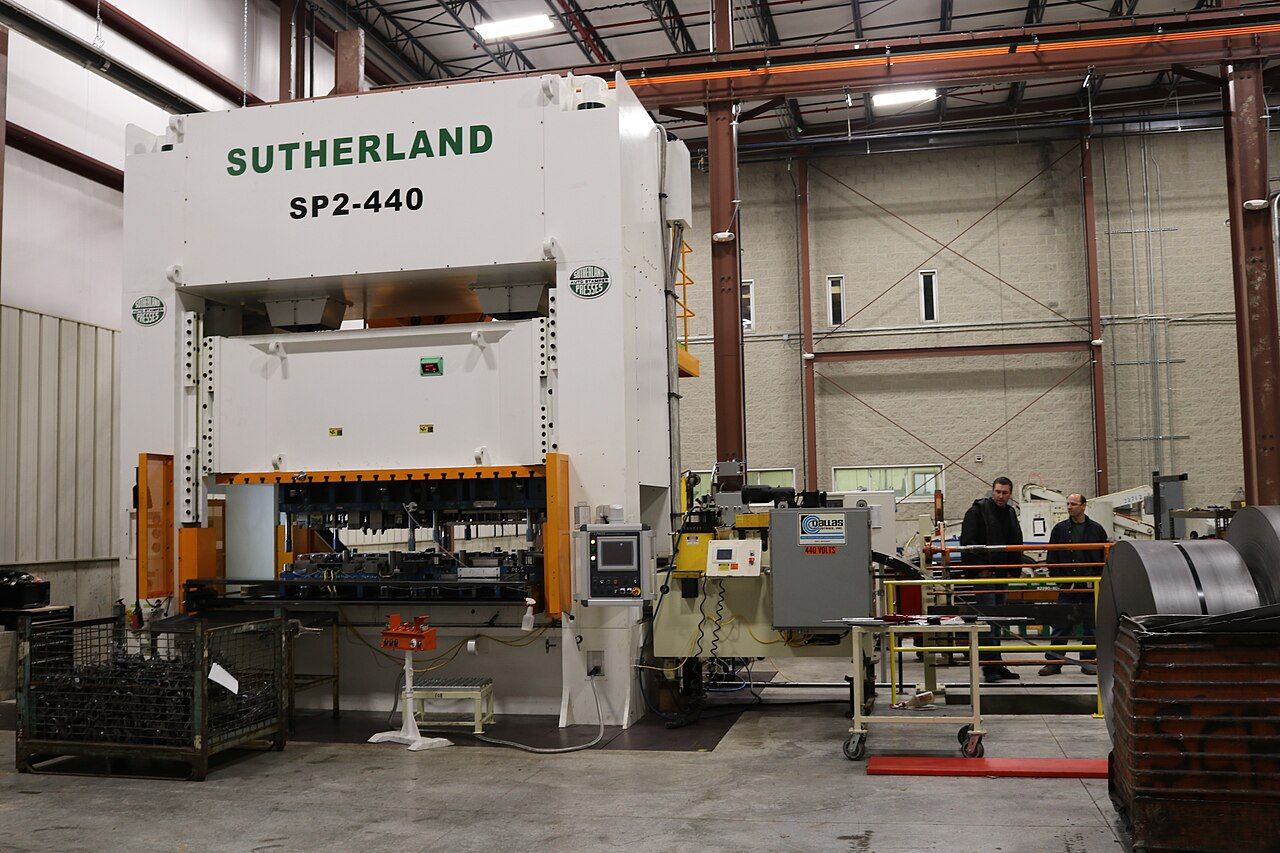
Metal stamping forms sheet metal between a punch and a die under a press rather than cutting material away, which is why the piece price is very low and the tooling cost is high. That makes stamping versus machining arithmetic rather than preference: a die is paid for once and amortised across every part it makes, while a machined part carries its full cycle time on every piece. The crossover comes when die cost divided by expected lifetime volume falls below the per-piece saving stamping delivers. Below that volume, machine it; above it, stamp it.
How does metal stamping work, and what are the main operations?
A press drives an upper tool into a lower tool with the workpiece trapped between them — a flat blank, or strip fed from a coil. Every operation either shears the metal through or forms it plastically.
- Blanking and piercing shear the metal: blanking cuts the outline free from the strip, piercing punches its holes and slots. Both need a controlled punch-to-die clearance, typically a few percent to a tenth of material thickness per side.
- Bending and forming deform metal around a radius, outer fibre stretching and inner fibre compressing, which is why a flat pattern is never the sum of the leg lengths.
- Coining squeezes metal under very high pressure so it flows to fill the tool, flattening a face, sharpening a corner or removing springback from a bend.
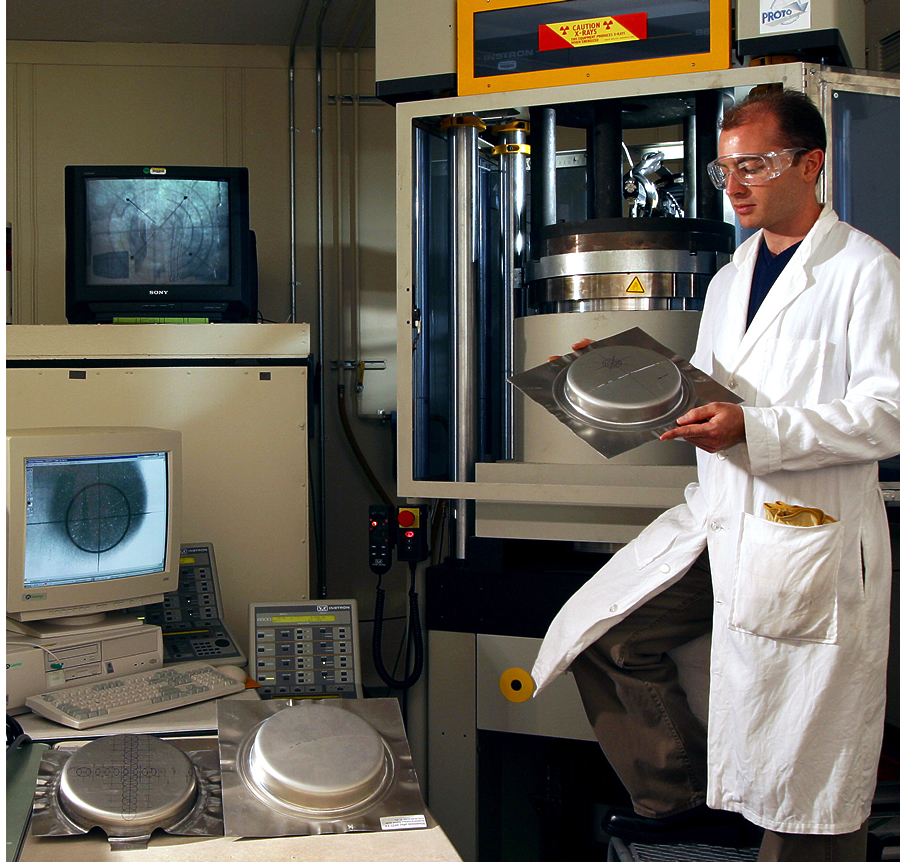
- Deep drawing pulls the blank through a die into a cup or shell, so material flows radially inward rather than stretching. Blank-holder pressure controls it: too little and the flange wrinkles, too much and the wall tears.
What is a progressive die, and why does it drive the piece price down?
A single-station die performs one operation per stroke, so a multi-feature part needs several setups. A compound die does several operations at one station in one stroke, usually blanking and piercing, giving excellent hole-to-edge accuracy because nothing moves between cuts. A progressive die is the volume answer: the strip advances one station pitch per stroke, each station adds an operation, and once the die is full a finished part leaves with every stroke.
That is the source of the low piece price: the press runs continuously, one operator tends it, and the strip is also the fixture, parts held on a carrier skeleton and registered by pilot pins. The same architecture makes the die a capital item — a multi-station assembly in hardened tool steel with ground inserts, strippers and springs, plus a tryout cycle of running, measuring and reworking until parts are inside drawing. Where a strip cannot carry a deeper part, transfer tooling moves it between stations with mechanical fingers.

Stamping, machining or forging: which process fits the part?
Decide by part character first, volume second: a process that cannot make the geometry never becomes cheap.
- Sheet-like geometry at volume — constant wall thickness, bends, flanges, holes, a drawn pocket: stamping. The part is a folded sheet, which is what a die makes best.
- Solid geometry, deep internal features, close-tolerance bores, or volumes in the hundreds to low thousands: machining. With no tooling to amortise, low volume favours the cutter.
- Load-bearing parts where directional grain flow carries the strength: forging, covered in our hot versus cold forging guide.
- Complex three-dimensional shapes at moderate volume that neither a die nor a cutter reaches: investment casting, discussed in our casting versus CNC machining guide.
What does stamping tooling cost, and when does it pay back?
Die cost scales with the number of stations, part size, material thickness and strength, the tolerance demanded and the tool steel chosen — and with how much of the part is formed rather than cut, since forming stations need tryout iterations that cutting stations do not. Die life is quoted in strokes and is a maintenance figure rather than a cliff: punches are resharpened and inserts replaced on schedule.
Ask for tooling as a separate one-time charge so you can weigh it against the per-piece saving and find the break-even; tooling amortised silently into the piece price hides the crossover. Allow for lead time too: die build and tryout, not the press, set the schedule to first samples, so a stamped part must be design-frozen earlier than a machined one.
Which design rules decide whether a part can be stamped?
Stamping DFM is not machining DFM. Each rule follows from what happens to sheet metal as it is bent and sheared.
Minimum bend radius is quoted as a multiple of material thickness because outer-fibre strain is set by the ratio of thickness to radius. Tighten the radius and strain rises until it exceeds the grade’s elongation, and the outside of the bend cracks: soft low-carbon steel tolerates a tight inside radius, a hard-temper aluminium needs several thicknesses. Bend relief, a notch at each end of a bend line at least one thickness deep, exists because metal at the end of a bend is pulled two ways at once and otherwise tears unpredictably.
A hole inside the deformation zone stops being round: material flowing toward the bend pulls it into an oval, so the usual starting point is a hole centre at least two and a half thicknesses plus the bend radius from the bend line. About two thicknesses of hole-to-edge distance stops the narrow web bulging or splitting as the punch shears, and a hole smaller than roughly one thickness risks buckling the punch.
Springback is elastic recovery: only part of the bend is permanent, so metal opens up when the press releases. The die compensates by overbending, and stronger material springs back more. Grain direction matters for a related reason — rolled sheet is anisotropic, and a bend parallel to the rolling direction cracks far more readily than one across it. Every pierced hole also has a side: rollover and a burnished band where the punch enters, a burr where it exits. If the hole is a bearing or sealing face, say which side the burr may fall on.
What material and temper suit a stamped part?
Specify sheet in the temper that can be formed, not just the alloy that meets the final strength target. Cold-rolled deep-drawing grades to EN 10130, DC01 through DC06, are graded precisely on formability; in aluminium, 5052-H32 bends and draws well while 6061-T6 tends to crack at tight radii. Austenitic stainless such as 304 forms well but work-hardens strongly, so a deep draw may need an intermediate anneal. Work hardening cuts both ways: cold forming raises yield strength where the metal was worked. Where forming cannot deliver the strength required, the part is heat treated afterwards.
What tolerances does stamping hold, and what still needs machining?
Stamping is highly repeatable within a die station and looser across formed features. Dimensions cut at one station repeat tightly stroke after stroke because tool geometry defines them; dimensions crossing a bend also carry springback, thickness variation and coil-to-coil property variation, and angular tolerance on a formed leg is looser still. That is why a close-tolerance feature is usually machined after forming.
- Deburring or tumbling to remove the shear burr and break edges.
- Tapping, reaming or milling one critical feature — a threaded hole, a bearing bore, a flat sealing face — after forming.
- Welding, riveting or press-fitting stampings into a sub-assembly.
- Heat treatment where strength or wear resistance demands it, with straightening if the part distorts.
- Surface treatment: plating, passivation, anodising or coating to suit the environment.
Where does metal stamping appear in safety hardware?
More often than most engineers expect. Mounting brackets, back plates, retainers, clips, washers, formed housings and anchor plates are all natural stampings. In fall protection and climbing hardware, D-ring and buckle blanks are stamped before being formed, heat treated and finished; connector bodies are usually forged, but the sheet-metal parts around them are pressed. Stamping moves a programme’s bracket and plate count off the machining schedule.
Working with Power Honour
Power Honour runs stamping alongside CNC machining, hot and cold forging, casting, heat treatment and surface treatment in Taiwan, with more than thirty years in safety hardware and precision metal parts under an ISO 9001 quality system. Because those processes sit under one roof, we can say honestly whether a part should be stamped, machined, or stamped with one machined feature. Send a drawing or STEP file with your annual volume, and we will return a process recommendation and a quote that separates tooling from piece price.