Mountaineering & Climbing Hardware
Slacklines
1 product
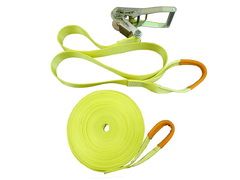
This category covers slackline kits for recreational balance training in parks, gardens and gyms. The SL-200 uses 2 in (about 5 cm) webbing, the common width for beginners because it gives a wider, more stable walking surface, with a main line of 15 m or 20 m and a ratchet side of 2 m or 30 cm. Its listed breaking strength is 11,000 lbs. A ratchet lets users tension the line quickly without pulleys, and slacklines are usually rigged between trees or posts with tree protection to prevent bark damage. Slacklining is a recreational activity rather than fall protection, and buyers should define the strength figures and safety instructions they want to publish. The SL-200 can be supplied OEM or private label, with line colour, printing, ratchet finish and retail packaging specified by the brand owner.
Frequently asked questions
- Why is 2 inch webbing standard for beginner slacklines?
- A 2 in (about 5 cm) line gives a wider, more stable surface to stand on than narrower performance lines, making it easier for beginners to learn balance. It is the most common width for recreational kits such as the SL-200.
- What length should a slackline kit be?
- A 15 m line suits most gardens and parks, while a 20 m line allows longer spans between anchors. The SL-200 is offered in both, and the choice of a 2 m or 30 cm ratchet side helps adapt to anchors at different distances.
- How do I protect trees when rigging a slackline?
- Wrap the anchor point with a tree protector or padding between the sling and the bark to prevent the webbing from damaging it. Many brands include tree protectors in their kits, and buyers can specify them in the RFQ.
- What should a slackline RFQ include?
- Specify main-line and ratchet-side lengths, webbing colour and printing, ratchet finish, any accessories such as tree protectors, retail packaging and the warnings to be printed on the product. Power Honour can supply the SL-200 as a private-label kit.
How these are made
Surface Treatment Guide: Anodising, Plating and Passivation
Choosing a surface treatment for metal parts comes down to the base metal plus the service environment. A practical guide to anodising, plating, passivation, salt spray testing and RoHS compliance.
Read more →Material Selection Guide: Aluminium, Steel, Stainless, and Titanium for Safety Hardware
Choosing the right material for load-bearing safety hardware involves balancing weight, strength, corrosion resistance, cost, and certification test requirements. Here is a practical comparison.
Read more →Need this in a different specification?
Different size, material, finish, strength rating or gate, or a part that is not here at all. Send a drawing or a sample and we will come back with a DFM review and a quotation.
- A reply within two business days from our team in Taipei.
- NDA on request before drawings or specifications change hands.
- An engineering and DFM review, not a sales pitch — we will say so if we are the wrong fit.
Prefer email? Write to service@fall-protect.com.