
Tool tethering means connecting a hand tool to a worker or to a structure so that a slip at height cannot become a falling object. In the United States the reference document is ANSI/ISEA 121, the American National Standard for Dropped Object Prevention Solutions, published in 2018 and revised as ANSI/ISEA 121-2023. It is a voluntary consensus standard rather than a regulation: it sets design, performance, testing and labelling requirements for four categories of equipment — tool attachments, anchor attachments, tool tethers and containers — but it does not tell an employer what to tether or when. OSHA cannot enforce it directly, though it can cite a site under the General Duty Clause for a recognised falling-object hazard.
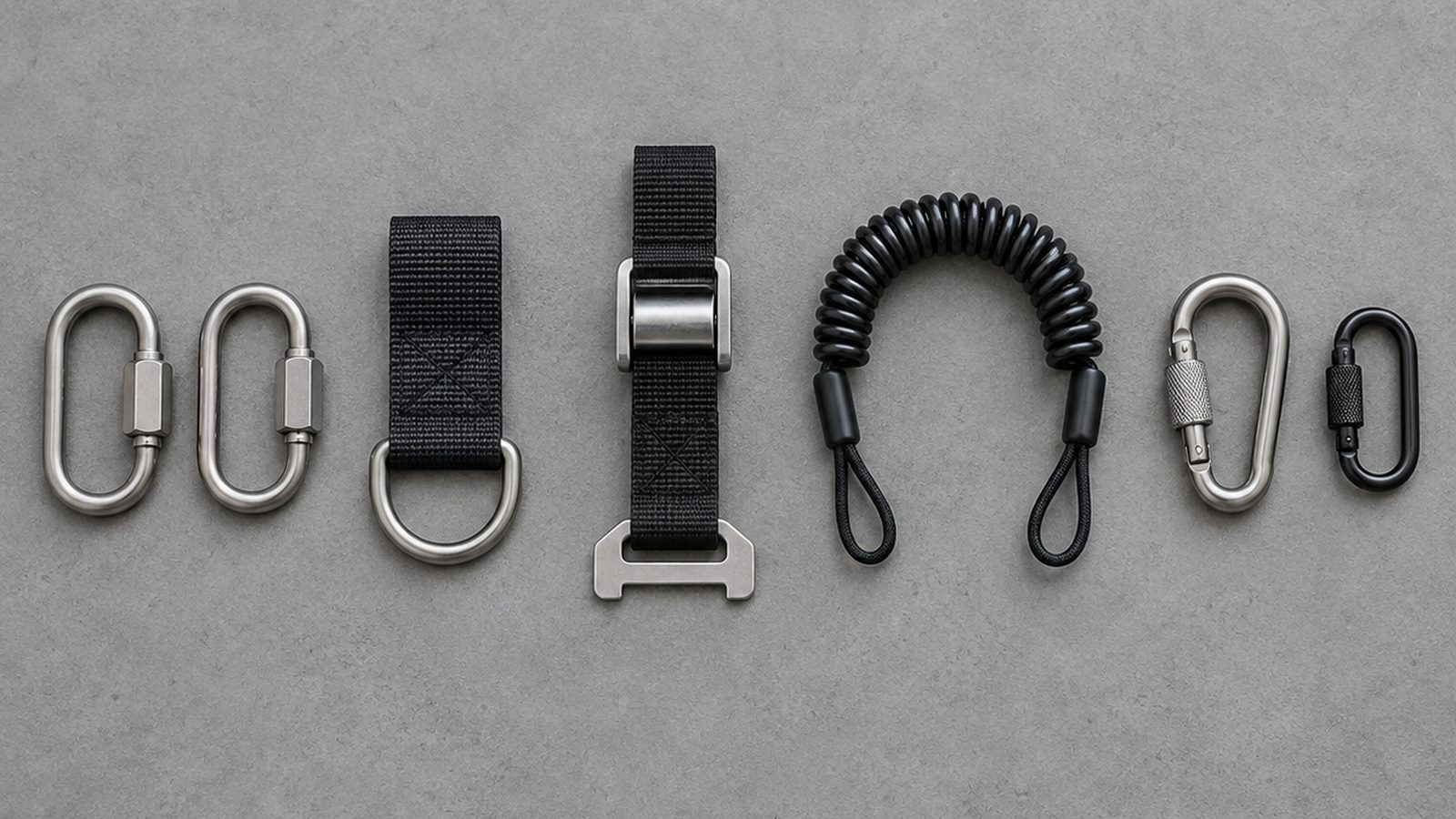
Almost everything in the first three categories is small load-rated metal, and that is the commercial point. A fall arrest system is mostly textile with metal at the ends; a tethering system is almost all metal — quick rings, D-ring adapters, tool traps, swivels and small locking carabiners, forged, stamped or machined, a few grams each. For a brand entering dropped object prevention, or DROPS, this is a precision metal parts problem, not a textile one.
What is ANSI/ISEA 121, and does the law require tool tethering?
ANSI/ISEA 121 is voluntary, so nothing in it is law. Developed through the International Safety Equipment Association and approved by ANSI, it gives manufacturers a common basis for design, testing and labelling, so buyers can compare suppliers on equal terms.
What is enforceable is OSHA’s position on falling objects. Provisions such as 29 CFR 1926.501(c) and 1910.28(c) call for hard hats, toeboards, screens, guardrails, canopies and barricades — all of which protect the person underneath after the object is already falling. Tethering attacks the problem at the release instead. Where a hazard is recognised and left uncontrolled, OSHA can cite under the General Duty Clause, Section 5(a)(1), and a consensus standard is the evidence that a feasible control existed; our companion piece on OSHA versus ANSI covers this.
ANSI/ISEA 121 also excludes passive measures — netting, barricades, toe boards — and hoisting or rigging, and does not decide what gets tethered or when. That judgement belongs to the site.
What are the four categories of dropped object prevention solutions?
- Tool attachments — retrofit points added to a tool to give it a connection it did not leave the factory with: tape-on loops, heat-shrink collars, cinch straps and handle traps.
- Anchor attachments — retrofit points on the worker or the structure for the tether to connect to: wristbands with a small D-ring, belt and harness D-ring adapters, quick rings.
- Tool tethers — the lanyards, coiled or straight, single or dual leg, with or without an energy absorber, and a connector at each end.
- Containers — bags, buckets and pouches for carrying tools to and from the work zone.
The first three are the tethering system proper.
A tethering system is a load path with two connectors
Read it as a load path with a weak link somewhere in it: an anchor attachment on the worker — a wristband, or a D-ring adapter slid onto belt or harness webbing — or on the structure; the tether; and a tool attachment on the tool. The anchor here holds a tool, not a person; anchorages rated for people fall under ANSI/ASSP Z359.18, covered in its own article. The metal sits at the two interfaces:
- Quick rings, split rings and screwlink closures join a soft loop to a hard point; the realistic failure mode is being worked open, not pulled apart.
- Tool traps, cinch attachments and tape-on points capture a tool that has no attachment point, by trapping the handle behind a shoulder, cinching onto a narrowing section, or holding a reinforced loop by friction — the last being the most installation-dependent part in any system.
- Swivel connectors let the tool rotate. A tether wound into a helix has lost usable length, and a tool that cannot turn feeds torsion into its attachment point.
Why a tethering carabiner is not a shrunken climbing carabiner
The load case is different. A climbing carabiner is designed around a rope in the basket and a predictable major-axis pull, as our comparison of aluminium and steel carabiner manufacturing describes. A tethering connector is left clipped to a small ring with no room to align, so minor-axis and gate-face loading are normal, not misuse.
The gate is different. Shrink the part and the opening becomes a large fraction of it, so a tool handle or rail edge reaches the gate easily. A screw-gate operated one-handed a hundred times a shift will not be screwed shut every time, which is why twist-lock and triple-action gates dominate here.
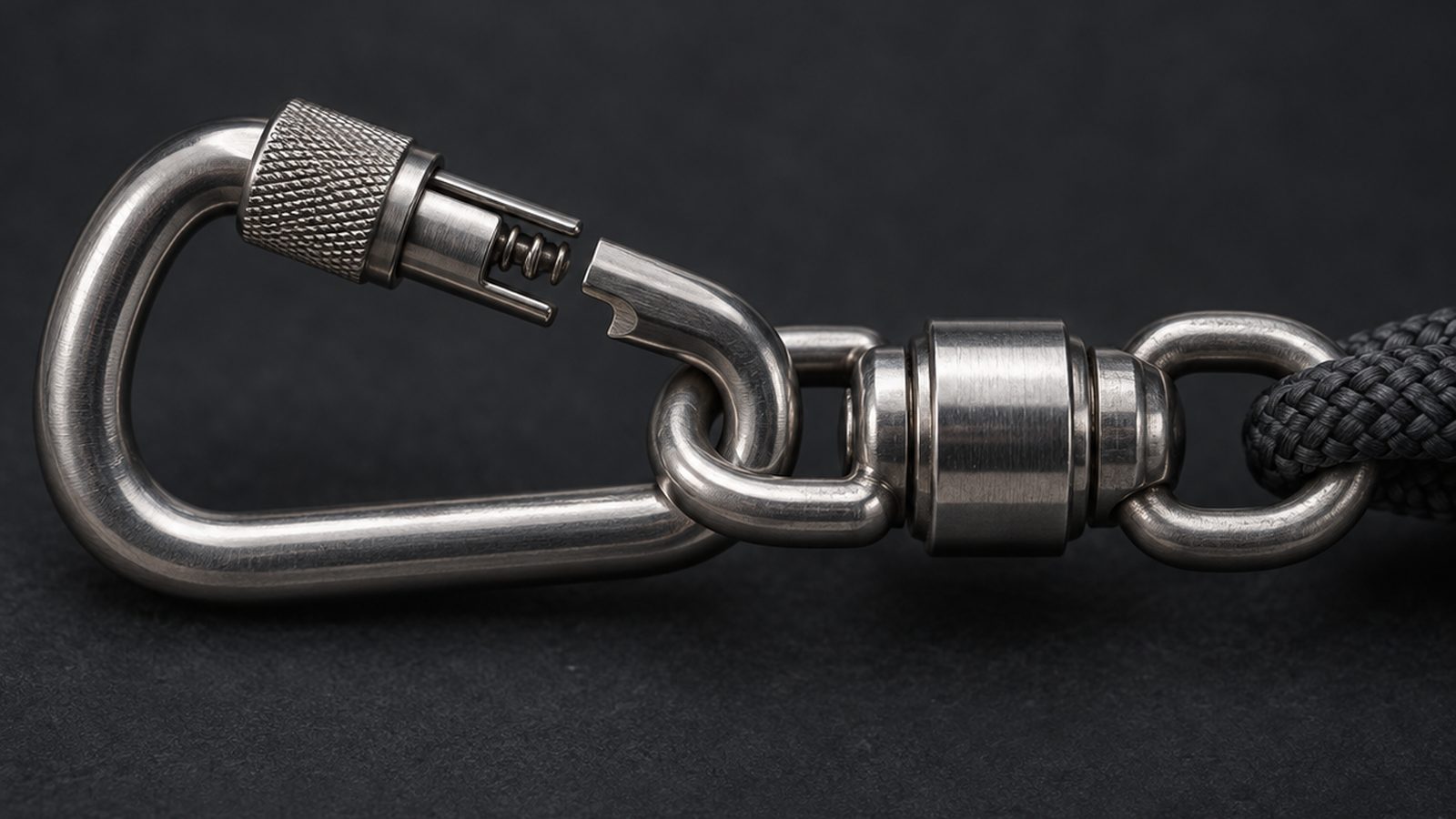
The failure mode of concern is different. Climbing hardware is engineered mainly against tensile failure; tethering hardware against accidental release — gate roll-out, a nose hooking on structure, a gate levered open in a pocket. A connector that never breaks and occasionally opens has still failed, in the only way that actually drops a tool. Rated strengths sit well below climbing figures; our explainer on breaking strength and working load limit covers what they mean.
Why a tool’s weight understates the load a drop generates
A 1 kg tool does not arrive at the end of a tether as a 1 kg load. It arrives as whatever force is needed to stop it in the distance available. After two metres of free fall it is travelling at roughly 6 m/s, and the tether absorbs that energy over a few centimetres of stretch: peak force is set by the deceleration distance, not the mass. Energy-absorbing tethers exist for that reason. Two consequences follow:
- Capacity is rated per component and for the assembly. The lowest-rated element governs: a 5 kg tether on a 2 kg attachment point is a 2 kg system, and the packaging must carry the assembly figure.
- Ratings come from testing, not calculation. Laboratories working to the standard describe static and dynamic loading above the rated working limit, destructive tensile testing, and drop testing with a weight equal to the device’s rated capacity. A rating does not transfer between orientations, or survive a changed radius or spring rate.
What corrosion, chemicals and cold do to small tethering hardware
Two failure modes dominate here, and neither is a broken part. A seized swivel stops working silently, and a gate spring packed with corrosion product no longer closes, turning a locking connector into an open hook. Offshore platforms, wind nacelles, refinery turnarounds and cold sites produce both.
Marine service argues for 316 stainless in anything that must keep moving and anodised aluminium where it need not, and it punishes mixed metals: a stainless pin in an aluminium body is a battery in salt air, and the pin bore shows it first. In refineries, solvent and acid mist attack coatings and polymer springs before the base metal. In the cold, grease thickens and a marginal gate spring stops closing. Neutral salt spray to ISO 9227 or ASTM B117 is the usual acceptance test; our surface treatment guide covers anodising, plating and passivation.
What should a brand specify when sourcing tool tethering hardware?
- Rated capacity, the direction it applies in, and how it was verified: which test, which report.
- Gate type and locking action: screw, twist-lock, triple-action or captive-eye, and the gate-opening force.
- Material and condition — alloy family and heat treatment, not just the word steel — and whether mill test certificates are needed.
- Corrosion performance as salt spray hours to a named method, and cycle life for every moving element.
- Markings, including rated capacity and batch identification, and where they sit. At this size, legibility is a tooling constraint.
Our guide to qualifying a safety hardware supplier covers the testing and liability side of that list, and our confined space rescue hardware article does the same for tripods, davits and winches.
Retrofit attachment points, or designed-in?
The category is overwhelmingly retrofit today, because the installed base of hand tools has no attachment points. That is changing: manufacturers are beginning to design the tether point into the handle, as a moulded boss with a metal insert or a machined lug. It removes the most installation-dependent link in the chain, and turns the attachment point into a load-rated component to be specified, tested and traced from the first tooling cut.
Working with Power Honour
Power Honour has made load-bearing metal parts for climbing hardware, fall protection and industrial PPE in Taiwan for more than 30 years, with forging, stamping, casting, CNC machining, heat treatment and surface treatment under one ISO 9001 system. Tethering hardware suits that mix: one kit can need a forged ring, a stamped adapter, a machined swivel body and a corrosion finish, all matched and rated. Send a drawing, the rated capacity you need and the environment the part must survive, and we will return a manufacturability review and a quotation.