Titanium is one of the most misunderstood materials in OEM manufacturing. Its reputation for being "difficult to machine" creates hesitation, while its reputation for exceptional performance creates over-specification. Here is a practical guide to when titanium makes sense and what to expect from the OEM process.

Titanium Grade 5 (Ti-6Al-4V) — properties
Ti-6Al-4V is the workhorse grade, accounting for over 50% of titanium use in engineering applications. Its properties:
- Density: 4.43 g/cm³ (about 60% denser than aluminium 7075, 57% lighter than steel)
- Tensile strength (annealed): ~950 MPa (similar to high-strength steel 4140, 1.7× higher than 7075-T6 aluminium)
- Yield strength: ~880 MPa
- Fatigue strength: Excellent — comparable to high-strength steel
- Corrosion resistance: Exceptional in most environments including salt water, dilute acids, and body fluids (hence aerospace and medical use)
- Temperature resistance: Usable to ~300°C in structural applications
The combination of high strength, low density, and excellent corrosion resistance is what makes titanium compelling for weight-critical applications.
When to specify titanium
Titanium is the right choice when:
Weight is a primary specification driver. In climbing and alpinism hardware, titanium carabiners can achieve the same CE/UIAA minimum breaking loads as aluminium 7075 equivalents at 30–40% lower weight. For a climber carrying 20+ pieces of hardware on a multi-day alpine route, this matters.
Corrosion resistance without coating is required. Titanium is naturally corrosion-resistant without anodising, plating, or coating. In marine environments, harsh chemical environments, or applications where surface coatings would fail, uncoated titanium outperforms.
High-temperature operating environments. For applications above ~200°C where aluminium loses strength, titanium maintains structural integrity significantly better.
Biocompatibility is required. For products in contact with the human body (implantable or skin-contact devices), titanium's biocompatibility is unmatched.
When not to specify titanium
Cost is a significant constraint. Titanium bar stock costs 5–10× more per kg than aluminium 7075, and machining cost is 3–5× higher (slower speeds, higher tool wear). For most applications where aluminium 7075 meets the strength requirement, the cost premium for titanium is not justified by a performance benefit.
Volume production efficiency. Titanium's machining challenges (work hardening, heat generation, tool wear) make it less suitable for high-volume production than aluminium or steel. It remains most practical for low-to-medium volume, high-value components.
Stiffness is the primary design driver. Titanium has similar elastic modulus to stainless steel (~114 GPa vs ~200 GPa for steel) but notably lower than you might expect given its strength. For stiffness-critical applications, titanium may not outperform lower-cost alternatives.
CNC machining titanium — what to expect
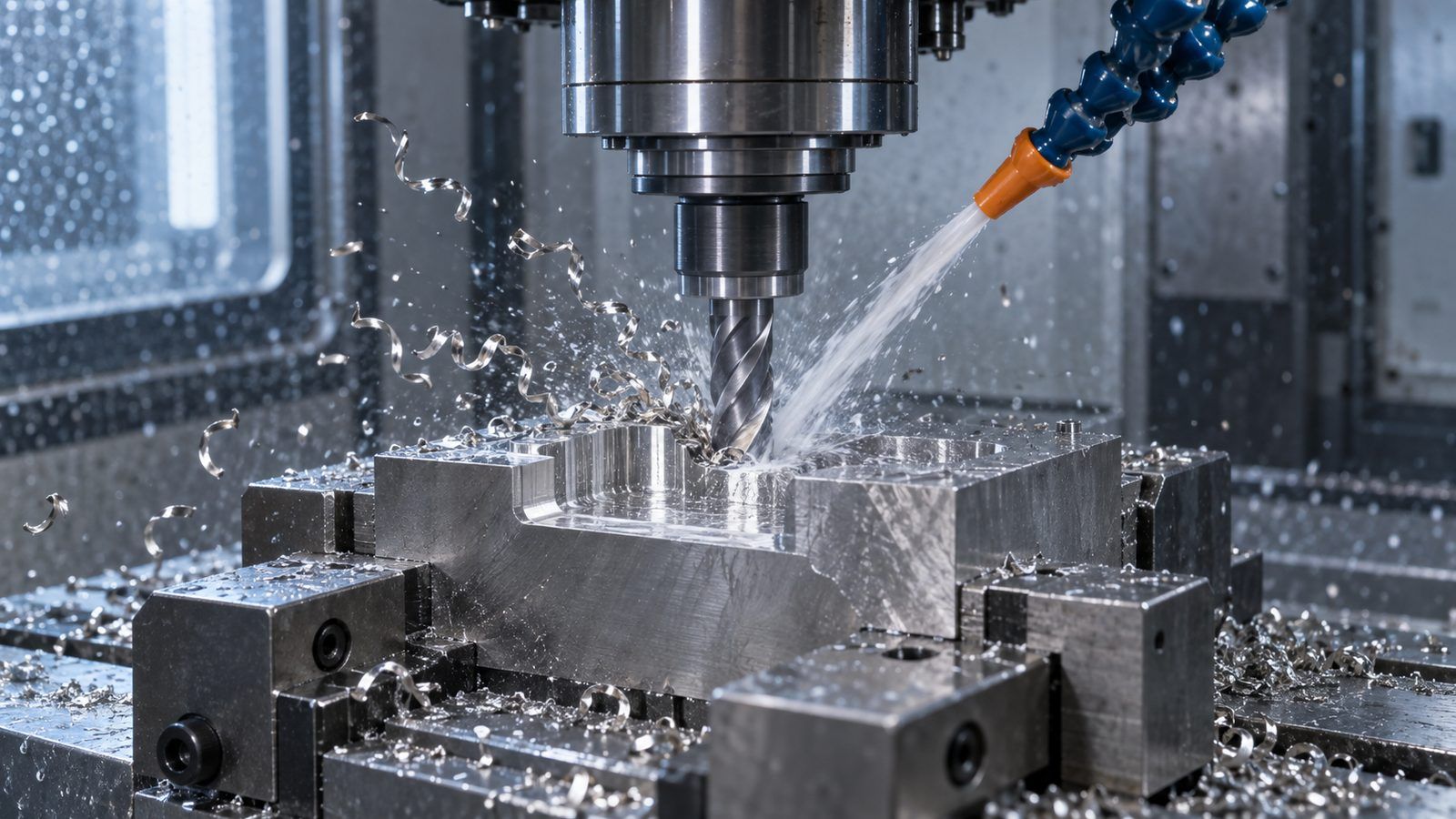
Cutting speeds are slow: Titanium machines at approximately 30–60 m/min, compared to 200–400 m/min for aluminium. This directly translates to longer cycle times and higher machine cost per part.
Tool life is short: Titanium's heat generation in cutting causes rapid tool wear. High-quality carbide tooling with appropriate coatings (AlTiN) is required, and tool life between changes is shorter than for aluminium or steel.
Work hardening: Titanium work-hardens significantly during machining. Cuts must be aggressive enough to get below the work-hardened layer from the previous pass. This requires attention to cutting parameters and tool paths.
Chip management: Titanium chips are sharp and retain heat. Good chip evacuation is essential, and flood coolant is required to manage heat at the cutting zone.
Despite these challenges, competent CNC shops with titanium experience routinely produce precision titanium parts. At Power Honour, we machine titanium for climbing hardware, tactical gear components, and precision mechanical assemblies.
Titanium anodising for colour and identification
Titanium anodising works differently from aluminium. Rather than creating an oxide layer with dye, titanium anodising creates a transparent oxide layer of controlled thickness. The colour is produced by light interference in the oxide layer — the same phenomenon that produces rainbow colours in thin films.
Voltage controls oxide thickness, which controls colour: - ~12V → gold/bronze - ~18V → purple - ~25V → blue - ~35V → green - ~75V → pink/red/orange
Titanium anodised colour is not as UV-stable as aluminium anodising (the interference colours can fade with UV exposure) but is excellent for product differentiation and identification coding in safety hardware — different gate types or weight variants can be colour-coded.
Working with Power Honour on titanium parts
We machine Ti-6Al-4V (Grade 5) and Grade 23 (ELI for biomedical) as standard materials. Typical applications include carabiners and connectors for ultralight climbing applications, tactical gear hardware, and precision custom components. Lead time for titanium prototypes is typically 4–6 weeks. Send a drawing for DFM review and quotation.