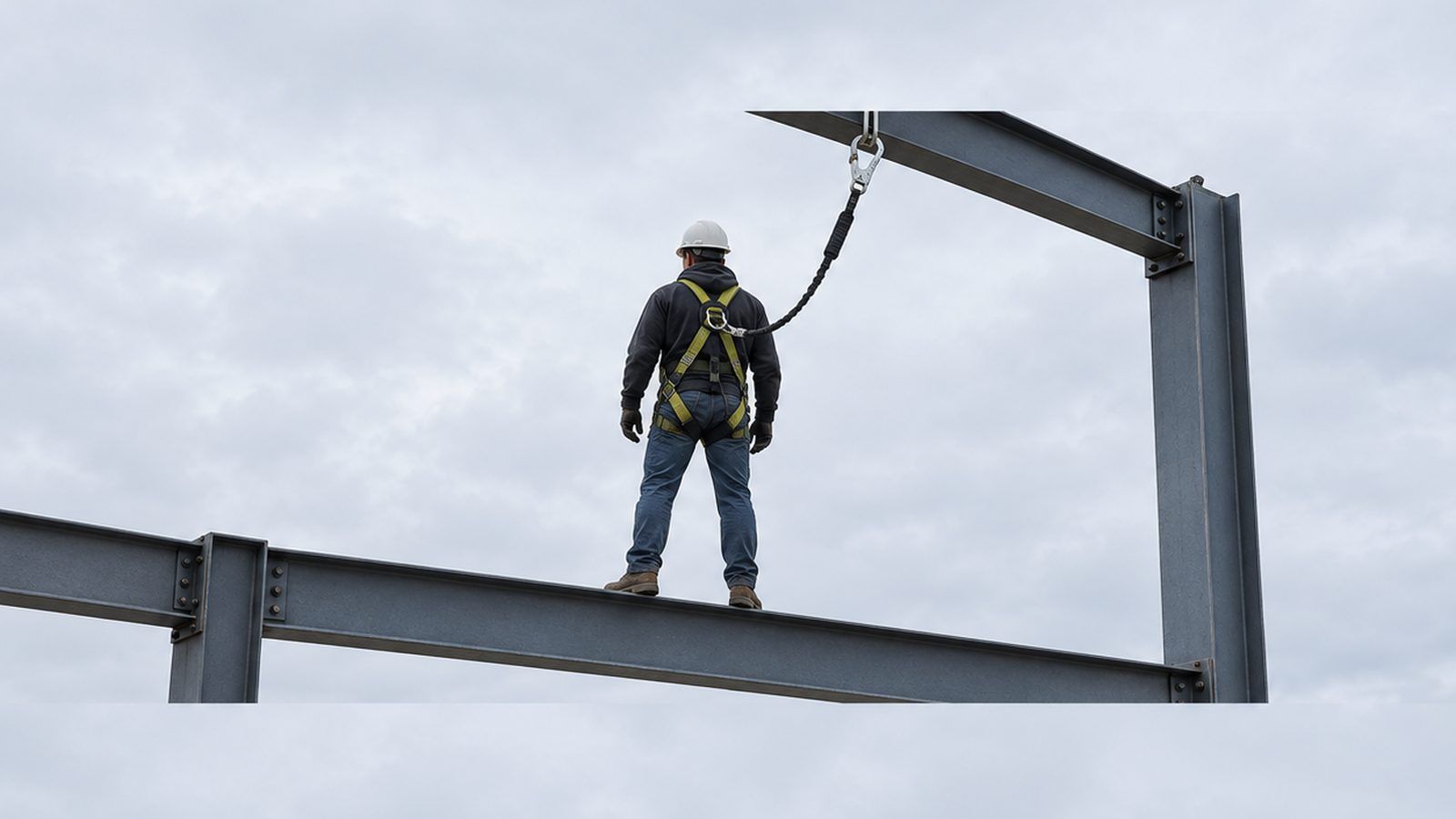
OSHA fall protection requirements are federal law; ANSI/ASSP Z359 is not. OSHA’s rules — 29 CFR 1926 Subpart M for construction, 29 CFR 1910 Subparts D and I for general industry — are enforceable regulations, and equipment used on a US jobsite must meet the criteria written in them. ANSI/ASSP Z359 is a voluntary consensus standard OSHA has not adopted or incorporated by reference, yet almost every credible product on the US market is built to it: Z359 specifies the design, testing and marking rules OSHA leaves out, and specifiers, insurers and courts treat it as the benchmark of reasonable practice. OSHA tells you what the system must achieve in use; Z359 tells you how the hardware must be built and proven.
Which OSHA numbers does a fall arrest product have to meet?
For construction the operative text is 29 CFR 1926.502(d), whose figures buyers misquote most often:
- Anchorages must be independent of any anchorage supporting or suspending platforms, and capable of supporting at least 5,000 pounds (22.2 kN) per employee attached — or be designed, installed and used under a qualified person’s supervision as part of a complete system with a safety factor of at least two. That figure is an anchorage requirement, not a product rating.
- Maximum arresting force on the worker is capped at 1,800 pounds (8 kN) with a body harness; body belts have been unacceptable in a fall arrest system since 1 January 1998.
- The system must be rigged so the worker can neither free fall more than 6 feet (1.8 m) nor contact a lower level, and deceleration distance is limited to 3.5 feet (1.07 m).
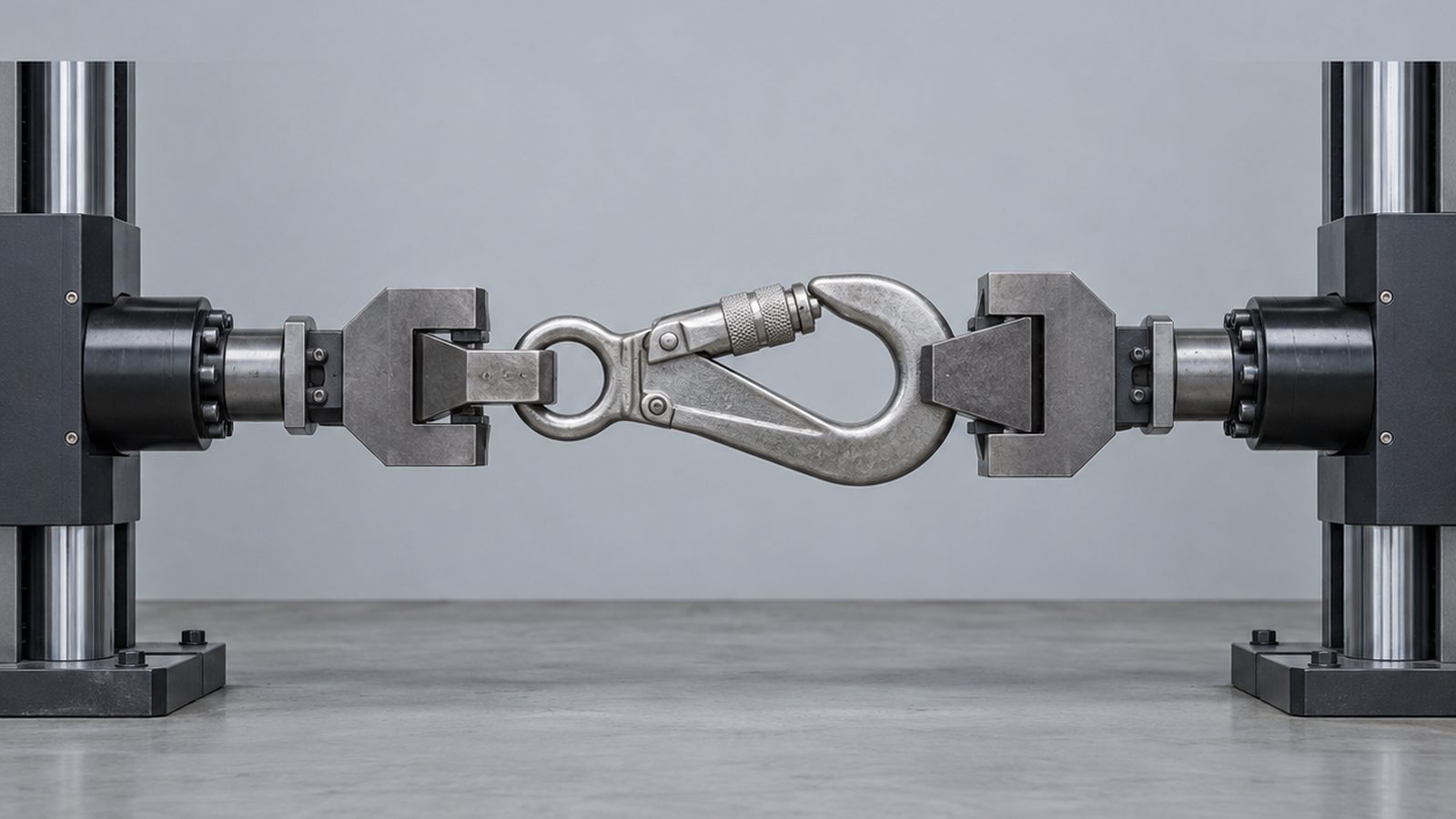
- Dee-rings and snaphooks need a minimum tensile strength of 5,000 pounds (22.2 kN) and must be proof-tested to 3,600 pounds (16 kN) without cracking, breaking or permanent deformation. Only locking snaphooks are permitted.
- Lanyards and vertical lifelines need a minimum breaking strength of 5,000 pounds. A self-retracting lifeline limiting free fall to 2 feet or less must sustain 3,000 pounds (13.3 kN) fully extended; one that does not, 5,000 pounds.
Two clauses are manufacturing instructions in disguise: (d)(1) requires connectors to be drop forged, pressed or formed steel or equivalent materials, and (d)(2) a corrosion-resistant finish with smooth surfaces and edges. That is OSHA’s whole design vocabulary for a connector; geometry, gate behaviour, fatigue and marking are left open. Every figure above is a strength floor, not a service load — our kN rating guide covers why breaking strength and working load limit differ.
How do the general industry rules differ from construction?
In trigger height, and in one clause that changes the part. Construction requires fall protection at an unprotected edge 6 feet or more above a lower level under 1926.501(b)(1); general industry sets that trigger at 4 feet under 1910.28(b)(1)(i). The duty sits in Subpart D, walking-working surfaces; the criteria live in 1910.140, inside Subpart I.
1910.140 is the newer text and far more specific about hardware. It names carabiners alongside D-rings and snaphooks at 5,000 pounds tensile. It adds a gate strength requirement the construction rule lacks: 3,600 pounds (16 kN) without the gate separating from the nose of the body by more than 0.125 inches (3.175 mm). It requires automatic-locking connectors needing at least two separate, consecutive movements to open. And it permits a free fall greater than 6 feet where the manufacturer designed and tested the system to hold arresting force at or below 1,800 pounds. A connector engineered only against 1926.502 can fall short of 1910.140; build to the stricter of the two.
Where does ANSI Z359 go beyond OSHA?
Almost everywhere a factory cares about. OSHA regulates systems as an employer uses them; it says nothing about how a harness is stitched, how a gate is loaded in test, what a label must carry, or how often a design is re-verified. Z359 does. Z359.11 covers full body harnesses, holding attachment points at 3,600 pounds (16 kN) for one minute in static test, within a user capacity range of 130 to 310 pounds (59 to 140 kg). Z359.12 covers connecting components, adding 3,600 pounds (16 kN) on the minor axis, gate face and gate side plus a 48-hour salt spray exposure, none of it in 1926.502. Z359.14 covers self-retracting devices; Z359.18 covers anchorage connectors. Our separate guide to the ANSI/ASSP Z359 family works through how they interlock; the design rules come from Z359, the enforceable duty from OSHA.
Why does the phrase “OSHA approved” not exist?
Because OSHA has no legal authority to approve, certify, endorse or list products, and has said so repeatedly in its letters of interpretation: it does not test, approve, certify or endorse any equipment, product or procedure. There is no OSHA register of compliant harnesses, no OSHA mark, no OSHA file number. The Nationally Recognized Testing Laboratory programme, sometimes reached for as a substitute, covers equipment OSHA requires to be approved, principally electrical; the fall protection standards impose no certification requirement at all.
What a manufacturer may legitimately state is narrow:
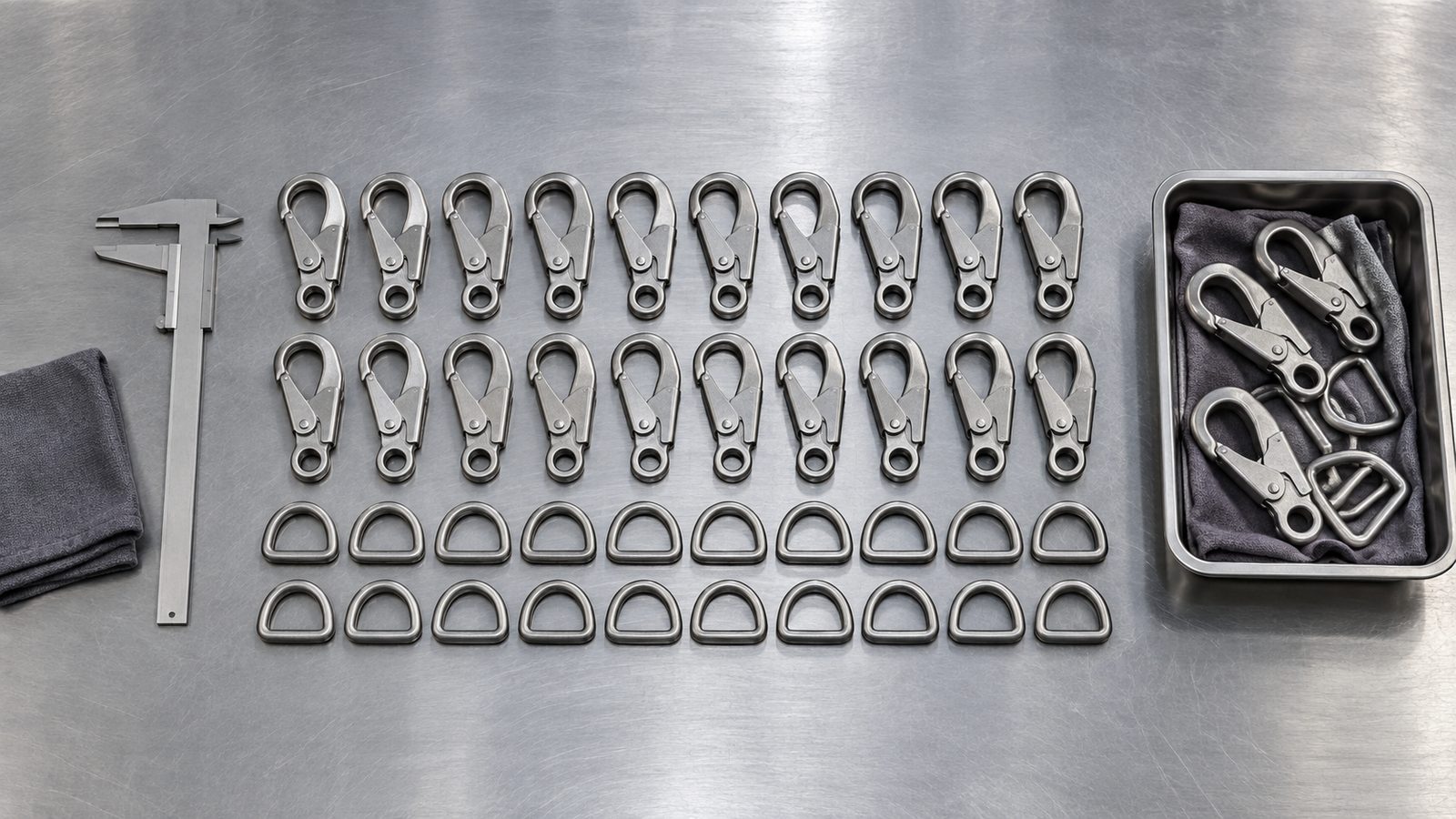
- That it meets the criteria of a named OSHA paragraph — that a snaphook meets the 5,000 lbf tensile and 3,600 lbf proof-load criteria of 1926.502(d)(3) and (d)(4), for instance.
- That it was tested by a named laboratory to a named edition of ANSI/ASSP Z359, with a report reference a customer can request.
- That it is CE marked under Regulation (EU) 2016/425 by a named notified body, where that applies.
What it must not state is that the object is OSHA approved, OSHA certified or OSHA compliant. Compliance is something an employer achieves on a jobsite out of equipment, training, rescue planning and correct use, not a property a part carries out of the factory. Catalogue copy claiming otherwise is the first document an opposing expert reads aloud in court.
If Z359 is voluntary, why does it behave like a requirement?
Because voluntary describes how the standard was written, not whether a supplier can ignore it. The General Duty Clause, Section 5(a)(1) of the OSH Act, requires employers to keep workplaces free of recognised hazards, and a consensus standard is routinely treated as evidence that an industry recognises one. Contracts do the rest: general contractors, owners and refinery operators write Z359 conformance into their specifications. Then there is liability: after a fall, the question is what a reasonable manufacturer would have done, and OSHA’s thinner criteria are a weak answer when the industry’s own standard asked for more.
What should a buyer ask for from a test report?
Four questions, and read the report, not the summary line.
- Who tested it. An in-house bench is legitimate evidence if described as such; an ISO/IEC 17025 accredited laboratory carries more weight, and a named laboratory beats “third-party tested”.
- To what standard, and which edition. Z359.12-2019 is not Z359.12-2009. An undated reference is not a claim.
- What was tested: sample count, fixture and loading direction, hold time, pass criteria, and whether units came from production tooling or prototypes.
- What happens per lot. Type testing proves a design once; batch testing tied to a lot number proves this shipment matches the one that passed.
What must a US brand specify so the finished product is compliant?
The metal hardware carries most of the load-bearing evidence, so the drawing must say more than dimensions:
- The governing document and edition behind each figure, and whether OSHA, Z359, EN or all three apply.
- Test loads with their geometry: major axis, minor axis, gate face, gate side, and hold time for each.
- The proof-load regime, sample or 100 percent, per lot or per shipment.
- Alloy, forming route, heat treatment condition, and surface treatment with a stated salt spray duration.
- Traceability: lot identification, record retention, and what documents ship with each lot.
- Marking content and placement, which the brand owns rather than the factory, because the legal claims live there.
Adjacent families raise the same questions in different clothing: anchorage connectors under Z359.18, tool tethering and dropped object prevention under ANSI/ISEA 121, and confined space rescue equipment — tripods, davits, winches — which adds rescue load cases on top of arrest. Our guides to harness hardware, self-retracting lifelines, supplier qualification, CE certification and sourcing from Taiwan go further; the CE route is a conformity assessment regime rather than a performance regulation.
Working with Power Honour
Power Honour is a Taiwan-based integrated OEM/ODM precision metal manufacturer with more than 30 years in climbing hardware, fall protection and industrial PPE. We build connectors and load-bearing hardware to CE EN 362 and ANSI/ASSP Z359 test methods with documented batch testing, running forging, casting, machining, stamping, heat treatment and surface treatment in house under an ISO 9001 system. Send us the drawing, the standard and edition you are building to, and the claims you plan to print, and we will tell you what the geometry, alloy and process route must be to support them. Initial reviews are no-commitment.