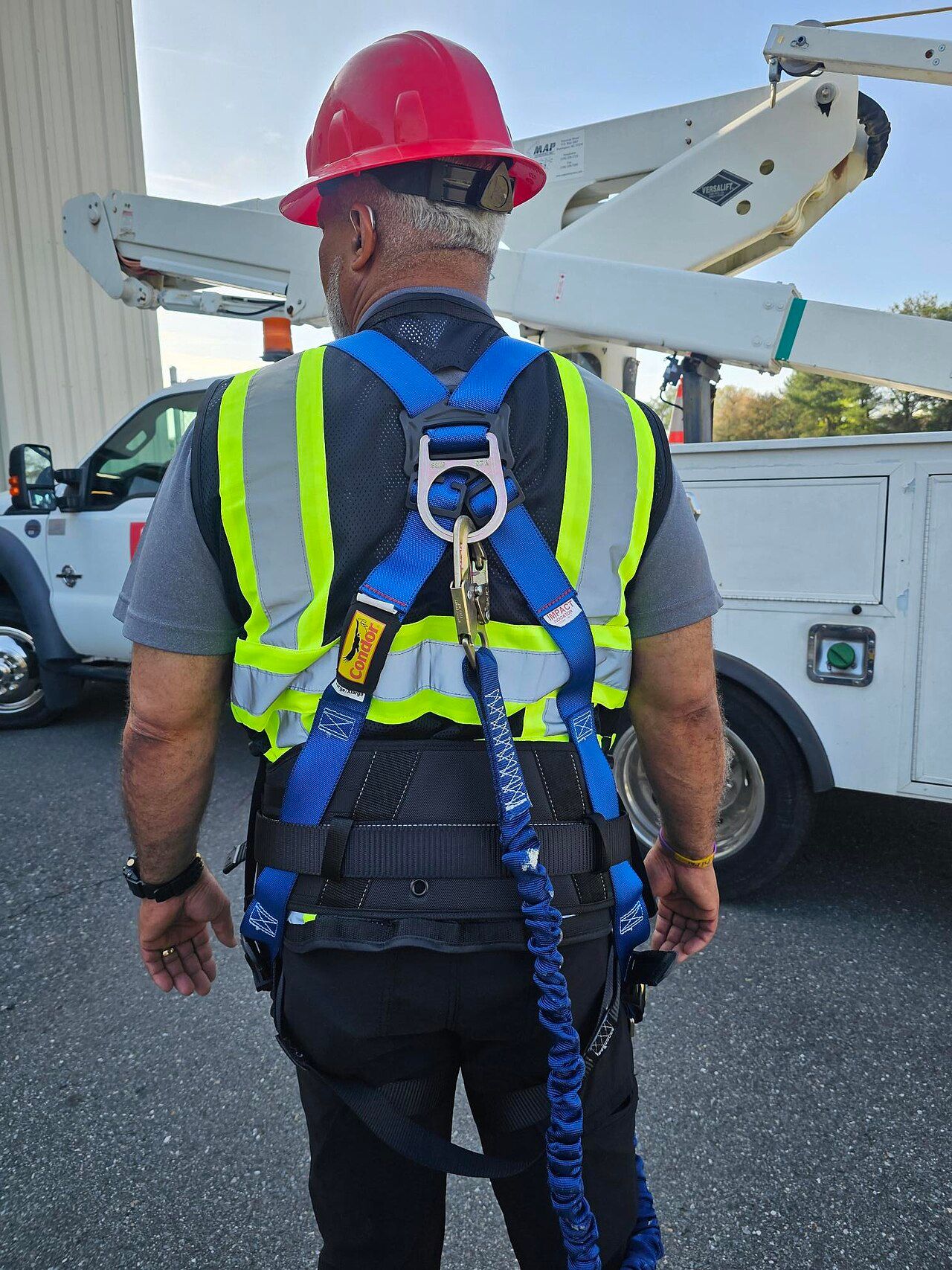
The ANSI/ASSP Z359 series is the primary voluntary standard for fall protection equipment in the United States, maintained by the American Society of Safety Professionals (ASSP). While OSHA regulations set the legal performance baseline, Z359 standards are widely adopted by manufacturers, employers, and procurement bodies as the detailed technical specification.

What Z359 covers
The Z359 series is not a single standard but a family covering different aspects of fall protection:
- Z359.0: Definitions and nomenclature — the vocabulary standard that all others reference
- Z359.1: Safety requirements for personal fall arrest systems — overall system requirements
- Z359.2: Minimum requirements for a comprehensive managed fall protection program — program management (not hardware)
- Z359.3: Safety requirements for positioning and travel restraint systems
- Z359.4: Safety requirements for assisted-rescue and self-rescue systems
- Z359.6: Specifications and design requirements for active fall protection systems — engineering and design
- Z359.7: Qualification and verification testing of fall protection products — the test methodology standard
- Z359.11: Safety requirements for full-body harnesses
- Z359.12: Design requirements for connecting components — this is the most relevant for carabiners, snap hooks, and connectors
- Z359.13: Personal energy absorbers and energy-absorbing lanyards
- Z359.14: Safety requirements for self-retracting devices
Z359.12 — Connecting components in depth
For manufacturers of carabiners, snap hooks, and other metal connectors, Z359.12 is the key standard. It sets:
Gate strength requirements: Snap hooks and carabiners must withstand specific loads with the gate open — typically 3,600 lbs (16 kN) major axis with gate open for carabiners in fall arrest applications.
Locking mechanisms: All personal fall arrest connecting components must have automatic locking mechanisms that prevent accidental opening. Double-locking (requiring two distinct, consecutive actions to open) is required for carabiners in personal fall arrest systems.
Proof load testing: Each unit must be proof-loaded to 50% of the rated minor axis load before shipment. This is a 100% production test requirement, not sampling — every unit.
Marking requirements: Components must be marked with manufacturer name, model number, date of manufacture (or lot number traceable to manufacture date), and rated loads. The marking must be permanent and legible after use.
Z359 vs CE: dual certification for transatlantic products
Many brands sell fall protection products in both the EU and US markets, which requires satisfying both regulatory frameworks. Here is the practical comparison:
Regulatory basis: CE is legally required in the EU by Regulation 2016/425. ANSI Z359 is voluntary in the US; OSHA 29 CFR 1926 (construction) and 1910 (general industry) set the legal performance minimums.
Test equivalence: The load requirements in Z359.12 and EN 362 are similar but not identical. Z359 uses US customary units (lbs) and EN 362 uses SI (kN). Test method details differ. A product that passes Z359.7 will often meet EN 362, but this is not automatic — it requires verification.
Notified body vs accredited lab: CE Category III requires a EU notified body. ANSI Z359 testing can be done at any ANSI-accredited laboratory. There is no requirement to use a US lab — a European accredited lab that follows the Z359 test methods can produce a valid Z359 test report.
Practical approach for dual-certification: Work with a test lab accredited to both systems. Have them run Z359 tests and EN tests in sequence on the same sample set. A single product design can be certified to both with one set of test articles if planned correctly.
OSHA compliance vs Z359 conformance
OSHA 29 CFR 1926.502 (fall protection in construction) and 29 CFR 1910.140 (personal fall protection in general industry) set minimum performance requirements. OSHA does not mandate Z359 conformance — a product can technically comply with OSHA without Z359 certification.
However, in practice, US distributors, large employers, and safety consultants treat Z359 conformance as the market standard. A product marketed for personal fall arrest in the US without Z359 data sheets faces significant commercial resistance, even if technically OSHA-compliant.
Working with Power Honour on ANSI certification
We have experience manufacturing fall-protection hardware for brands selling in the US market. Our process includes Z359.12 compliant proof load testing on 100% of units as standard, material certs and traceability documentation for OSHA recordkeeping, and test lab coordination with US-accredited labs. We can also coordinate dual CE/ANSI certification programmes for brands targeting both markets.